🌅 Sunset & Golden Hour · Oklahoma
Best Sunset Locations
Oklahoma sits squarely in tornado alley, and the same atmospheric dynamics that produce severe weather also generate some of the most dramatic skies in the country. The wide-open prairie gives you a 360-degree horizon and sunsets that spread across the entire sky — not just a slice above the treeline. The Wichita Mountains in the southwest and the red rock formations of Red Rock Canyon add physical interest to what would otherwise be pure sky photography. Partly cloudy evenings are peak conditions here — Oklahoma's big skies light up when there's something to catch the color. Check GoldCast before you leave.
⛰️
Wichita Mountains Wildlife Refuge, Lawton Comanche County · Southwest Oklahoma
The granite peaks and boulder fields of the Wichita Mountains rise abruptly from the surrounding plains, creating dramatic silhouette compositions at golden hour. Mount Scott's paved summit road gives you a 360-degree elevated view over the refuge — bison grazing in the meadows below, the reservoir catching the last light, and a sky that goes on forever. Arrive at least an hour before sunset to work the light as it transitions through the boulder fields on the lower slopes.
🏜️
Red Rock Canyon Adventure Park, Hinton Caddo County · Central Oklahoma
The red sandstone cliffs of Red Rock Canyon glow in a way that almost defies description when the late afternoon sun hits them directly. The canyon's north-south orientation means the west walls are in full light at golden hour while the east walls fall into shadow — a natural contrast ratio that makes exposure challenging but the results spectacular. The canyon floor has a creek and cottonwood trees that add foreground depth. Early October brings color to the cottonwoods that combines with the red rock beautifully.
GoldCast
Golden hour timing + fog & cloud forecast
Sunset · Sunrise · Marine Layer · Cloud Cover
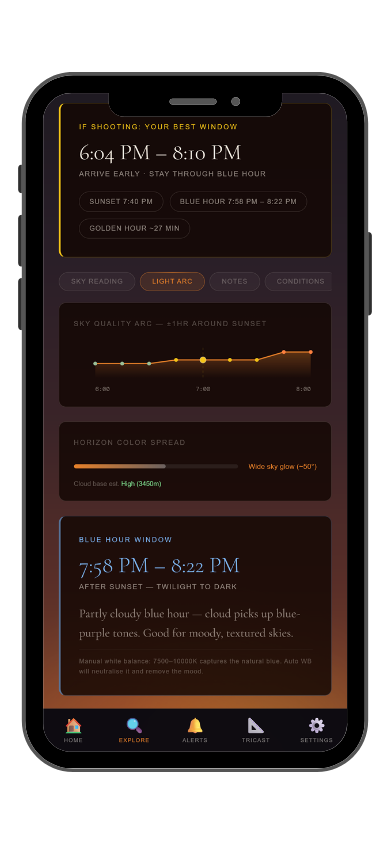
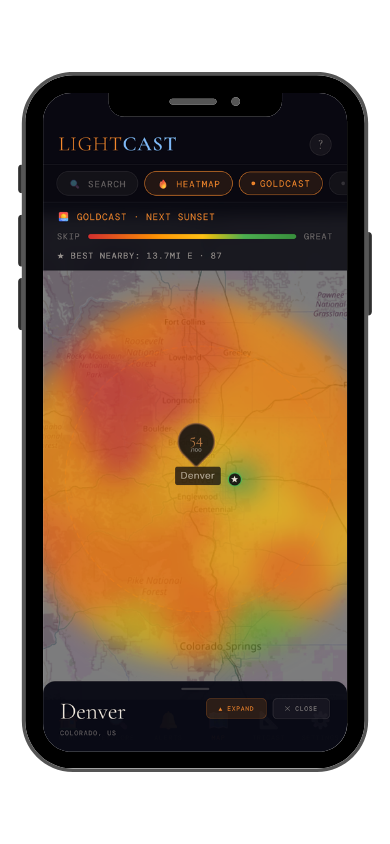
GoldCast shows exact golden hour and blue hour windows, plus cloud cover so you know whether the light will actually reach your subject. Check conditions for any Oklahoma location before you leave.
Get LightCast on iPhone
$2.99/mo · 7-day free trial
Check GoldCast on web →
GoldCast: golden hour forecast (left) · conditions heatmap (right)
🌌 Astrophotography · Oklahoma
Best Astrophotography Locations
Oklahoma is one of the most underrated astrophotography states in the country. The low population density across the western two-thirds of the state, combined with a relatively dry climate and flat terrain that keeps the horizon low, produces legitimately dark skies across a huge geographic area. The panhandle and far western Oklahoma can reach Bortle 2–3 on a good night — darker than most of what's available in the eastern half of the US. Wind is the variable to watch — the plains can be breezy even on clear nights, which affects atmospheric seeing. Check StarCast for the full picture.
🌾
Black Mesa, Cimarron County Bortle 2–3
Oklahoma's highest point sits in the far northwestern panhandle, one of the darkest and most remote corners of the continental United States. At 4,973 feet, Black Mesa is elevated enough to reduce atmospheric interference, and the surrounding high desert is so sparsely populated that the nearest significant light dome is hours away. The mesa top gives you an unobstructed 360-degree view. Milky Way shots here from late spring through early fall are genuinely world-class. Plan for a night or two of camping — this is a serious drive from anywhere.
🦌
Wichita Mountains Wildlife Refuge, Lawton Bortle 3–4
The refuge's granite boulders and elevated terrain make it one of the best foreground environments for night sky work in the southern plains. The dark skies here are good enough for wide-field Milky Way work with interesting terrestrial subjects — boulder fields, prairie ponds, and bison silhouettes against a star-filled sky. The refuge is protected from development, which helps preserve the dark sky envelope. Rock formations near Elk Mountain give you elevated south-facing compositions for core shots.
StarCast
Night sky score · moon · transparency · seeing
Cloud Cover · Moon Phase · Atmospheric Transparency · Seeing
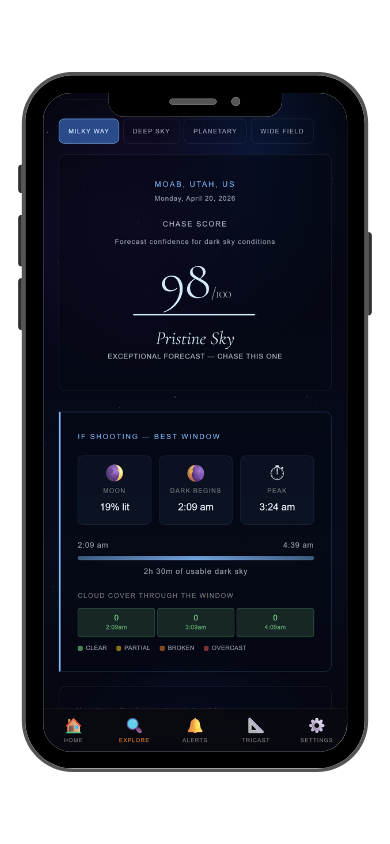
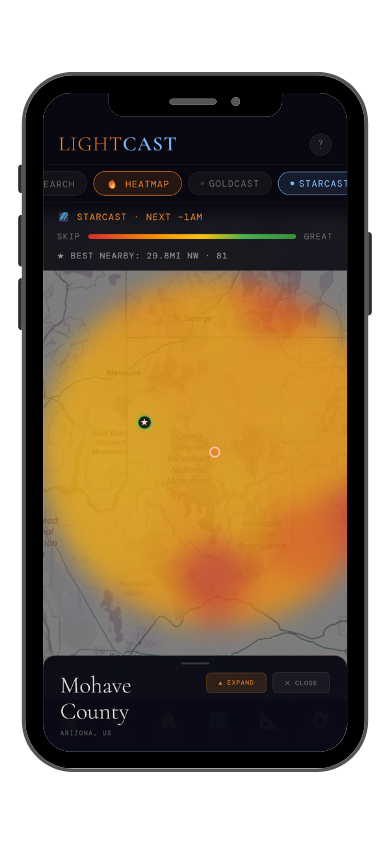
StarCast scores cloud cover, moon phase, atmospheric transparency, and astronomical seeing into a single verdict — updated daily for any location. See on a map where skies are clearest before committing to the drive.
Get LightCast on iPhone
$2.99/mo · 7-day free trial
Check StarCast on web →
StarCast: night sky score (left) · conditions heatmap (right)
🚁 Drone Photography · Oklahoma
Best Drone Locations
Oklahoma's wide-open terrain is some of the most drone-friendly landscape in the country — the rolling red dirt plains, river systems, and the mountain terrain of the southeast all read dramatically from altitude. Airspace near Tinker Air Force Base (Oklahoma City), Will Rogers World Airport, and Tulsa International requires LAANC authorization. The panhandle and western portions of the state are relatively airspace-clear. Wind is your main operational challenge — Oklahoma can be persistently breezy; always check Dronecast before launch, not just at home the night before.
🌾
Great Salt Plains State Park, Cherokee Alfalfa County · North-Central Oklahoma
The salt flats surrounding Great Salt Plains Lake create an otherworldly white surface that looks nothing like typical Oklahoma terrain from altitude. The contrast between the white salt crust, the reservoir blue, and the red-brown surrounding prairie makes for aerial compositions with a distinctly surreal quality. Morning light from the east catches the salt surface texture in a way that adds dimension. Wind is typically calmer in the first two hours after sunrise.
🏔️
Ouachita National Forest, Southeastern Oklahoma LeFlore County · Talimena Scenic Drive
The Ouachita Mountains in southeastern Oklahoma are the state's most dramatic terrain, with forested ridgelines that rival the Appalachians in fall color intensity. The Talimena Scenic Drive follows ridgetops for 54 miles — from altitude, the canopy view in mid-October is among the best fall foliage aerial subjects in the South-Central US. The terrain also channels wind in unpredictable ways; scout the ridge orientation before launch and check Dronecast for gust readings at altitude.
Dronecast
Wind, gusts, visibility & flight score
Wind Speed · Gusts · Visibility · Cloud Base
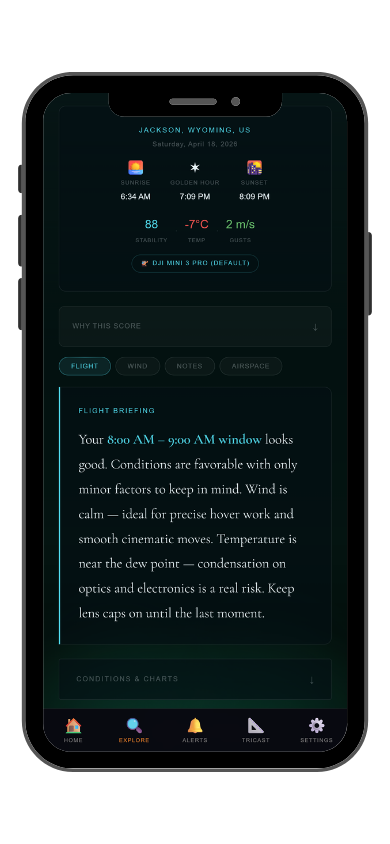
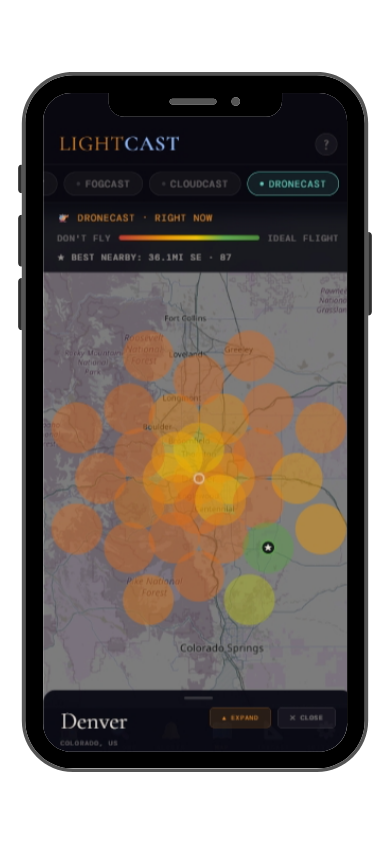
Dronecast scores wind speed, gusts, visibility, and cloud base into a single flight verdict — updated hourly. See window-by-window when conditions are safe and stable for your launch.
Get LightCast on iPhone
$2.99/mo · 7-day free trial
Check Dronecast on web →
Dronecast: flight score (left) · conditions heatmap (right)
Frequently asked
Where is the best place to photograph sunset in Oklahoma?
The Wichita Mountains Wildlife Refuge near Lawton offers granite peaks above the plains with 360-degree golden hour views — bison in the meadows below and open sky above. Red Rock Canyon in Hinton is outstanding for late-day red sandstone color. Check
GoldCast for cloud cover, as Oklahoma's partly cloudy evenings produce some of the most explosive sunset color in the country.
Can you see the Milky Way in Oklahoma?
Yes — and better than almost anywhere east of the Rockies. Black Mesa in the panhandle reaches Bortle 2–3, which is genuinely exceptional. The Wichita Mountains are Bortle 3–4 with great foreground subjects. You need a new moon window and good atmospheric transparency; check
StarCast before committing to the drive.
Where can I fly a drone in Oklahoma?
Much of rural western Oklahoma is relatively airspace-clear, making it some of the most accessible drone territory in the country. Avoid the controlled airspace around Oklahoma City (Tinker AFB), Tulsa, and Lawton without LAANC authorization. The Great Salt Plains and Ouachita National Forest areas offer strong aerial subjects with manageable airspace. Always confirm current restrictions and check
Dronecast for wind — Oklahoma can be persistently breezy.
What makes Oklahoma good for landscape photography?
Oklahoma's photography range is wider than most people expect: dark sky panhandle, red rock canyon country, forested Ouachita Mountains, dramatic plains skies, and the granite peaks of the Wichitas. The climate is drier than neighboring states, which improves atmospheric clarity for astrophotography. And the open terrain means cloud formations and golden hour light are visible across the full sky, not just a slit above the horizon.
What is LightCast?
LightCast is a suite of sky and weather tools built specifically for photographers.
GoldCast handles sunset and sunrise timing with cloud and fog forecasts.
StarCast scores night sky conditions for astrophotography.
Dronecast gives wind and visibility forecasts for drone pilots. All three are free on web; full features are available in the
LightCast iOS app — $2.99/month after a 7-day free trial.