LightCast · Oregon

Best Landscape Photography Locations in Oregon
Sunset, night sky, and drone — the top spots in Oregon, and how to know when conditions are right before you make the drive.
iOS app: $2.99/mo · 7-day free trial
🌅 Sunset & Golden Hour · Oregon
Best Sunset Locations
Oregon has more landscape photography range per square mile than almost any state — Pacific surf, old-growth forest, high desert, volcanic peaks, and river gorges, all within a few hours of each other. The coast faces due west with no offshore obstruction, making it one of the premier sunset environments on the continent. East of the Cascades, the dry air and open terrain give you cleaner light and longer golden hours. Marine layer and coastal fog are the main variables on the coast — a clear afternoon can cloud over fast after sunset. Check GoldCast before every coastal shoot.
🌊
Cannon Beach & Haystack Rock Clatsop County · Northern Oregon Coast
Haystack Rock is one of the most photographed sunset foreground elements on the West Coast — the 235-foot sea stack silhouettes perfectly against a western sky and reflects in the wet sand during low tide. The rocks around its base add texture at the foreground. Summer sunsets here track northwest, which means the rock is lit from the side rather than backlit — warm color on the basalt with a glowing sky behind. Low tide charts and GoldCast should both be open on your phone before you drive out.
🌋
Smith Rock State Park, Terrebonne Deschutes County · Central Oregon
Smith Rock's rhyolite and tuff formations turn deep amber and orange at golden hour — the light-colored rock catches warm tones that darker basalt never would. The Crooked River loops through the canyon below, adding a reflective element that works beautifully for foreground. The classic viewpoint from the Misery Ridge trail gives you Monkey Face and the main wall as towering silhouettes against the Central Oregon sky. This is high desert — clear skies are common but wind can pick up after midday; plan your sunset hike accordingly.
GoldCast
Golden hour timing + fog & cloud forecast
Sunset · Sunrise · Marine Layer · Cloud Cover
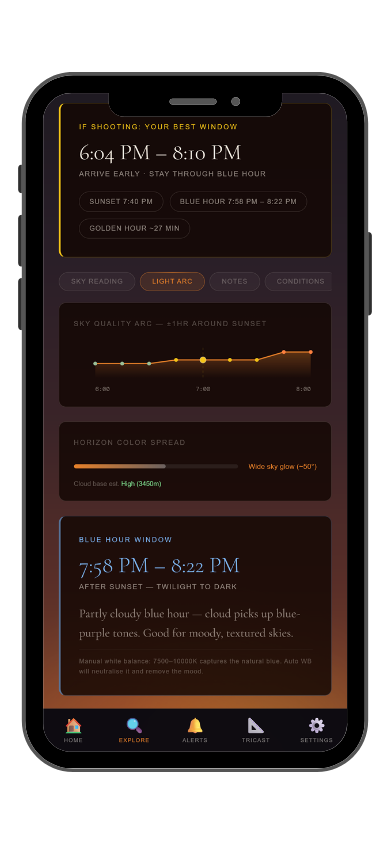
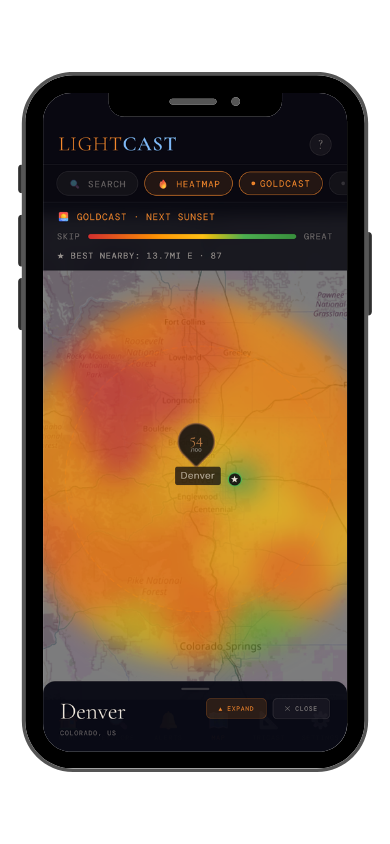
GoldCast shows exact golden hour and blue hour windows, plus cloud cover so you know whether the light will actually reach your subject. Check conditions for any Oregon location before you leave.
Get LightCast on iPhone
$2.99/mo · 7-day free trial
Check GoldCast on web →
GoldCast: golden hour forecast (left) · conditions heatmap (right)
🌌 Astrophotography · Oregon
Best Astrophotography Locations
Oregon east of the Cascades is world-class astrophotography territory. The high desert has some of the darkest skies in the lower 48, and the combination of volcanic landforms, alkali lakes, and ancient lava fields gives you foreground subjects that don't exist anywhere else. The Painted Hills, Crater Lake, and the Hart Mountain area all deliver Bortle 2–3 conditions on a clear night. The Cascade rain shadow is your friend — while the coast and Willamette Valley are frequently overcast, eastern Oregon often stays clear. StarCast will show you exactly where the clear window is.
🌋
Crater Lake National Park, Klamath County Bortle 2–3
Crater Lake's caldera sits at 6,178 feet, above much of the atmospheric interference that degrades transparency at lower elevations. The lake's intense blue reflects the Milky Way on still nights in a way that few places on Earth can match. Rim Drive gives access to multiple viewpoints — Cloudcap Overlook to the east is the most elevated and often the clearest. Summer is the only season with reliable access; the park typically opens fully by mid-June. Milky Way core is visible from late May through early October.
🏜️
Alvord Desert, Harney County Bortle 2
The Alvord Desert is one of the most remote and darkest accessible locations in the continental United States. The flat playa extends for miles, giving you a perfectly level foreground that reflects the sky when wet in spring. The Steens Mountain escarpment rises 5,000 feet to the west and creates dramatic silhouettes without introducing light pollution. Cell service is essentially nonexistent — download your maps, print your directions, and check StarCast before you leave. This is a multi-day commitment, and entirely worth it.
StarCast
Night sky score · moon · transparency · seeing
Cloud Cover · Moon Phase · Atmospheric Transparency · Seeing
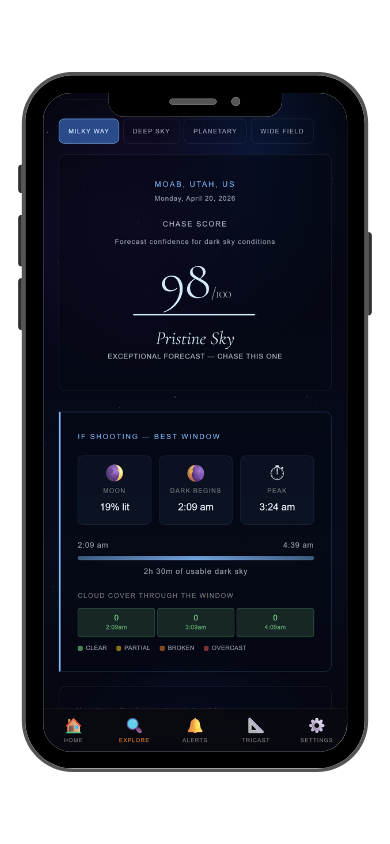
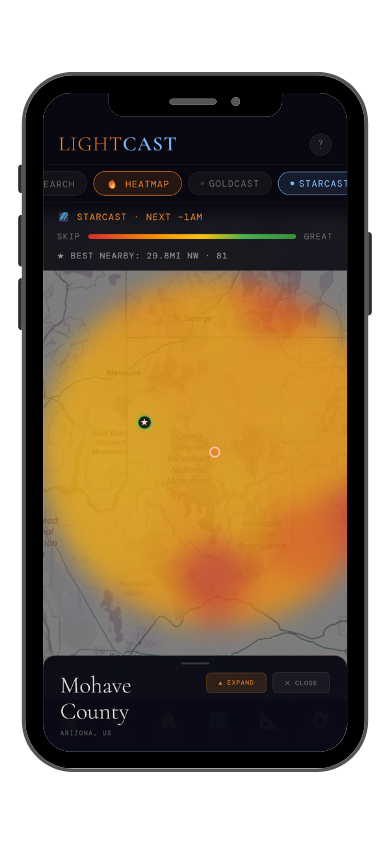
StarCast scores cloud cover, moon phase, atmospheric transparency, and astronomical seeing into a single verdict — updated daily for any location. See on a map where skies are clearest before committing to the drive.
Get LightCast on iPhone
$2.99/mo · 7-day free trial
Check StarCast on web →
StarCast: night sky score (left) · conditions heatmap (right)
🚁 Drone Photography · Oregon
Best Drone Locations
Oregon's landscape range makes it one of the premier drone states in the country — but the regulatory environment is complex. National parks including Crater Lake prohibit drone use entirely. Oregon state parks have varying policies. The coast has FAA controlled airspace around North Bend and Portland airports, and the Columbia River Gorge has its own TFRs. Check LAANC authorization and park-specific rules before every flight. East of the Cascades, the open terrain is dramatically photogenic and relatively airspace-clear. Dronecast gives you the wind picture before you launch — coastal and gorge winds can spike fast.
🏜️
Painted Hills, Wheeler County John Day Fossil Beds National Monument
The banded clay hills — red, gold, black, and tan — look like something from another planet at altitude. The color banding from above reveals patterns that ground-level photography can't fully capture. Note that as a National Monument, you must check current NPS drone regulations before flying; regulations have evolved and vary by unit. The surrounding Bureau of Land Management land outside the monument boundary is often an alternative launch point. Morning light is ideal — the warm colors intensify in direct low-angle sun.
🌊
Oregon Dunes, Coos County Oregon Dunes National Recreation Area
The largest expanse of coastal sand dunes in North America extends 40 miles along the central Oregon coast — from altitude, the flowing dune shapes, interdunal lakes, and forest margins create abstract compositions unlike anything else on the West Coast. Parts of the recreation area permit drone use; check with the Reedsport ranger district for current rules and no-fly zones. Coastal wind is the primary operational challenge — Dronecast's hourly wind forecast is essential before any coastal launch.
Dronecast
Wind, gusts, visibility & flight score
Wind Speed · Gusts · Visibility · Cloud Base
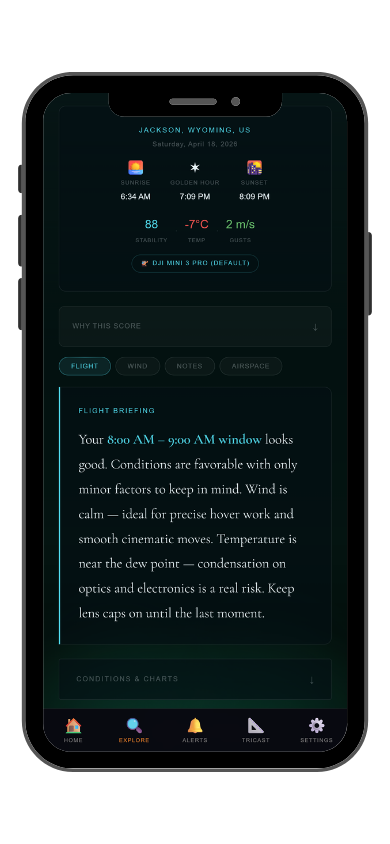
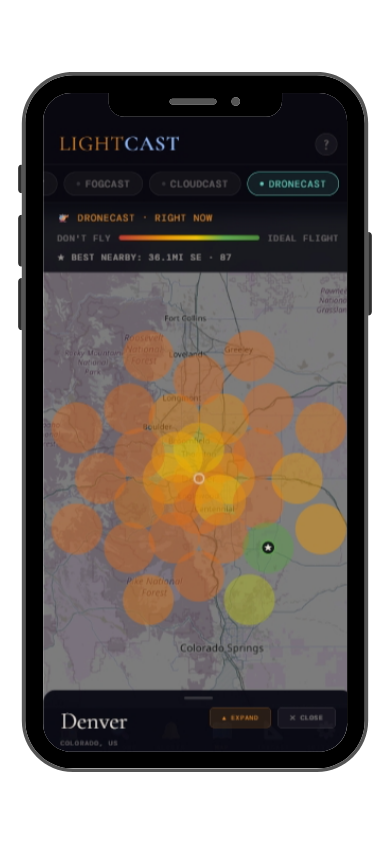
Dronecast scores wind speed, gusts, visibility, and cloud base into a single flight verdict — updated hourly. See window-by-window when conditions are safe and stable for your launch.
Get LightCast on iPhone
$2.99/mo · 7-day free trial
Check Dronecast on web →
Dronecast: flight score (left) · conditions heatmap (right)
LightCast · All tools
5 Forecasts in 1 App
🌫️
Fog Cast
Coastal fog, hour by hour
See when fog is expected to roll in or clear — so a murky morning doesn't end your golden hour session before it starts.
☁️
Cloud Cast
Cloud cover that matters to photographers
Not just "cloudy or clear" — see cloud type and coverage so you know whether you're getting dramatic texture or a blown-out white sky.
✦ Fog Cast and Cloud Cast are app-exclusive features
Frequently asked
Where is the best place to photograph sunset in Oregon?
Cannon Beach and Haystack Rock are among the most iconic West Coast sunset locations — the sea stack silhouettes perfectly against the Pacific sky. Smith Rock State Park in Central Oregon delivers warm golden light on rhyolite cliffs with the Crooked River below. Check
GoldCast for marine layer conditions on the coast before you commit to the drive.
Can you see the Milky Way in Oregon?
Eastern Oregon is world-class for Milky Way photography — Crater Lake sits at elevation with exceptional transparency, and the Alvord Desert in Harney County reaches Bortle 2, among the darkest accessible locations in the US. The Cascade rain shadow keeps eastern Oregon clear when the coast is socked in. Check
StarCast for the cloud and moon forecast before planning your trip.
Can you fly a drone at Crater Lake in Oregon?
Drone use is prohibited inside Crater Lake National Park. The surrounding Winema and Fremont National Forests may permit flights in certain areas — check with the local ranger district for current rules. For drone photography in Oregon, the Oregon Dunes NRA and eastern Oregon BLM lands offer strong aerial subjects with more permissive policies. Always verify current regulations before flying.
When is the best time to photograph the Oregon coast?
Fall (September–November) is consistently the most rewarding coastal season — storm light produces dramatic waves and dramatic skies, the summer crowds are gone, and marine layer frequency drops compared to June–August. Winter storms bring powerful surf and dramatic conditions but require weather monitoring. Check
GoldCast to track the marine layer and cloud cover timing for any coastal location.
What is LightCast?
LightCast is a suite of sky and weather tools built specifically for photographers.
GoldCast handles sunset and sunrise timing with cloud and fog forecasts.
StarCast scores night sky conditions for astrophotography.
Dronecast gives wind and visibility forecasts for drone pilots. All three are free on web; full features are available in the
LightCast iOS app — $2.99/month after a 7-day free trial.