🌅 Sunset & Golden Hour · South Dakota
Best Sunset Locations
South Dakota's western half is built for landscape photography. The Badlands erode into shapes and colors that change dramatically with the angle of light, and golden hour turns the banded clay formations from gray-brown to deep rust and amber. The Black Hills rise abruptly from the plains and give elevated perspectives on a landscape that is otherwise relentlessly flat. The Great Plains atmosphere is cleaner and drier than most of the country, which means when the cloud structure cooperates, South Dakota sunsets can be genuinely spectacular. Check GoldCast before driving out — the distances here make a wasted trip costly.
🏜️
Badlands National Park, Interior Jackson County · Southwest SD
The Badlands formations are at their best in the hour before and after sunset. The banded buttes — striped in white, gray, rust, and pink — absorb and reflect warm light differently than almost anything else in the country. The Notch Trail and the Door Trail both put you among the formations at eye level; the Big Badlands Overlook and the Yellow Mounds Overlook give wider panoramic compositions. The light changes quickly in the Badlands: compositions that looked flat at 4pm turn vivid by 7pm and then deep gold in the last 20 minutes before the sun drops. Plan to be in position well before golden hour and don't leave until full blue hour has passed.
🌲
Custer State Park, Custer County Black Hills · Southwest SD
Custer State Park's Wildlife Loop Road is one of the best all-around landscape drives in the northern Great Plains. The park holds bison herds, granite spires, ponderosa pine forest, and open meadows in close proximity, which means sunset compositions are varied and you rarely have to drive far between locations. The Needles Highway at golden hour turns the granite pinnacles warm pink and orange. The open prairie near Blue Bell in the southwest corner of the park gives unobstructed western horizon shots with bison as foreground elements when the herds are near the road.
GoldCast
Golden hour timing + fog & cloud forecast
Sunset · Sunrise · Cloud Cover · Atmospheric Clarity
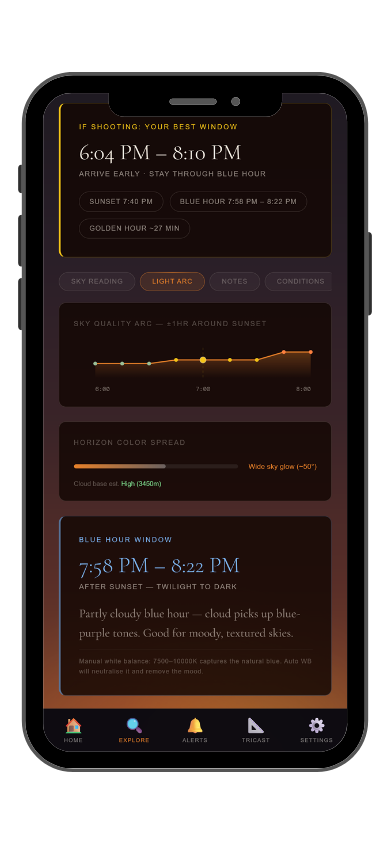
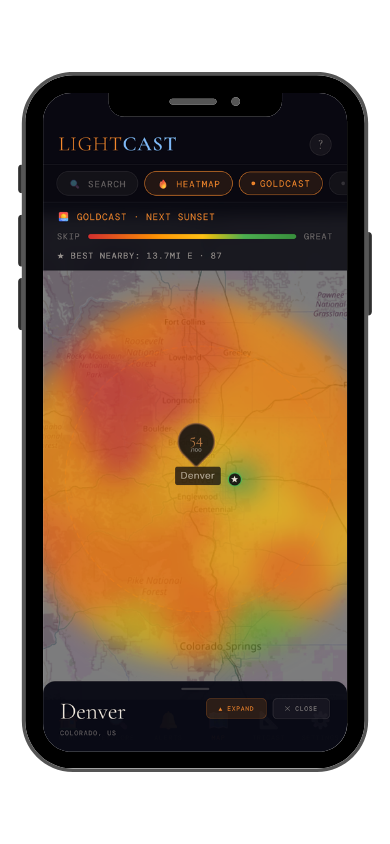
GoldCast shows exact golden hour and blue hour windows, plus cloud cover so you know whether the light will actually reach your subject. Check conditions for any South Dakota location before you leave.
Get LightCast on iPhone
$2.99/mo · 7-day free trial
Check GoldCast on web →
GoldCast: golden hour forecast (left) · conditions heatmap (right)
🌌 Astrophotography · South Dakota
Best Astrophotography Locations
South Dakota's low population density and dry continental air make it one of the better astrophotography states in the country. The Badlands and the remote areas east of the Black Hills are consistently dark, with minimal artificial light for miles in every direction. The elevation of the Black Hills also helps with atmospheric transparency. Wind is the practical challenge in South Dakota: Great Plains gusts can be strong enough to affect long-exposure sharpness and make cold-weather night shoots genuinely difficult. Plan around calmer nights; StarCast shows hourly wind data alongside sky conditions.
🌑
Badlands National Park, Interior Bortle 2–3
Badlands is an International Dark Sky Park with reliably dark skies and essentially no nearby light sources in any direction. The formations make extraordinary foregrounds for Milky Way photography: the eroded buttes, spires, and canyon walls in the foreground against a dense star field above produce compositions that are hard to replicate anywhere else. The Ben Reifel Visitor Center area has a designated astronomy field. The Milky Way core is up from April through October; fall is the best combination of darkness and moderate temperatures. Bring warm layers regardless of the season — temperatures drop fast after sunset at altitude.
⛰️
Black Elk Peak, Black Hills Bortle 3
At 7,244 feet, Black Elk Peak is the highest point in the United States east of the Rocky Mountains. The summit tower gives a 360-degree view above the surrounding forest and provides some separation from the Black Hills' modest light domes. The hike to the summit is 3.5 miles one way from the Sylvan Lake trailhead, which limits casual traffic on weeknights. The stone fire tower at the summit is a strong foreground element for wide-angle Milky Way compositions. Conditions at the summit can turn quickly; check wind and temperature forecasts before committing to a night hike.
StarCast
Night sky score · moon · transparency · seeing
Cloud Cover · Moon Phase · Atmospheric Transparency · Seeing
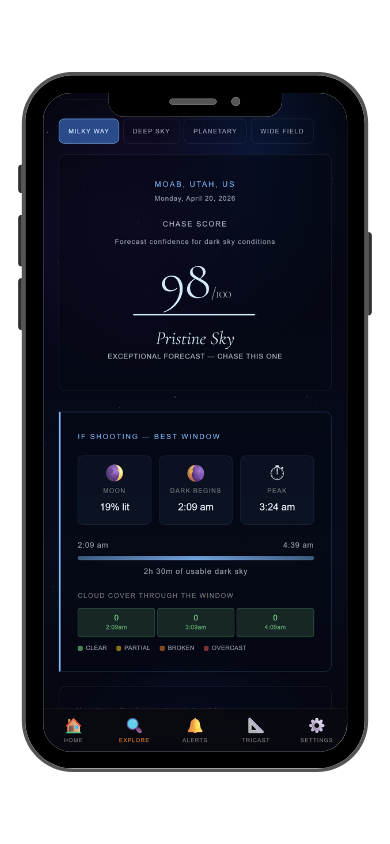
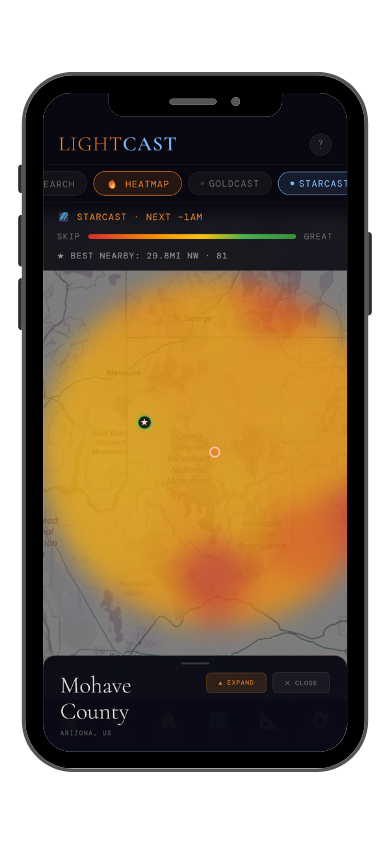
StarCast scores cloud cover, moon phase, atmospheric transparency, and astronomical seeing into a single verdict — updated daily for any location. See on a map where skies are clearest before committing to the drive.
Get LightCast on iPhone
$2.99/mo · 7-day free trial
Check StarCast on web →
StarCast: night sky score (left) · conditions heatmap (right)
🚁 Drone Photography · South Dakota
Best Drone Locations
South Dakota's wide open terrain is visually compelling from altitude, but the most photogenic areas carry airspace and regulatory restrictions. Badlands National Park prohibits drone use. Mount Rushmore has strict NPS and National Memorial airspace restrictions in force at all times. Custer State Park generally prohibits drones without special use permits. The open prairie and national grasslands east of the Black Hills are where the fewest restrictions apply, and the aerial views of the prairie landscape, river drainages, and isolated homestead remnants can be compelling. Always confirm via FAA B4UFLY and verify land manager rules before every flight.
🌾
Buffalo Gap National Grassland, Fall River County Southwest SD · Open Prairie
The Buffalo Gap National Grassland wraps around the south and east sides of Badlands National Park and gives access to open prairie and Badlands-edge terrain outside the park's flight restrictions. The transition zone where the grass prairie gives way to the eroded Badlands formations is particularly striking from altitude: two completely different visual environments in the same frame. Wind is nearly always a factor here, so Dronecast's gust forecast is worth checking carefully before launching — prairie gusts can be abrupt and strong, especially in spring and fall.
💧
Missouri River, Chamberlain Area Brule County · Central SD
The Missouri River at Chamberlain and the surrounding Lake Francis Case reservoir give aerial views that read clearly as the geographic divide between the eastern prairie and the western plains. The wide river bends, bluffs, and agricultural patchwork from above have a graphic quality that's distinct from both the Badlands and the Black Hills. The area is largely Class G airspace away from the Chamberlain Municipal Airport, and the Corps of Engineers manages recreation areas along the shoreline that serve as launch points. Morning calm is more reliable than afternoon when plains winds tend to build.
Dronecast
Wind, gusts, visibility & flight score
Wind Speed · Gusts · Visibility · Cloud Base
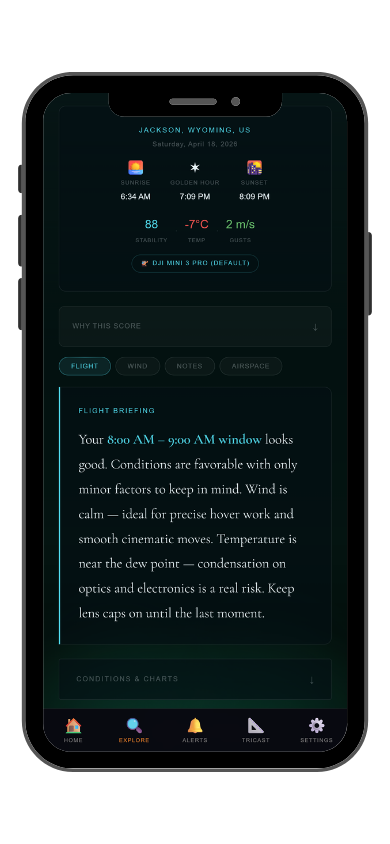
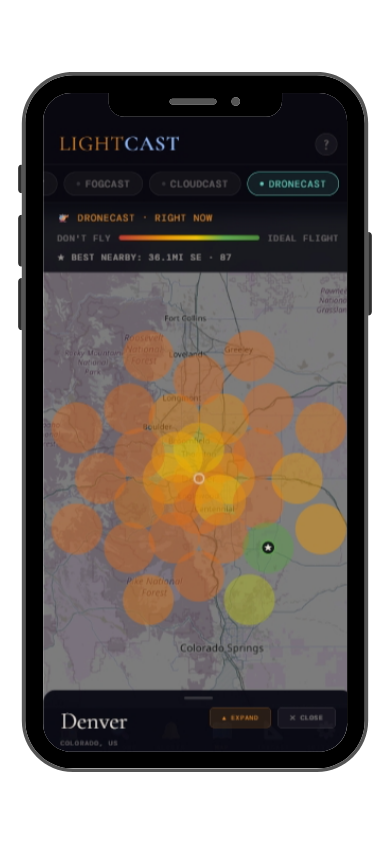
Dronecast scores wind speed, gusts, visibility, and cloud base into a single flight verdict — updated hourly. On the Great Plains, gusts can be significant even when sustained wind looks acceptable. Check window-by-window before you launch.
Get LightCast on iPhone
$2.99/mo · 7-day free trial
Check Dronecast on web →
Dronecast: flight score (left) · conditions heatmap (right)
Frequently asked
Where is the best place to photograph sunset in South Dakota?
Badlands National Park is the most visually dramatic sunset location in the state. The banded clay formations turn from gray-brown to deep rust and amber in golden hour, and the change is rapid. For a different mood, Custer State Park's Needles Highway and Wildlife Loop Road offer granite spires and open prairie with bison. Check
GoldCast before heading out — cloud cover is the deciding factor for how good the light gets.
Is Badlands a good place for astrophotography?
Yes, one of the best in the Great Plains. Badlands National Park is a designated International Dark Sky Park with Bortle 2–3 skies and formations that make extraordinary Milky Way foregrounds. The park has a designated astronomy area near the visitor center. You need a new moon window and ideally a night with low wind. Check
StarCast for sky conditions and wind before making the drive.
Can you fly a drone at Badlands National Park?
No. The National Park Service prohibits drone launches, landings, and operation within Badlands National Park. Mount Rushmore also has strict permanent airspace restrictions. The Buffalo Gap National Grassland, which surrounds the park on the south and east, is outside NPS jurisdiction and offers similar terrain with fewer restrictions. Always verify via FAA B4UFLY before any flight in western South Dakota.
When is the best time to visit South Dakota for landscape photography?
Late September through October is the peak window: the tourist crowds have thinned, temperatures are manageable, the light is lower in the sky (which means longer golden hours), and the Milky Way is still up in early evening before it sets. Spring (May through June) is the second-best window for Badlands color and wildlife in Custer. Summer brings the most daylight but also the highest crowds and most wind. GoldCast's cloud forecast helps you pick the best shooting window regardless of season.
What is LightCast?
LightCast is a suite of sky and weather tools built specifically for photographers.
GoldCast handles sunset and sunrise timing with cloud and fog forecasts.
StarCast scores night sky conditions for astrophotography.
Dronecast gives wind and visibility forecasts for drone pilots. All three are free on web; full features are available in the
LightCast iOS app — $2.99/month after a 7-day free trial.