LightCast · Vermont
Best Landscape Photography Locations in Vermont
Sunset, night sky, and drone — the top spots in Vermont, and how to know when conditions are right before you make the drive.
iOS app: $2.99/mo · 7-day free trial
🌅 Sunset & Golden Hour · Vermont
Best Sunset Locations
Vermont earns its reputation as a fall foliage destination, but the state rewards photographers year-round. The Green Mountains run north-south through the center, giving you ridgeline views in every direction. In October, almost any elevated field or country road becomes a viable shooting location — the challenge is picking the best foreground. New England cloud cover is the main variable — partly cloudy skies produce spectacular color, while dense overcast kills it in minutes. Check GoldCast before making the drive.
🍂
Stowe Village & Mount Mansfield Lamoille County · 4,393 ft summit
Vermont's highest peak anchors one of the most photographed foliage scenes in New England. The drive up Smugglers' Notch passes through narrow cliff walls that frame the valley below in a way no wide-angle lens can quite capture in its entirety. The gondola to the Stowe summit provides elevated views over the foliage canopy in both directions along the ridge. Shoot from the valley farms in the late afternoon when Mansfield's west face catches the last light.
🌅
Quechee Gorge & Upper Valley Windsor County · Quechee
Vermont's "Little Grand Canyon" drops 165 feet through ancient granite, and the highway bridge over it gives an instant composition most visitors photograph from. Serious photographers hike down to the gorge floor for waterfall and foliage views that look back up at the bridge. The Upper Connecticut River valley just north offers pastoral scenery — dairy farms, covered bridges, and the river bending through flat meadows — that catches long golden hour light beautifully in late September and October.
GoldCast
Golden hour timing + fog & cloud forecast
Sunset · Sunrise · Marine Layer · Cloud Cover
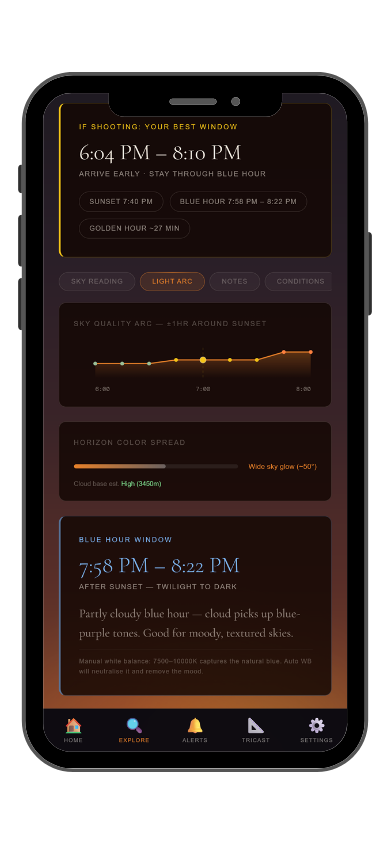
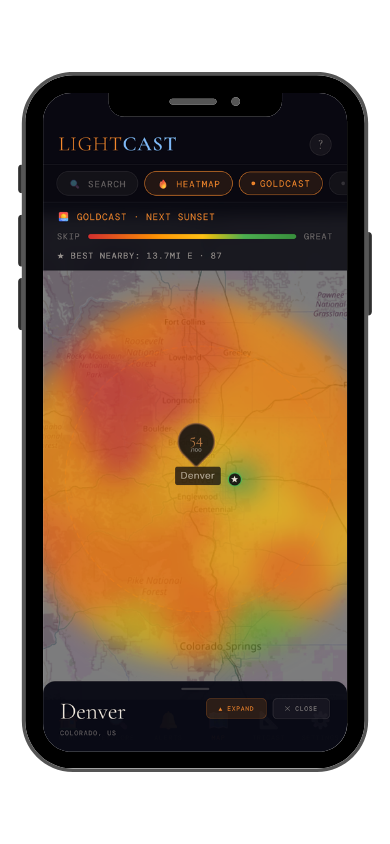
GoldCast shows exact golden hour and blue hour windows, plus cloud cover so you know whether the light will actually reach your subject. Check conditions for any Vermont location before you leave.
Get LightCast on iPhone
$2.99/mo · 7-day free trial
Check GoldCast on web →
GoldCast: golden hour forecast (left) · conditions heatmap (right)
🌌 Astrophotography · Vermont
Best Astrophotography Locations
Vermont has some of the darkest skies in the northeastern US. The Northeast Kingdom in the state's upper corner is particularly remote, with few roads and fewer towns. The Green Mountain ridgelines also provide dark-sky shooting with elevation. Vermont's weather is highly variable — clear nights can close in within an hour. Transparency is often better in winter when Arctic air pushes in from Canada, though cold temperatures require extra attention to battery life. Always check StarCast before the drive.
🌲
Northeast Kingdom — Brighton State Park Bortle 3–4
The Northeast Kingdom around Island Pond and Brighton State Park offers Vermont's most accessible dark skies. Spectacle Pond within the park provides a still-water foreground for Milky Way reflections from late spring through early fall. The area is sparsely populated and the light domes from Burlington and Montpelier are distant enough to allow genuine wide-field astrophotography. The park closes after the summer season — plan for dispersed camping or day use in shoulder months.
⛰️
Mount Ascutney, Windsor County Bortle 3–4
This isolated monadnock in the Connecticut River valley rises 3,100 feet above surrounding terrain, providing 360-degree darkness on clear nights. The summit road is open seasonally, and the open summit ledges give unobstructed sky views in all directions. The Connecticut River valley to the east can produce low fog that blocks the horizon but leaves the sky above clear — a beautiful two-layer composition on the right night. Bring wind protection; it's exposed.
StarCast
Night sky score · moon · transparency · seeing
Cloud Cover · Moon Phase · Atmospheric Transparency · Seeing
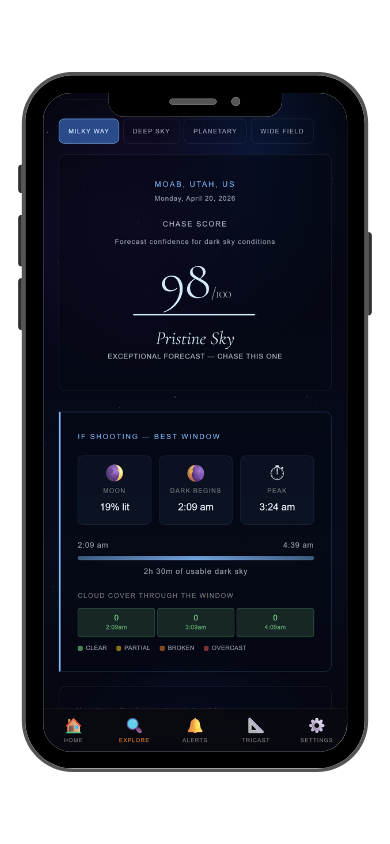
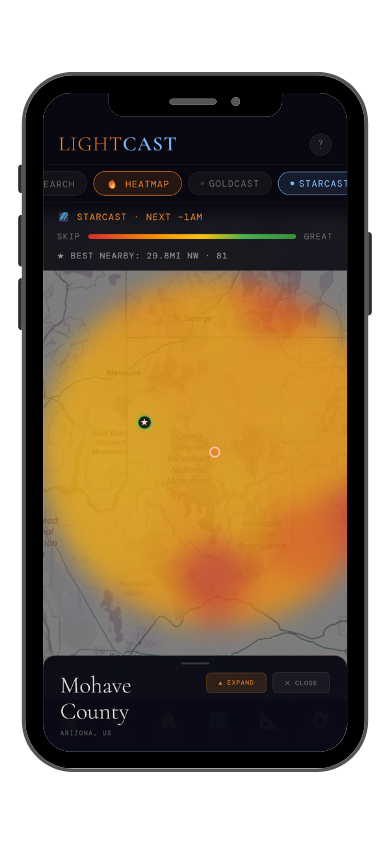
StarCast scores cloud cover, moon phase, atmospheric transparency, and astronomical seeing into a single verdict — updated daily for any location. See on a map where skies are clearest before committing to the drive.
Get LightCast on iPhone
$2.99/mo · 7-day free trial
Check StarCast on web →
StarCast: night sky score (left) · conditions heatmap (right)
🚁 Drone Photography · Vermont
Best Drone Locations
Vermont's pastoral landscape — rolling hills, covered bridges, dairy farms, and river valleys — translates exceptionally well to aerial photography. The state has no major commercial airports that create broad restricted zones, though Burlington International and smaller fields require attention. State parks vary in their drone policies; some allow it with a permit and others prohibit it entirely. Confirm with the specific park before flying. Dronecast is essential in Vermont's variable winds, especially on ridgelines and in mountain gaps.
🌉
Mad River Valley, Waitsfield & Warren Washington County
The Mad River Valley is one of Vermont's most scenic and least developed corridors. The valley floor holds a patchwork of farms, the winding river, and the covered bridge at Warren — all visible in a single elevated composition. The surrounding hillsides turn brilliant color in early October, typically peaking a few days before Stowe. Fly in the morning when valley winds are calm; afternoon thermals off the ski area slopes can be unpredictable.
🏞️
Lake Champlain, Grand Isle County Northwest Vermont
Lake Champlain's island chain — North Hero, Grand Isle, and South Hero — sits between Vermont's Green Mountains and New York's Adirondacks. Aerial views show the lake's full breadth with both mountain ranges as backdrops. The flat island terrain makes for stable launches, and the open water views to the west catch sunset light long after it's left the Vermont hills. Winds off the lake can pick up quickly; check Dronecast for gust forecasts before flying over water.
Dronecast
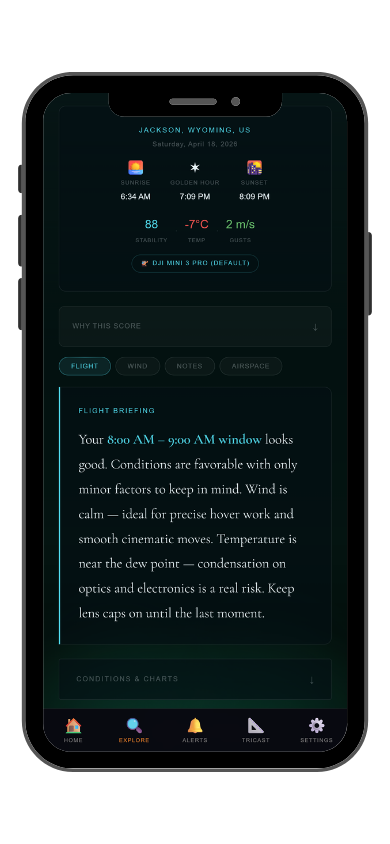
Wind, gusts, visibility & flight score
Wind Speed · Gusts · Visibility · Cloud Base
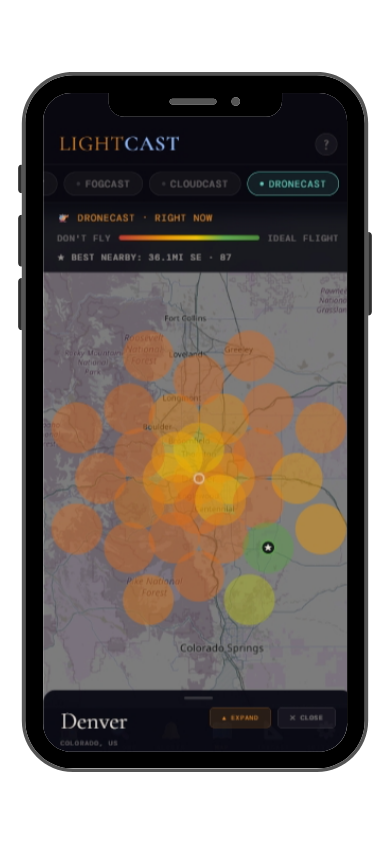
Dronecast scores wind speed, gusts, visibility, and cloud base into a single flight verdict — updated hourly. See window-by-window when conditions are safe and stable for your launch.
Get LightCast on iPhone
$2.99/mo · 7-day free trial
Check Dronecast on web →
Dronecast: flight score (left) · conditions heatmap (right)
LightCast · All tools
5 Forecasts in 1 App
🌫️
Fog Cast
Coastal fog, hour by hour
See when fog is expected to roll in or clear — so a murky morning doesn't end your golden hour session before it starts.
☁️
Cloud Cast
Cloud cover that matters to photographers
Not just "cloudy or clear" — see cloud type and coverage so you know whether you're getting dramatic texture or a blown-out white sky.
✦ Fog Cast and Cloud Cast are app-exclusive features
Frequently asked
Where is the best place to photograph fall foliage in Vermont?
Stowe and the Mount Mansfield area are the most iconic, but the Mad River Valley and the Northeast Kingdom are less crowded and equally colorful. Peak typically falls in the first two weeks of October at higher elevations. Check
GoldCast for cloud cover — partly cloudy skies produce the best foliage light.
Can you see the Milky Way in Vermont?
Yes — Vermont has some of the darkest skies in the Northeast, particularly in the Northeast Kingdom near Island Pond and on the Green Mountain ridgelines. New moon timing is important, and Vermont's weather is variable, so plan around a clear forecast. Use
StarCast for a daily sky-quality score before you commit to the drive.
Where can I fly a drone in Vermont?
Vermont has relatively open airspace outside Burlington International Airport and a few smaller fields. State parks have individual policies — some permit drones with a permit, others prohibit them. The Mad River Valley and Lake Champlain's Grand Isle chain are good starting points for aerial work. Always check FAA authorization before flying.
When is the best time to photograph Vermont landscapes?
Fall (late September–mid October) is the obvious peak for foliage. But Vermont's mud season clears in May to reveal green hillsides and rushing waterfalls worth shooting. Winter brings snow-covered farms and frozen waterfalls that reward early-morning trips. Spring fog in the valleys can produce atmospheric sunrise scenes with the right forecast.
What is LightCast?
LightCast is a suite of sky and weather tools built specifically for photographers.
GoldCast handles sunset and sunrise timing with cloud and fog forecasts.
StarCast scores night sky conditions for astrophotography.
Dronecast gives wind and visibility forecasts for drone pilots. All three are free on web; full features are available in the
LightCast iOS app — $2.99/month after a 7-day free trial.