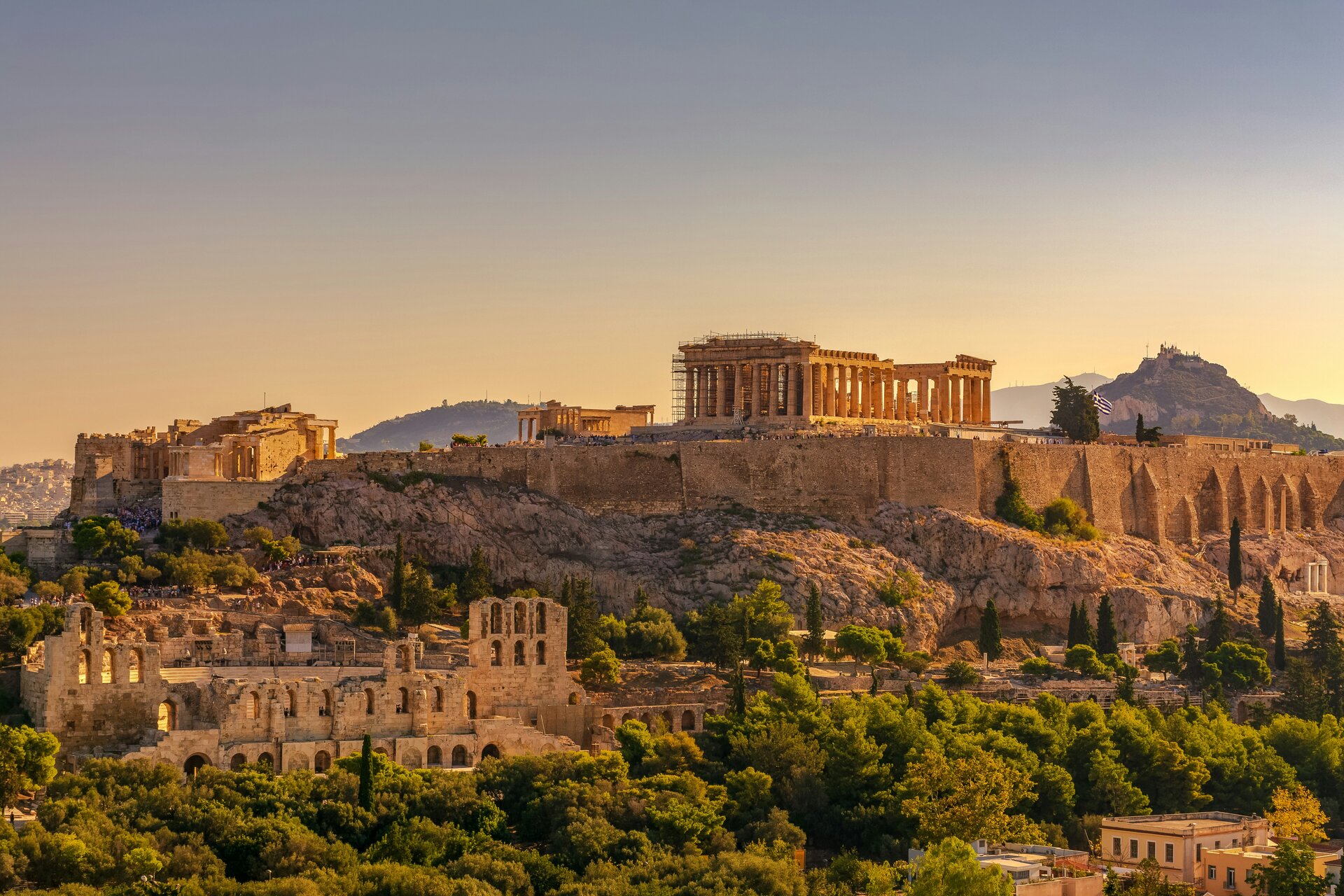
Athens
Athens, Greece
Live Conditions

Athens
Photography Conditions

Sunset · Astrophotography · Drone Flight  ·  Pre-loaded for Athens

Tonight's Forecast
Sunset & Sunrise
Goldcast
Loading…
Reading the sky…
Open Goldcast
Stars & Night Sky
Starcast
Loading…
Reading the sky…
Open Starcast
Drone Conditions
Dronecast
Loading…
Reading the sky…
Open Dronecast
Best Spots in Athens
Sunset
Lycabettus Hill
Kolonaki · 277 m summit

The highest point in Athens and the best overall photography vantage. The Acropolis sits below you to the southwest, the city spreads in every direction, and the Saronic Gulf frames the horizon. At golden hour, the Parthenon catches warm light while you shoot from above. Take the funicular or hike 20 minutes from Kolonaki. Arrive 45 minutes before sunset: the summit is small and crowds arrive quickly.

Check tonight's sunset →
Sunset Sunrise
Philopappos Hill
Thissio · Faces the Acropolis west

The single best spot for a clean Acropolis and Parthenon silhouette at golden hour. The hill faces the Acropolis directly from the west — at sunset, the Parthenon is perfectly backlit. A 10-minute walk from Thissio metro. Photographers can spread out along the ridge and find multiple compositions. At sunrise, shoot from the Acropolis side facing east toward Hymettus.

Check Acropolis conditions →
Sunset Astro escape ~70 km south
Cape Sounion
Attica · Temple of Poseidon · Bortle 5–6

The Temple of Poseidon perches on a cliff 60 m above the Aegean — one of Greece's most photographed locations. Sun sets directly over the sea from the temple promontory March through September. For astrophotography, the site faces open ocean with no light dome to the south or west. Milky Way core rises over the sea in summer with the temple columns as foreground. 70 km from central Athens via the coastal road.

Check Sounion tonight →
Sunrise
Mount Hymettus
East Athens · 1,026 m

The long ridge rising directly east of Athens catches first light in spectacular fashion and gives the city below a rare aerial perspective. Drive up the mountain road to the monastery viewpoints for sunrise. In October and November, mist settles in the Attic basin below while the summit stays clear — a rare inversion shot. Not commonly used by tourists; you'll often have the ridge to yourself.

Check sunrise forecast →
Milky Way Season Near Athens
Core visible
Jan Feb Mar Apr May Jun Jul Aug Sep Oct Nov Dec
Summer haze reduces transparency Jul–Aug · Drive 70 km to Cape Sounion for sea horizon shots
Dark Sky Escapes from Athens
LocationDistanceBortleBest for
Mount Parnitha 40 km northwest 4–5 Near-city dark sky, forested horizon Starcast →
Cape Sounion 70 km south 5–6 Ocean horizon, Temple of Poseidon foreground Starcast →
Peloponnese Highlands 150 km southwest 3–4 Wide Milky Way, mountain foreground Starcast →
Epirus Region 320 km northwest 2–3 Premier dark skies in Greece Starcast →
Athens by Season
Spring · Mar–May
Best light of the year. Wildflowers on the hills.
  • Clear post-rain transparency produces the most saturated sunset colors
  • Wildflowers on Philopappos and Parnitha add rare foreground variety
  • Milky Way core returns in April — Cape Sounion is prime on new moon nights
  • Temperatures mild, crowds minimal before Easter tourist rush
Summer · Jun–Aug
Long evenings. Watch the haze.
  • Sunset at 8:30–9:00 PM — a full evening of shooting from Lycabettus
  • Summer Meltemi winds (north-northwest) regularly exceed drone limits
  • July–August haze from urban heat and Saharan dust reduces color intensity
  • Escape to islands or Cape Sounion for cleaner air and sea horizons
Autumn · Sep–Nov
Peak conditions. Fewer crowds.
  • September is the sweet spot: summer-like sunset times with autumn clarity
  • Hymettus inversions begin in October — city fog below, clear sky above
  • Milky Way still active in early September from Cape Sounion
  • November rains clear quickly, leaving exceptional post-storm transparency
Winter · Dec–Feb
Mild and clear. Best star transparency.
  • Golden hour at 4:30–5:00 PM — compact sessions, but vivid low-angle light
  • Snow on Hymettus and Parnitha creates dramatic backdrops over the city
  • Clear winter nights have exceptional star transparency: best Starcast scores
  • Crowds nonexistent — popular viewpoints are yours alone

Free Alerts

Email Alerts

Get notified when the sunset near Athens is worth chasing.

You're on the list
Alerts enabled.
Frequently Asked

Frequently Asked Questions — Athens Photography

Athens has over 300 sunny days a year, but summer haze can flatten color on what looks like a clear day. Goldcast reads live aerosol levels, cloud cover, and horizon clarity for Athens and returns a 0–100 score. Scores above 65 from Lycabettus or Philopappos Hill typically produce vivid results. Spring and autumn scores are consistently the highest. Check tonight's score →
At 37.9° north, Athens has moderate seasonal variation. Summer golden hour begins around 7:45–8:15 PM; in winter it starts near 4:30 PM. The Mediterranean light in spring and autumn is exceptional — low humidity means colors are more saturated than equivalent cloud scores in northern cities. Goldcast calculates today's exact window. Get today's golden hour →
The city is Bortle 9 — unusable. The closest viable site is Mount Parnitha (40 km northwest, Bortle 4–5). Cape Sounion (70 km south, Bortle 5–6) is popular for its sea horizon and Temple of Poseidon foreground. For serious dark sky work, drive to the Peloponnese or northern Greece. Summer haze also reduces star transparency, so Starcast scores matter even at dark sites. Check tonight's astro score →
The galactic core is visible April through September. April, May, and September are the best months: new moon windows, clear skies, and good transparency. July and August have longer dark windows but summer haze frequently reduces star quality. Cape Sounion on a transparent September new moon is the classic Attica Milky Way shot. Check Cape Sounion tonight →
Athens International Airport creates controlled airspace over most of the eastern city. Flying near the Acropolis or any archaeological site is prohibited under Greek heritage law — penalties are strict. EASA registration and a flyer ID are required. The Meltemi wind system creates frequent above-limit conditions in summer. Always check Dronecast for current winds before flying outside restricted zones. Check Athens wind conditions →
Lycabettus Hill (277 m) for the elevated Acropolis-and-city composition. Philopappos Hill for the direct west-facing Parthenon silhouette at golden hour. Areopagus rock for intimate low-angle Acropolis framing. Cape Sounion (70 km) for open sea horizons with the Temple of Poseidon. Mount Hymettus east ridge for sunrise inversions over the city basin. See tonight's forecast →
More Cities