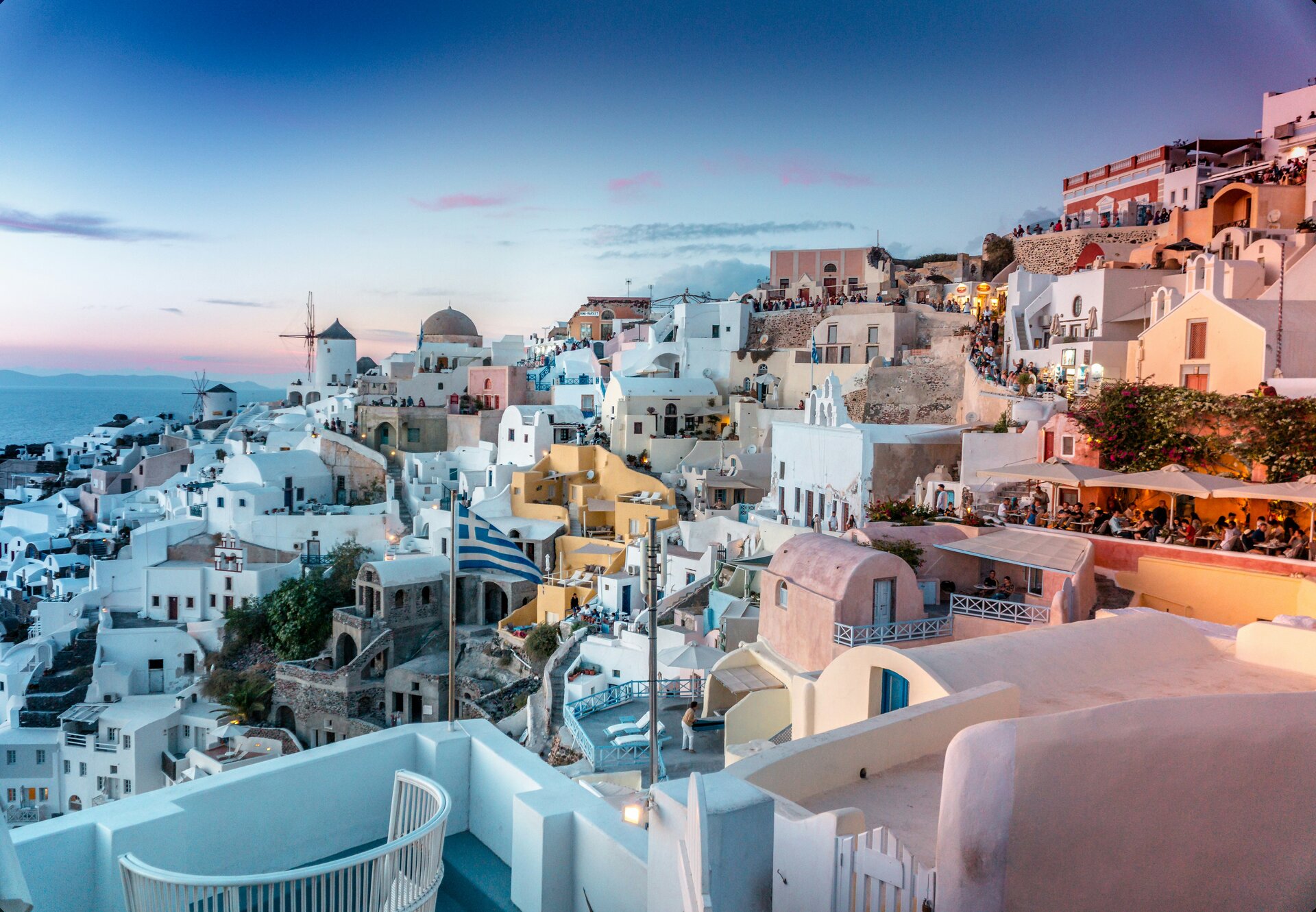
 Santorini, Greece
Santorini
Photography Conditions
Sunset · Oia · Caldera · Golden Hour · Pre-loaded for Santorini
The most famous sunset position in Greece. The ruined Venetian castle at Oia's northwestern tip faces directly west over the Aegean — the sun sets into open water with the caldera walls falling away to the left and the windmills of Oia on the ridge to the right. The white cave houses on the cliff below catch layered amber light in the final 15 minutes. In high season this viewpoint draws 400+ people: arrive 90 minutes early and position on the upper castle walls for unobstructed sightlines. At the actual moment of sunset, the crowd applauds. Once it drops, slip down to the blue dome area (10 minutes walk) for uncrowded blue hour shots.
Check tonight's sunset →Imerovigli sits at the highest point of the caldera rim and gives the longest single caldera panorama on the island — from Fira in the south all the way to Oia in the north, with the volcano and Thirassia island directly west. Far fewer people than Oia. The path down to Skaros Rock (20-minute hike on loose trail) gives a nearly-private position with open ocean on three sides. The village's caldera-edge path also gives multiple blue-dome compositions — smaller, less famous than Oia's, but with space to shoot without a crowd around you.
Check Imerovigli conditions →Firostefani is where the famous blue-dome photograph is actually easiest to make. The domed churches sit directly on the caldera path with unobstructed western sky behind them — sunset colors silhouette the domes perfectly. This is a fraction of the crowd pressure of Oia and gives the composition most people associate with Santorini. Blue hour here when the domes catch the fading indigo sky is exceptional. Walk the caldera path south from Oia to Fira (10.5 km) and stop here at golden hour — it's a natural pause point.
Check Fira conditions →Pyrgos is the highest village on the island at 350 m and the least touristy. From the kastro walls you see both the caldera to the west and the Aegean coast to the east simultaneously. At sunrise the first light catches the island from the east before it reaches the caldera-side villages — a completely different shooting angle from the standard western-facing positions. The Profitis Ilias monastery summit above Pyrgos (567 m) is the highest point on the island and gives the most complete 360° panorama. At night, the interior is darker than the caldera villages — better for astrophotography.
Check star conditions →- April and May: lower tourism pressure, caldera air clarity is good, temperatures comfortable for hiking the Fira-to-Oia path
- Wildflowers across the island's volcanic landscape in April — unusual foreground for the caldera shots
- Oia viewpoint manageable with 30-minute early arrival rather than 90 minutes in peak season
- Goldcast scores are consistently good: Aegean humidity hasn't built to summer levels
- Sunset at 8:45 PM in late June — one of the latest golden hours in the Mediterranean
- Oia viewpoint: 400+ people on peak nights; arrive 90 minutes early, position on castle walls
- Meltemi wind (June–August) can arrive suddenly — it clears the sky but creates difficult shooting conditions at exposed cliff positions
- Cruise ships add 5,000–10,000 day visitors daily in July and August: afternoons in Oia are extremely dense
- September: the Meltemi wind calms, air quality improves, and the light on the caldera walls is exceptional
- Oia viewpoint is significantly more manageable from mid-September — 20–30 minute early arrival is often sufficient
- October is quiet, cooler, and often the clearest sky of the year — Goldcast scores peak in this window
- Imerovigli and Firostefani are easy to reach and nearly crowd-free after summer
- Most hotels and restaurants close November through March — the island becomes very quiet and intimate
- The caldera path from Fira to Oia is uncrowded and walkable in good weather
- Winter storms bring dramatic Aegean cloud and moody light — the white architecture against dark storm skies is exceptional
- Short golden hour (sunset ~5:30 PM) but the low Mediterranean winter sun produces warm directional light across the cliff faces