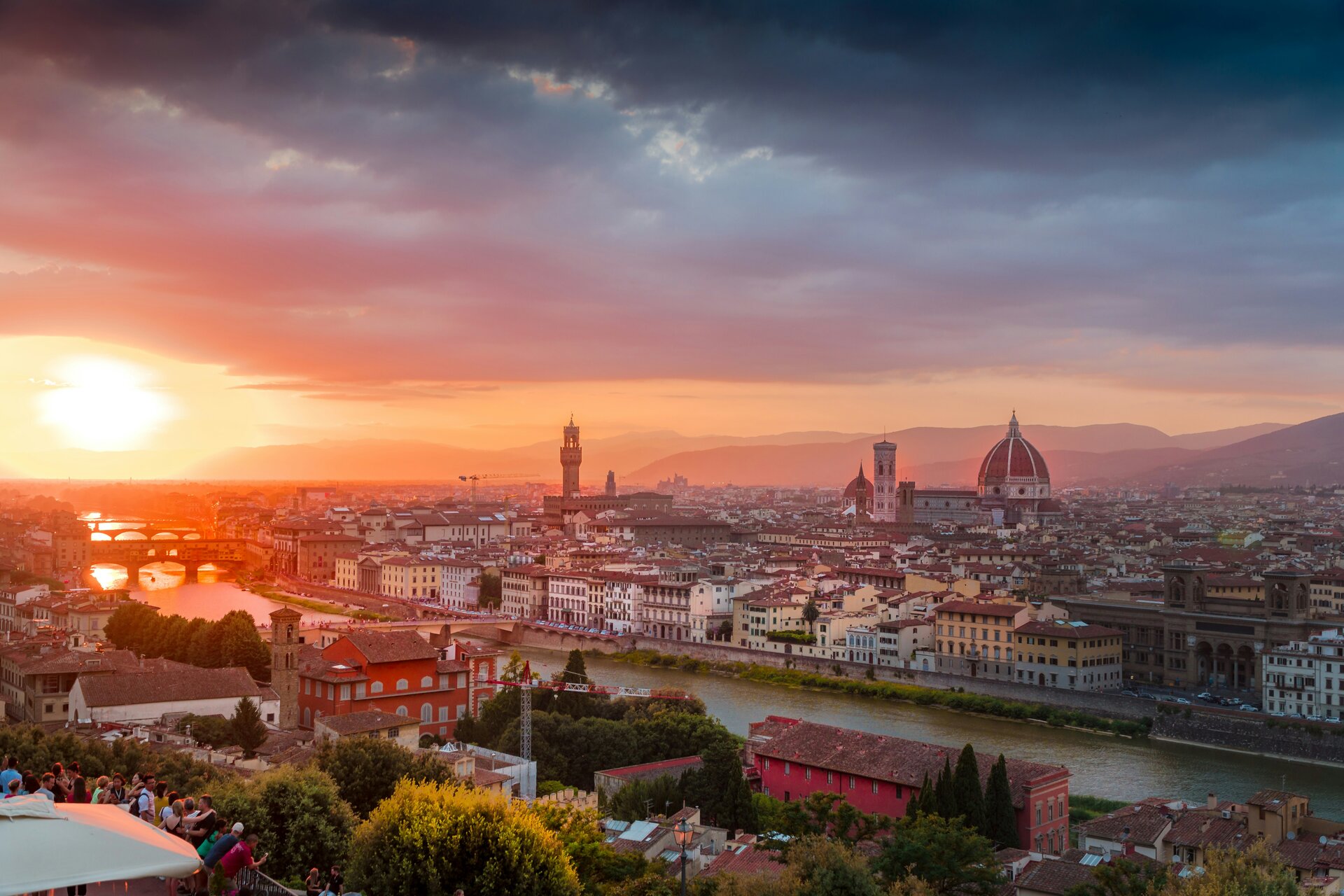
 Florence, Italy
Florence
Photography Conditions
Sunset · Astrophotography · Drone Flight · Pre-loaded for Florence
The definitive Florence viewpoint. The Duomo, Palazzo Vecchio tower, Ponte Vecchio, and the full Arno bend are visible from a single position. At golden hour the Duomo's terracotta dome glows orange against the sky. The piazzale is large enough for multiple compositions. It is popular: arrive 45+ minutes early to find your frame without fighting the crowd. Sunrise from here is substantially quieter.
Check tonight's sunset →A 10-minute walk uphill from Piazzale Michelangelo brings you to the Romanesque church of San Miniato and a terrace 60 m higher with a near-identical view and a fraction of the crowd. The church's white-and-green marble facade catches last light beautifully. The cemetery adjacent to the church has cypress-framed compositions that most tourists never find.
Check San Miniato conditions →The hilltop town above Florence gives a broader perspective than Piazzale: the full city, the Arno valley, and Tuscan hills rolling south to the horizon. The Roman amphitheater terrace and the main Piazza Mino offer multiple framings. Take the No. 7 bus from Santa Maria Novella. Sunset from Fiesole positions the city below with the western sky behind it — the composition is wider and more dramatic than from Piazzale in good light.
Check Fiesole forecast →The classic Tuscany of cypress trees, rolling vineyards, and dark skies. Drive south on the Chiantigiana (SR222) to the ridgelines between Greve and Panzano for open southerly horizons. Milky Way core rises in the south June through August with Tuscan farmhouse silhouettes as foreground. This is one of the most photogenic dark sky landscapes in Italy. Check Starcast before leaving Florence — valley humidity can affect transparency differently at elevation.
Check Chianti tonight →| Location | Distance | Bortle | Best for | |
|---|---|---|---|---|
| Chianti Hills (Greve area) | 25 km south | 4–5 | Tuscan farmhouse foreground, cypress silhouettes | Starcast → |
| Apennine Pass (Passo della Futa) | 40 km north | 3–4 | High elevation, open north and south horizons | Starcast → |
| Maremma Coast | 120 km southwest | 3–4 | Sea horizon, Milky Way core over the Tyrrhenian | Starcast → |
| Crete Senesi | 90 km south | 3 | Premier dark sky in Tuscany, wide open terrain | Starcast → |
- Post-rain clarity produces the most saturated golden hour colors of the year
- Wisteria blooms on the Ponte Vecchio banks in April
- Milky Way returns in April — Chianti hills are accessible on new moon nights
- Crowds manageable before the summer rush
- Sunset at 8:30–9:00 PM — the longest shooting windows of the year
- Arno valley humidity traps haze in the basin: Goldcast scores may look lower than expected on clear days
- Escape to Fiesole or Chianti ridges above the valley floor for cleaner air
- Piazzale Michelangelo crowd peaks in July–August: arrive at 6 PM minimum
- September clarity is exceptional: best Goldcast scores of the year
- Harvest season in the Chianti: vineyards and olive groves for foreground color
- Milky Way window closes by mid-September, shifting focus to golden hour
- October fog fills the Arno valley at dawn for layered city-and-mist compositions
- Golden hour at 4:30 PM — brief but the light raking the Duomo dome is exceptional
- Snow on the hills above Florence is rare but spectacular: check 10-day forecasts in January
- Piazzale Michelangelo almost deserted before 3 PM in winter
- Best star transparency of the year on clear winter nights