StarCast · Badlands, SD

Night Sky Tonight in Badlands

Reading tonight's sky conditions…
/ 100
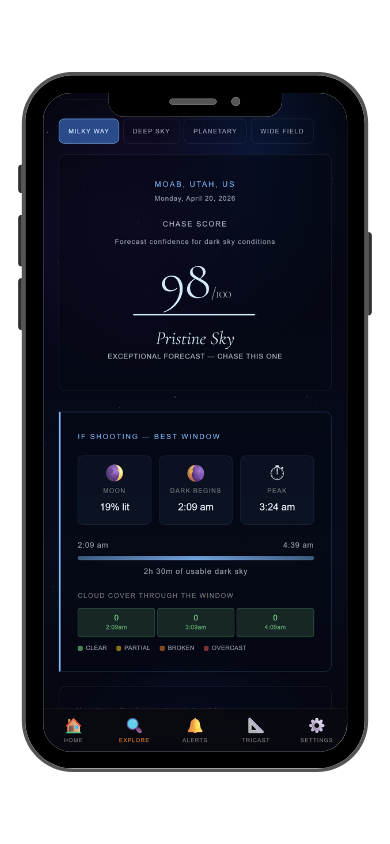
Moon
Dark window
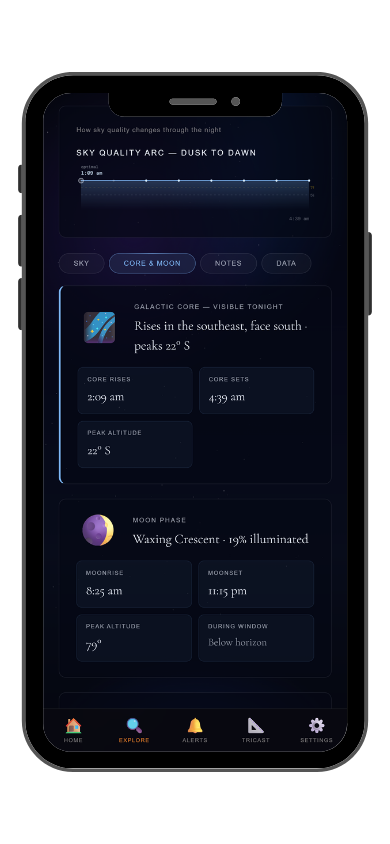
Galactic core
Conditions
Tonight
Bortle class · Badlands
LightCast
Now on iOS
LightCast Suite
Push alerts · 3-day forecast · nearby dark skies

Get notified before clear nights. Set your threshold once and never miss a prime shooting window again.

Download on the App Store
7-day free trial · $2.99/mo · Cancel anytime in App Store
Learn more →

What's in the score
Cloud cover
Moon illumination
Bortle class
Transparency
Humidity

What the app shows you
StarCast galactic core forecast
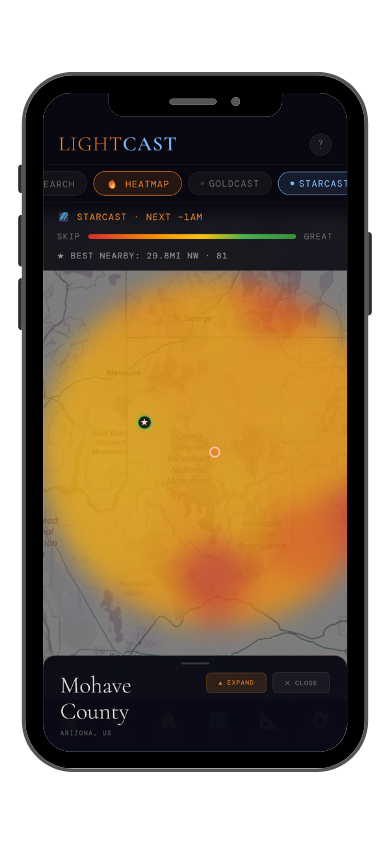
Nearby dark sky locations

Live scores for the night sky, Milky Way Core windows, darker skies nearby, & more
Get LightCast Suite on iOS


Also check for Chicago
GoldCast
Sunset conditions tonight in Zion
Check sunset →

Frequently asked
Is tonight good for stargazing at the Badlands?
The live score above pulls today's forecast and runs it through StarCast's scoring model, factoring in cloud cover, moon illumination, Bortle class, humidity, and atmospheric transparency. Above 70 is an excellent night. Below 40, conditions are poor. The score updates daily.
What makes the Badlands good for astrophotography?
Badlands National Park is a certified International Dark Sky Park in one of the least light-polluted regions of the Great Plains, with Bortle 2 conditions across most of the park. The eroded buttes, spires, and canyons of the White River Badlands create otherworldly foreground compositions under the Milky Way. The park sits at 2,500 to 3,000 feet on the Great Plains with a wide, flat horizon and unobstructed sky in all directions. The Yellow Mounds, Pinnacles Overlook, and the main loop road all give good access to dark sky positions without requiring backcountry permits.
When is the Milky Way visible at the Badlands?
The galactic core is visible from March through October. The Great Plains latitude puts the core lower in the southern sky than Southwest locations, but the completely flat horizon to the south means you can shoot the core as it rises. Summer new moon nights are the primary target. The park campground at Cedar Pass is dark enough for serious astrophotography from the campsite.