Frequently asked
Is tonight good for stargazing at Crater Lake?
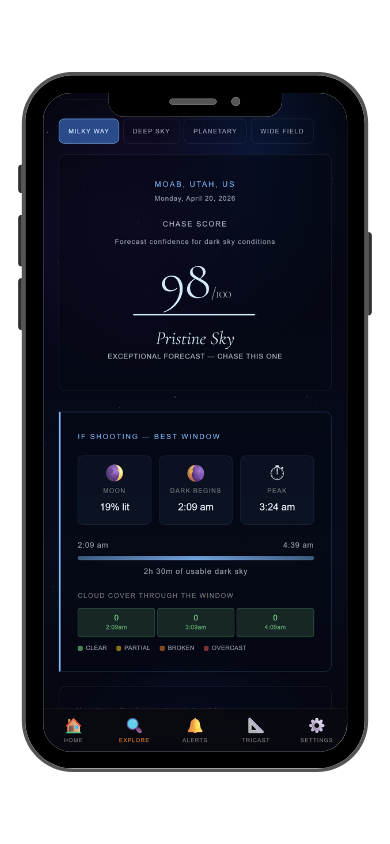
The live score above pulls today's forecast and runs it through StarCast's scoring model, factoring in cloud cover, moon illumination, Bortle class, humidity, and atmospheric transparency. Above 70 is an excellent night. Below 40, conditions are poor. The score updates daily.
What makes Crater Lake good for astrophotography?
Crater Lake is an International Dark Sky Park, sitting at 7,100 feet on the rim of a collapsed volcano in southern Oregon. The lake itself — the deepest in the US at 1,943 feet — is so optically clear it reflects stars and the Milky Way in long exposures, creating mirror-image compositions unique to this location. The rim sits above most atmospheric haze, and the surrounding Cascades isolate the park from significant light pollution. Bortle 2 conditions are achievable on the east and south rim away from the lodge area. The season is compressed due to heavy snowfall — the rim road typically opens in late June.
When is the Milky Way visible at Crater Lake?
The galactic core is visible from approximately June through October at Crater Lake, with the compressed season due to snowpack keeping the rim road closed until late June most years. July and August are peak months, with the core rising over the lake to the south. Cloudcap Overlook and the Watchman give the best southern and western exposures. Clear nights can be exceptional — the combination of lake reflection and dark sky is one of the most photographed night compositions in the Pacific Northwest.