Frequently asked
Is tonight good for stargazing at Marfa?
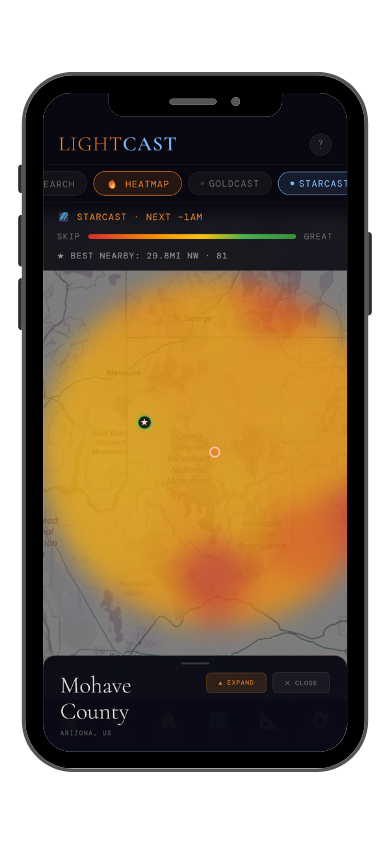
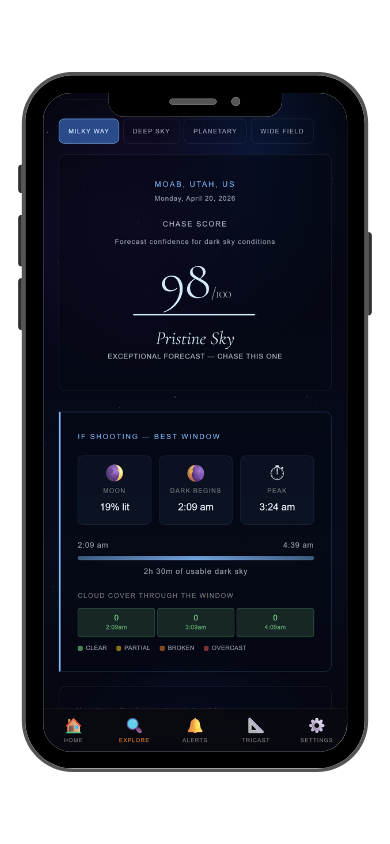
The live score above pulls today's forecast and runs it through StarCast's scoring model, factoring in cloud cover, moon illumination, Bortle class, humidity, and atmospheric transparency. Above 70 is an excellent night. Below 40, conditions are poor. The score updates daily.
What makes Marfa good for astrophotography?
Marfa sits at 4,700 feet on the Trans-Pecos high desert, one of the darkest inhabited regions in the lower 48. The surrounding Chihuahuan Desert has Bortle 1 conditions within a short drive, and the town itself has minimal light pollution by US small-town standards. The flat desert horizon gives unobstructed views in all directions. The Marfa Lights Viewing Area on Highway 90 is a well-known dark sky spot, and the McDonald Observatory — the nearest major professional observatory — is 90 minutes east, confirming how seriously dark this region is.
When is the Milky Way visible at Marfa?
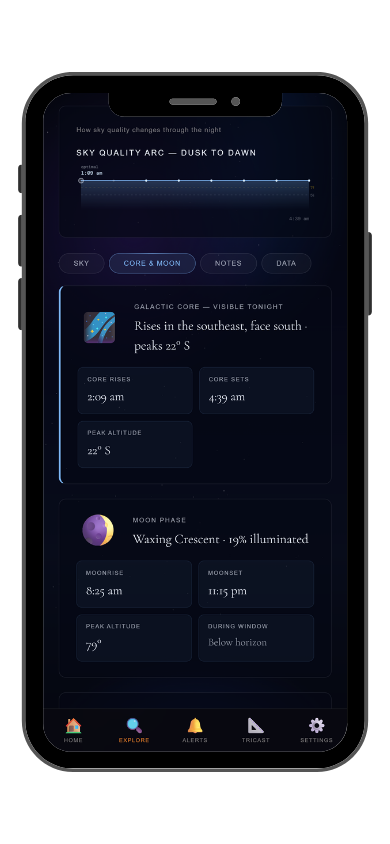
The galactic core is visible from March through October. The Trans-Pecos region sits at a latitude where the galactic center rises high in the south during summer, making June through August the peak window. The dry desert air and consistently low humidity mean transparency is excellent most nights outside monsoon season, which brings afternoon thunderstorms but often clears by midnight.