Frequently asked
Is tonight good for stargazing near Tucson?
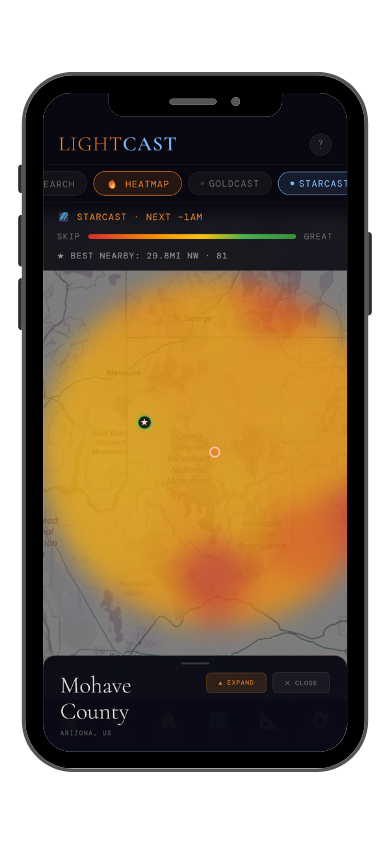
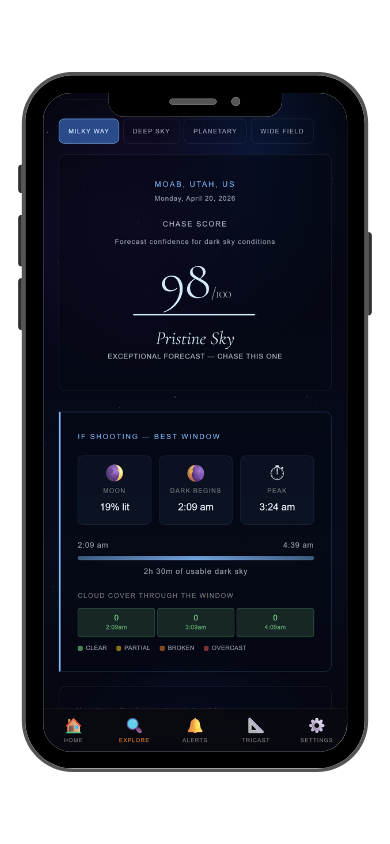
The live score above pulls today's forecast and runs it through StarCast's scoring model, factoring in cloud cover, moon illumination, Bortle class, humidity, and atmospheric transparency. Above 70 is an excellent night. Below 40, conditions are poor. The score updates daily.
What makes Tucson good for astrophotography?
Tucson has some of the strongest dark sky protection ordinances of any US city, adopted specifically to protect the observatory corridor on Mount Lemmon and Kitt Peak. The city uses fully shielded, low-color-temperature streetlighting, which measurably reduces sky glow compared to most cities its size. Kitt Peak National Observatory sits 56 miles southwest at 6,875 feet with Bortle 2 conditions. Saguaro National Park on both sides of the city offers Bortle 3 to 4 skies with saguaro cactus foregrounds, one of the most iconic Arizona compositions for Milky Way photography.
When is the Milky Way visible near Tucson?
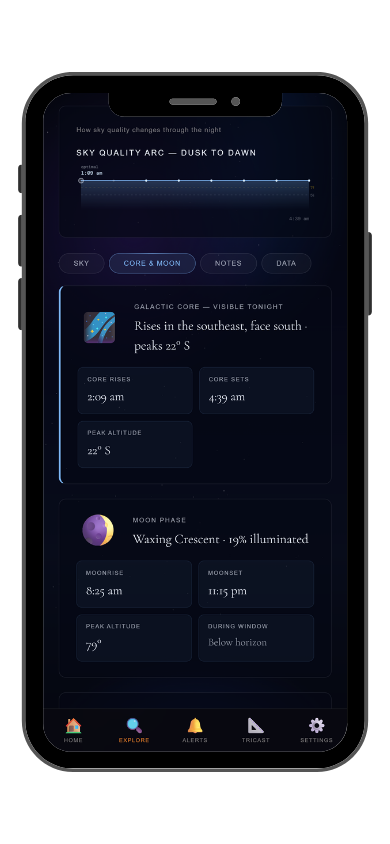
The galactic core is visible from March through October. Tucson's southern latitude (32°N) means the core rises higher in the sky than at most US locations, improving contrast and detail in long exposures. The summer monsoon season (July through September) brings afternoon and evening thunderstorms but often clears overnight, producing exceptionally transparent air after storms pass.