Frequently asked
Is tonight good for stargazing at White Sands?
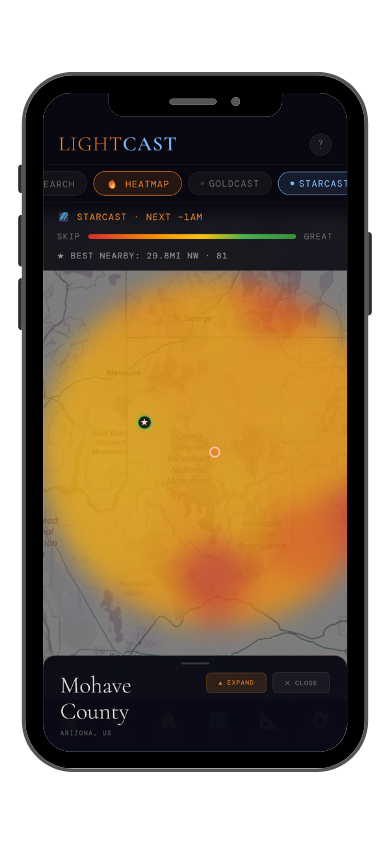
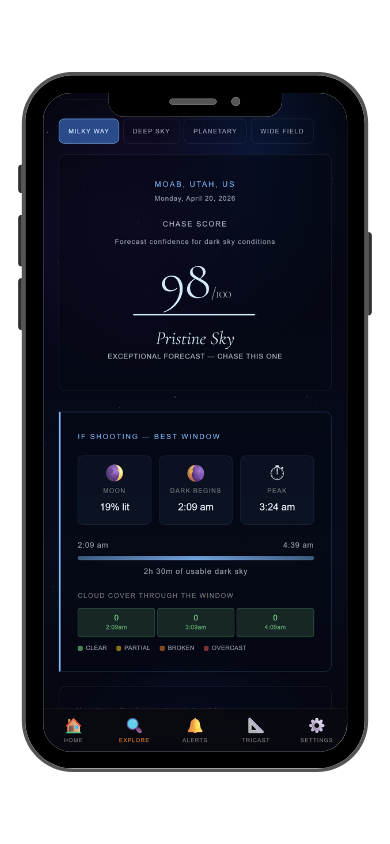
The live score above pulls today's forecast and runs it through StarCast's scoring model, factoring in cloud cover, moon illumination, Bortle class, humidity, and atmospheric transparency. Above 70 is an excellent night. Below 40, conditions are poor. The score updates daily.
What makes White Sands good for astrophotography?
White Sands National Park sits in the Tularosa Basin at 4,000 feet, surrounded by mountain ranges that block distant light pollution in most directions. The gypsum dunes are brilliant white and reflect starlight and moonlight in a way no other landscape does — even under a thin crescent moon, the dunes glow faintly. On a true dark night, the Milky Way reflects off the white sand in long exposures. The park is an International Dark Sky Park with Bortle 2 to 3 conditions. The flat, open basin gives unobstructed 360-degree sky views.
When is the Milky Way visible at White Sands?
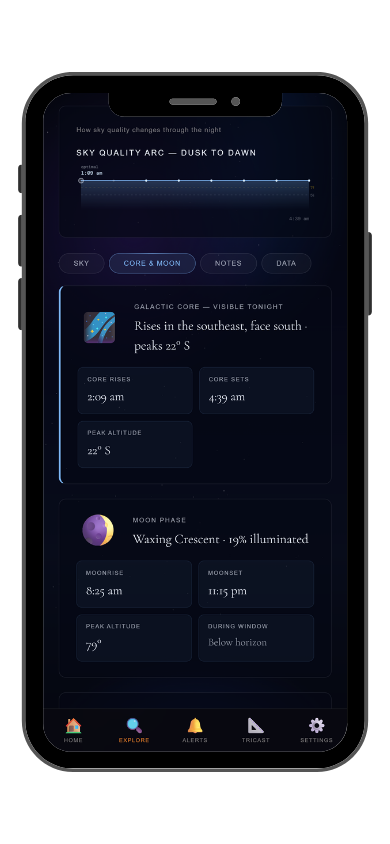
The galactic core is visible from March through October. The park holds special full moon nights for hiking, but new moon nights are the target for astrophotography. The dune field interior, reached via Alkali Flat Trail, gives the most isolated dark sky experience. Access is limited to park hours — check NPS schedules for evening programs that extend access after dark.