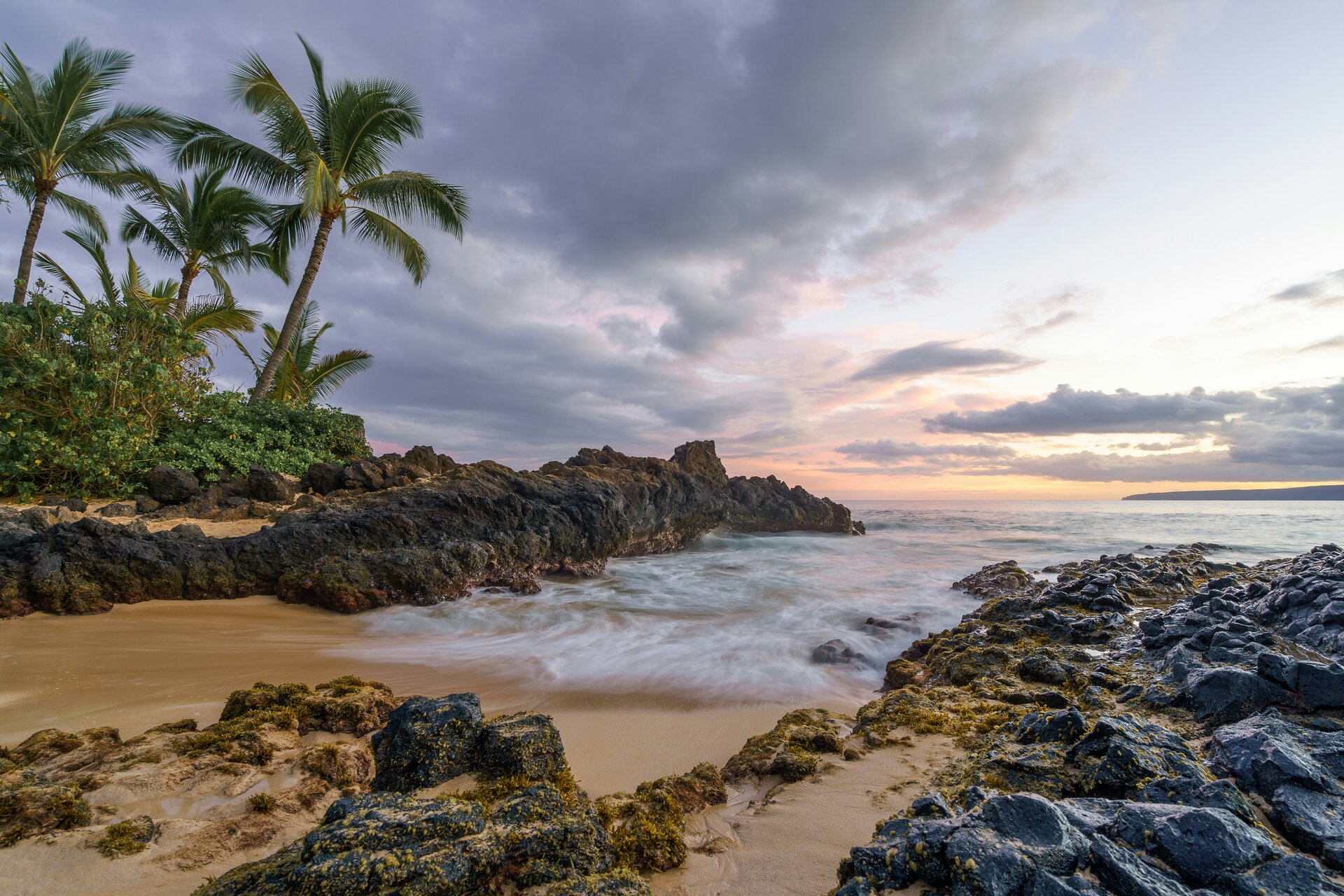
 Maui, Hawaii
Maui
Photography Conditions
Sunset · Astrophotography · Drone Flight · Pre-loaded for Maui
One of the most famous sunrise spots on earth. The volcanic crater rim at 10,023 feet sits above the cloud layer most mornings, giving you a view of the sun rising over a sea of clouds stretching to the horizon. At night, Haleakala is Bortle 1-2: among the darkest accessible skies in the United States. The summit requires a timed entry reservation between 3 AM and 7 AM. Temperatures at the summit can drop below freezing year-round — dress in layers regardless of the beach weather below.
Check Haleakala sunrise →Black volcanic sand beach, sea arches, blowholes, and dramatic basalt coastline facing east into first light. The black sand and green naupaka contrast with turquoise water for bold color compositions at sunrise. The sea arch framing the rising sun is one of the most iconic Maui shots. A reservation is also required for entry here — book through the Hawaii DLNR system. Arrive right at park opening to get the best light before the beach fills up.
Check sunrise forecast →The west coast of Maui faces directly into the sunset over the Pacific, with the islands of Molokai and Lanai sitting on the horizon as mid-ground elements at golden hour. Kapalua Bay and the Kapalua Coastal Trail give clean west-facing compositions. The Dragon's Teeth lava formation at Makaluapuna Point is a strong foreground for wide-angle sunset work. The calm of the leeward coast also means gentler surf for long exposures compared to the north and east shores.
Check tonight's sunset →The area around the Visitor Center at 6,800 feet doesn't require the sunrise reservation. At this elevation you're often at or just above the marine layer, giving layered cloud and light compositions without the 3 AM drive to the summit. The Leleiwi Overlook at 8,800 feet is another no-reservation option with crater views. These mid-elevation locations are the right call if you missed a summit reservation or want a less crowded experience.
Check Haleakala forecast →| Location | Distance | Bortle | Best for | |
|---|---|---|---|---|
| Haleakala Summit (10,023 ft) | On island | 1–2 | Milky Way, above marine layer, volcanic crater | Starcast → |
| Mauna Kea Summit (Big Island) | Flight or ferry + drive | 1 | Best seeing in the Northern Hemisphere | Starcast → |
| Upcountry Maui (3,000–4,000 ft) | On island · 45 min | 3–4 | Accessible dark sky without summit drive | Starcast → |
| East Maui / Hana coast | On island · 2.5 hr | 2–3 | Remote coastline, minimal light pollution | Starcast → |
- Humpback whale season peaks January through March — whale breaches at golden hour on the west coast
- North shore surf is at its largest: Jaws (Peahi) breaks produce dramatic wave photography
- Summit temperatures at Haleakala can drop to 20°F — dress for near-freezing conditions
- Milky Way core below the horizon — summit shoots focus on star trails and the zodiacal light
- Galactic core rises in March — first viable Milky Way nights of the year from Haleakala
- Late whale season through March: overlapping Milky Way and whale opportunity in the same trip
- Drier conditions on the west coast, more variable on the east and north shores
- Silversword plants on the Haleakala crater floor bloom sporadically — a rare foreground subject
- Galactic core highest and most prominent in the sky — best Milky Way window of the year
- Trade winds keep the summit clear more consistently than winter months
- West coast sunsets are long and warm with the most stable marine layer of the year
- Summer is Maui's busiest tourist season — Haleakala reservations sell out furthest in advance
- Milky Way core visible through October before dropping below the horizon
- Fewer tourists than summer: Haleakala reservations easier to secure
- Transition to wetter north and east shore conditions as trade winds shift
- West coast sunset conditions remain excellent through November
