 Stockholm, Sweden
Stockholm
Photography Conditions
Sunset · Astrophotography · Drone Flight · Pre-loaded for Stockholm
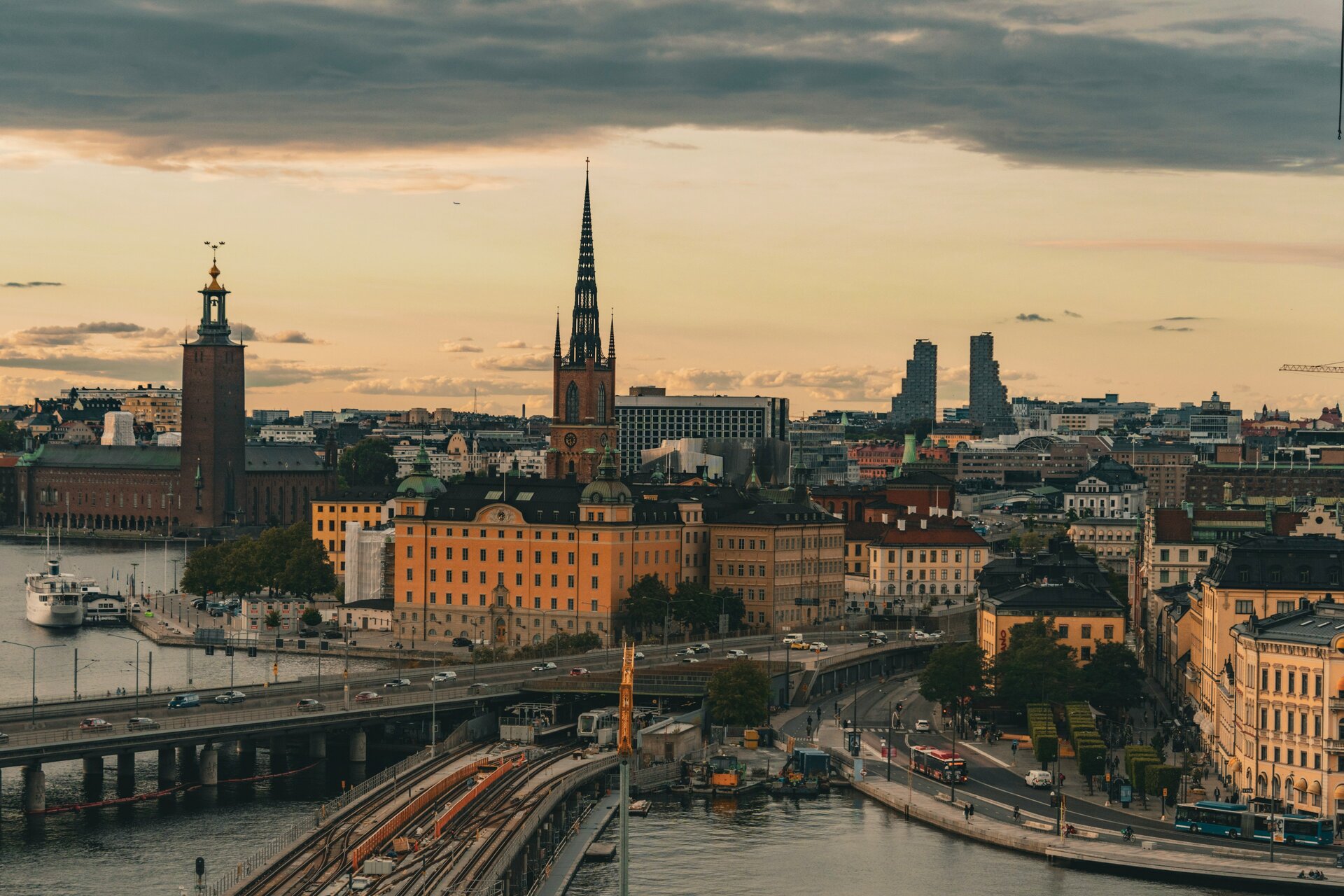
The most famous photography viewpoint in Stockholm. The cliff-top path along Södermalm faces north across the Riddarfjärden waterway toward Gamla Stan's distinctive coloured facades, the Riddarholmen church spire, and City Hall's golden crown tower. At sunset the western sky lights the water and the church spires from the side. The path is fully open and accessible — no elevation gain beyond reaching Södermalm itself. Arrive 30 minutes before golden hour to secure a clear position; it is popular year-round.
Check tonight's sunset →The eastern edge of Södermalm gives a broader city panorama than Monteliusvägen — the full spread from Djurgården in the east to the City Hall in the west, with the archipelago visible on clear days beyond. Fjällgatan street itself runs along the cliff with multiple open platforms. At sunrise, the first light comes from behind the viewer (east) and illuminates the Gamla Stan facades and the church spires across the water. Less crowded than Monteliusvägen, especially in the early morning.
Check Fjällgatan forecast →The quiet inlet waterway on Djurgården between the Vasa Museum and the Djurgårdsbrunn canal gives long waterway reflection shots with the wooded island banks as context. In winter the waterway sometimes freezes — ice skaters on the canal at blue hour with snow-dusted trees is one of Stockholm's most intimate winter photography conditions. The Rosendal Gardens and the Liljevalchs art gallery add architecture along the water. Best in early morning before Djurgården fills with visitors.
Check Djurgården conditions →The Stockholm archipelago extends 80 km east into the Baltic with over 30,000 islands. The outer archipelago (Sandhamn, Landsort, Utö) gives Bortle 4–5 skies with open Baltic horizon. Milky Way core is visible April through September from the outer islands on new moon nights. Waxholmsbolaget ferries run from Strömkajen in the city centre — outer island ferries take 2–4 hours. The rocky Swedish granite coastline gives exceptional foreground for wide-angle Milky Way shots facing south over the Baltic.
Check archipelago tonight →| Location | Distance | Bortle | Best for | |
|---|---|---|---|---|
| Outer Archipelago (Sandhamn) | 50 km east | 4–5 | Baltic horizon, granite coast foreground | Starcast → |
| Landsort (southernmost island) | 80 km southeast | 3–4 | Open Baltic, lighthouse foreground | Starcast → |
| Dalarna (Siljan lake area) | 270 km northwest | 3 | Swedish lake dark sky, red cottages foreground | Starcast → |
| Abisko (northern Sweden) | 1,200 km north | 1–2 | World-class aurora and dark sky, midnight sun in summer | Starcast → |
- April and May: the best all-round window — long evenings, spring colour on the islands, clear continental air
- May Day (Valborg) bonfires around Lake Mälaren give a unique fire-and-twilight photography window
- Milky Way visible in April and May before midnight sun eliminates dark sky in June
- By late June the sun barely sets — golden twilight from 9 PM to 2 AM is extraordinary but dark sky is gone
- The sun never reaches astronomical darkness mid-May through late July — no astrophotography possible
- Golden twilight light persists all night near the solstice: shooting at 1 AM is viable
- Archipelago by kayak or ferry: the outer islands are at their most accessible in summer
- Midsommar (late June): traditional midsummer celebrations across the archipelago islands are photogenic
- September: dark sky returns after summer — first viable Milky Way and aurora nights of the season
- October foliage in the Djurgården park and across the city islands: Swedish autumn colour is vivid and abrupt
- Cold Baltic air in October brings exceptional transparency — Goldcast scores spike after fronts clear
- Archipelago boats still running through September: last chance for outer island astrophotography trips
- Golden hour arrives around 2:45 PM in December — the sun barely clears the southern horizon all day
- Snow on Gamla Stan, the City Hall, and the frozen Lake Mälaren transforms the city completely
- Christmas markets on Stortorget (Old Town) and Skansen through December: warm market light at blue hour
- Strong aurora events (KP 4–5+) are occasionally visible from the outer archipelago on clear winter nights