Frequently asked
Is tonight good for stargazing at Abisko?
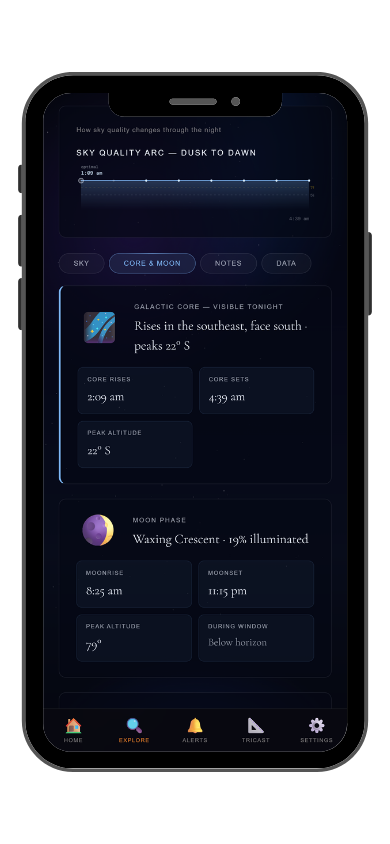
The live score above pulls today's forecast and runs it through StarCast's scoring model, factoring in cloud cover, moon illumination, Bortle class, humidity, and atmospheric transparency. Above 70 is an excellent night. Below 40, conditions are poor. The score updates daily.
What makes Abisko good for astrophotography?
Abisko National Park in Swedish Lapland is widely regarded as one of the most reliable aurora photography destinations in the world. The park sits in a microclimate created by Lake Torneträsk: the surrounding mountains deflect incoming weather systems, producing a clear sky window known locally as the 'blue hole of Abisko' that keeps the area cloud-free far more often than the surrounding region. The Aurora Sky Station cable car reaches 900 meters above the lake for an elevated view above any valley fog. The park is within the auroral oval and sees major geomagnetic events frequently from September through March.
When is the Milky Way visible at Abisko?
The Milky Way galactic core is not a practical target at Abisko's latitude of 68 degrees north: the core stays below the southern horizon during the dark months. Astronomical darkness returns in late August after the midnight sun, and aurora season runs through early April. The primary draw is the northern lights, not the galactic core. September through March offers the longest and most productive aurora windows. The STF Abisko Turiststation and the Aurora Sky Station are the main bases for night photography.