Frequently asked
Is tonight good for stargazing in the Adirondacks?
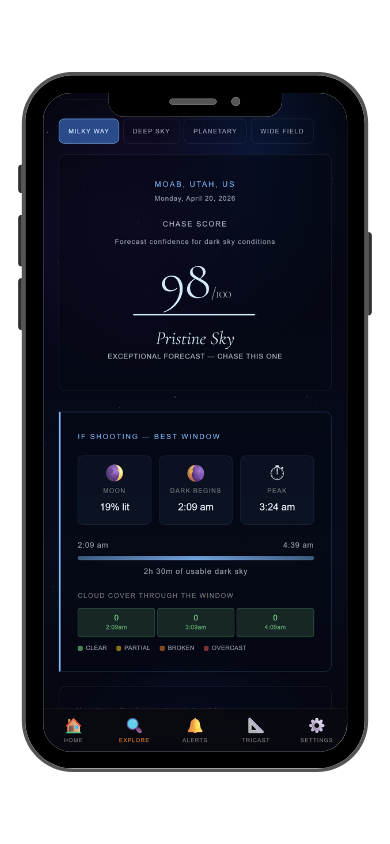
The live score above pulls today's forecast and runs it through StarCast's scoring model, factoring in cloud cover, moon illumination, Bortle class, humidity, and atmospheric transparency. Above 70 is an excellent night. Below 40, conditions are poor. The score updates daily.
What makes the Adirondacks good for astrophotography?
The Adirondack Park covers 6.1 million acres in northern New York, the largest protected area in the contiguous United States outside Alaska, roughly the size of Vermont. The park's interior reaches Bortle Class 2 to 3 conditions, among the darkest accessible skies in the northeastern US. The thousands of lakes and ponds within the park, including Upper Saranac, Long Lake, and the Fulton Chain, provide open water reflections for foreground photography. The Adirondack Sky Center in Tupper Lake is the region's primary astronomy hub and hosts an annual astrophotography conference in September. The mix of mountain peaks, open water, and boreal forest creates compositional variety that few eastern dark sky destinations can match.
When is the Milky Way visible in the Adirondacks?
The galactic core is visible from April through October, with July and August the clearest window. The Adirondacks can be cloudy, particularly in spring and early summer, so checking the forecast before heading into the backcountry matters. Bug season through July is significant in the lake regions. Fall, from September through October, often delivers the clearest skies, comfortable temperatures, and foliage that adds color to foreground compositions.