Frequently asked
Is tonight good for stargazing in Alamogordo?
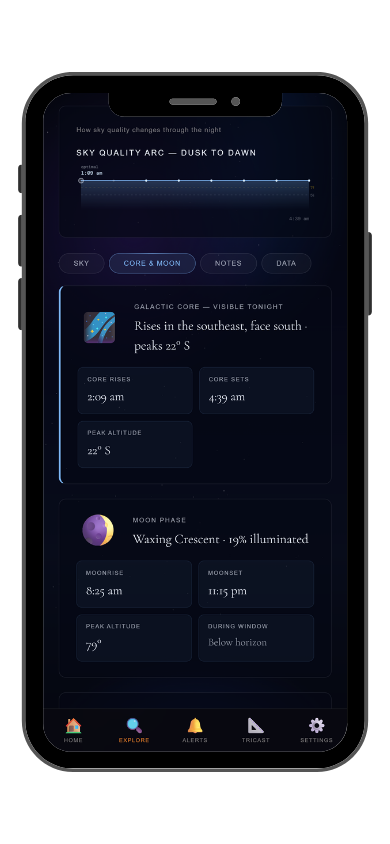
The live score above pulls today's forecast and runs it through StarCast's scoring model, factoring in cloud cover, moon illumination, Bortle class, humidity, and atmospheric transparency. Above 70 is an excellent night for astrophotography. Below 40, conditions are poor. The score updates daily.
What makes Alamogordo good for astrophotography?
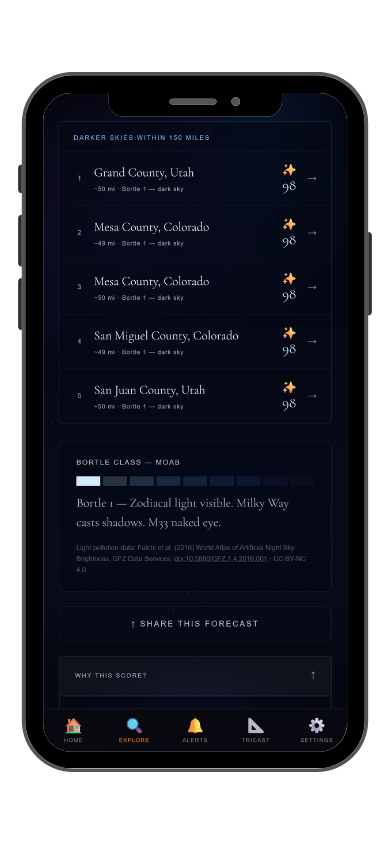
Alamogordo sits at 4,300 feet in the Tularosa Basin of southern New Mexico, flanked by the Sacramento Mountains to the east and the gypsum dunes of White Sands National Park to the west. White Sands is one of the most striking and singular Milky Way foregrounds in the United States — the luminous white gypsum dunes glow faintly under starlight, creating a lunar-landscape aesthetic unique in North American astrophotography. The park is an International Dark Sky Park, and its location between the mountains and the desert isolates it from any significant light pollution. Oliver Lee Memorial State Park and the upper slopes of Sierra Blanca (elevation 11,981 feet) are other nearby dark sky options. Alamogordo's arid desert climate produces very high annual clear-night frequency.
When is the Milky Way visible near Alamogordo?
The galactic core is visible from late February through early November at Alamogordo's southern latitude. White Sands National Park allows limited access for night photography, and the park hosts dedicated dark sky events that permit tripod use after hours — check the park's schedule for current night photography programs. Prime season runs April through September, with the core reaching its highest southern altitude in late June and July. Monsoon moisture in July through September can bring afternoon and evening clouds, but desert nights often clear after midnight. New moon windows in May and June, before monsoon onset, are particularly reliable for Milky Way photography over the white dunes.