Frequently asked
Is tonight good for stargazing in Alpine, Texas?
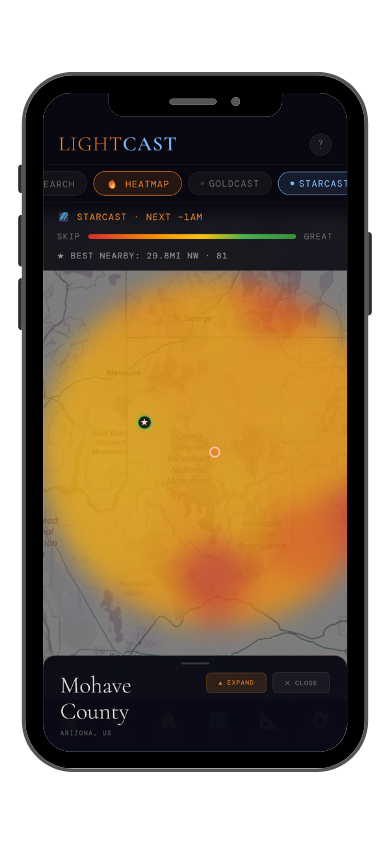
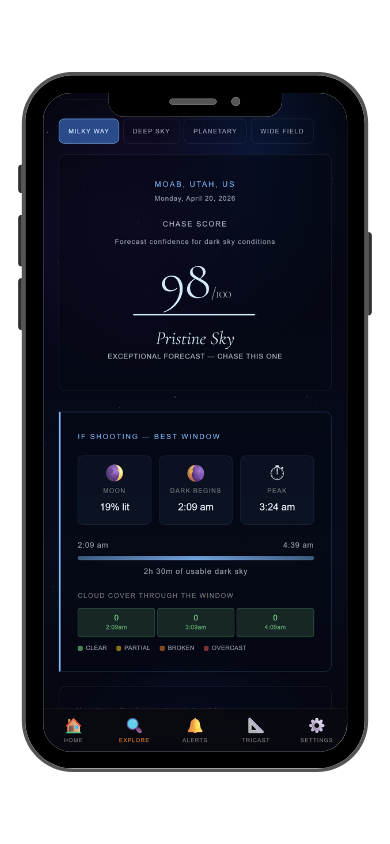
The live score above pulls today's forecast and runs it through StarCast's scoring model, factoring in cloud cover, moon illumination, Bortle class, humidity, and atmospheric transparency. Above 70 is an excellent night for astrophotography. Below 40, conditions are poor. The score updates daily.
What makes Alpine good for astrophotography?
Alpine sits at about 4,475 feet in the Trans-Pecos region of West Texas, at the southern edge of the Davis Mountains. Just north lies McDonald Observatory, one of the world's premier research observatories, built here specifically because of how consistently dark and clear the air stays. The surrounding ranchland has minimal light pollution, and the combination of high elevation and low humidity produces excellent atmospheric transparency for both wide field and telescope work. Sul Ross State University's Big Bend country setting also gives photographers rolling grassland and mountain silhouettes as low, unobstructed foregrounds.
When is the Milky Way visible near Alpine?
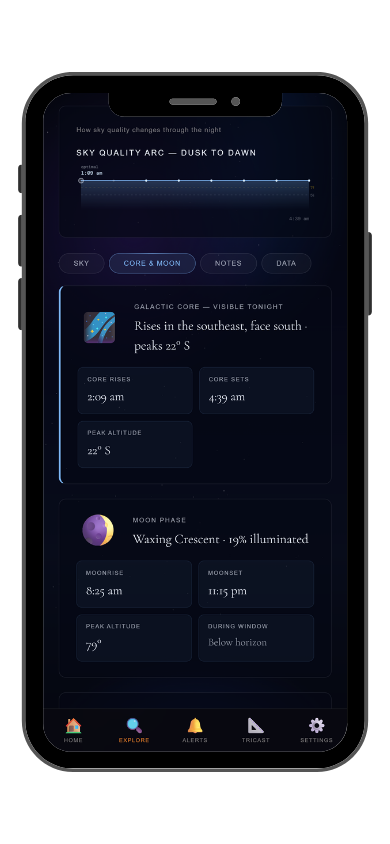
The core is visible from late February through October at this latitude. April through June is the prime window, when skies are driest and clearest before the July and August monsoon season brings afternoon cloud buildup. McDonald Observatory runs public star parties through most of the year, which is a reliable signal of how consistently clear and dark conditions stay around Alpine.