Frequently asked
Is tonight good for stargazing at Amistad NRA?
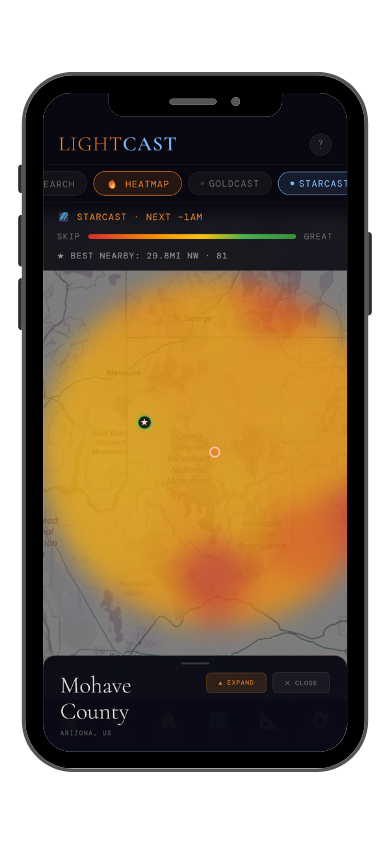
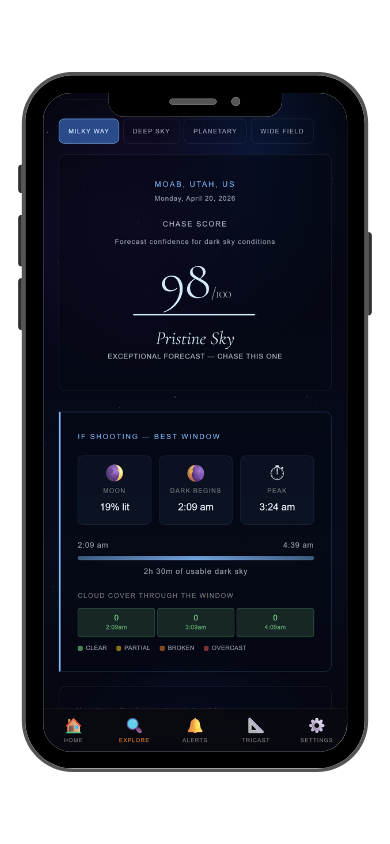
The live score above pulls today's forecast and runs it through StarCast's scoring model, factoring in cloud cover, moon illumination, Bortle class, humidity, and atmospheric transparency. Above 70 is an excellent night. Below 40, conditions are poor. The score updates daily.
What makes Amistad NRA good for astrophotography?
Amistad National Recreation Area sits on the US-Mexico border near Del Rio, Texas, in the western edge of the Texas Hill Country where it meets the Chihuahuan Desert. The reservoir created by Amistad Dam on the Rio Grande covers roughly 67,000 acres and provides open water foreground in a region of genuinely dark skies. The surrounding Trans-Pecos landscape is part of the Greater Big Bend International Dark Sky Reserve zone and sees Bortle Class 2 conditions. Del Rio is small enough to contribute minimal horizon glow. The combination of large open water, desert canyon geology, and dark sky conditions is rare for the region. There is virtually no competing astrophotography content for this location, making original images from here distinctive.
When is the Milky Way visible at Amistad?
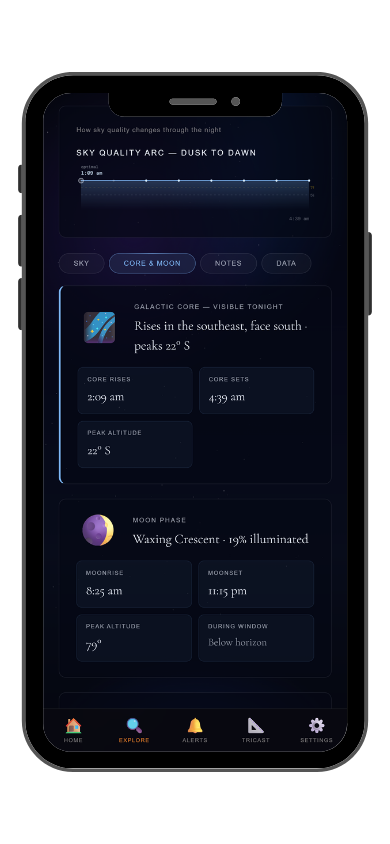
The galactic core is visible from March through October, with summer peak. The low latitude relative to most US dark sky sites means the galactic center rises high in the southern sky. The area receives relatively low annual rainfall and has a semi-arid climate, keeping cloud cover and humidity low on most nights outside storm systems. Water access around the reservoir provides multiple composition options throughout the season.