Frequently asked
Is tonight good for stargazing at Antelope Wells?
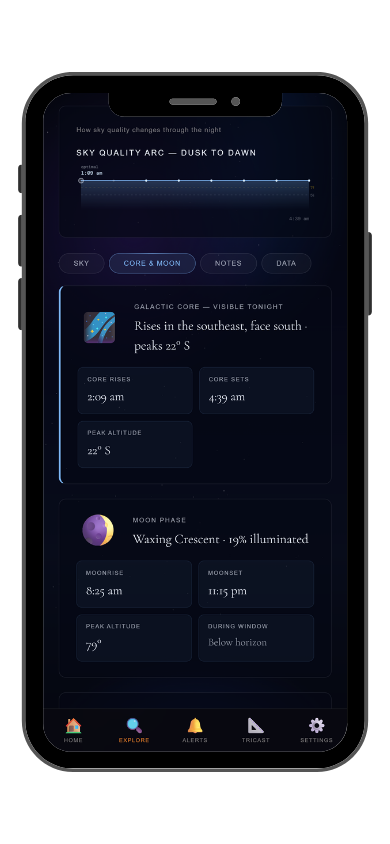
The live score above pulls today's forecast and runs it through StarCast's scoring model, factoring in cloud cover, moon illumination, Bortle class, humidity, and atmospheric transparency. Above 70 is an excellent night. Below 40, conditions are poor. The score updates daily.
What makes Antelope Wells good for astrophotography?
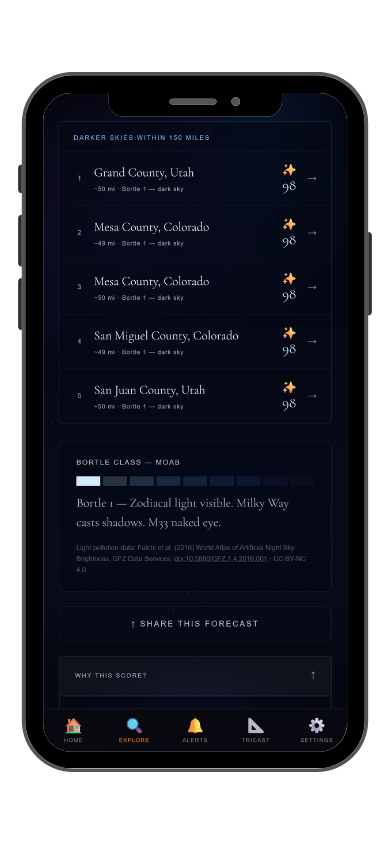
Antelope Wells is a remote port of entry on the US-Mexico border in the Bootheel region of southwestern New Mexico, one of the most sparsely populated areas in the lower 48. The nearest city of any size is more than an hour away. The high desert Chihuahuan landscape sits at approximately 4,500 feet, and the surrounding region produces Bortle Class 1 conditions on moonless nights. The flat, open terrain extends for miles in every direction, giving an unobstructed 360-degree horizon. The southern latitude relative to most US dark sky sites means the galactic center rises slightly higher here, producing stronger compositions. This is not a destination with infrastructure: it requires a high-clearance vehicle and preparation.
When is the Milky Way visible at Antelope Wells?
The galactic core is visible from March through October, with the peak running from May through August. The Chihuahuan Desert's low humidity keeps atmospheric transparency high outside the summer monsoon season, which typically runs from July through early September. Nights outside monsoon season are among the most reliably clear in the country. This is one of the best latitudes in the US for getting the galactic center high in the southern sky.