Frequently asked
Is tonight good for stargazing at Anza-Borrego?
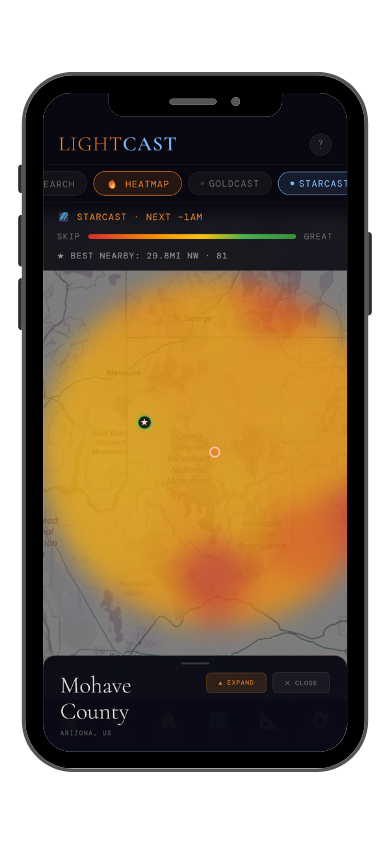
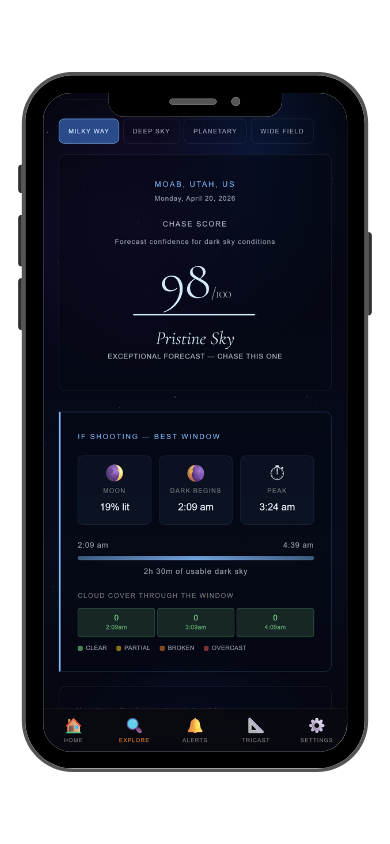
The live score above pulls today's forecast and runs it through StarCast's scoring model, factoring in cloud cover, moon illumination, Bortle class, humidity, and atmospheric transparency. Above 70 is an excellent night. Below 40, conditions are poor. The score updates daily.
What makes Anza-Borrego good for astrophotography?
Anza-Borrego Desert State Park is California's largest state park, covering roughly 600,000 acres of the Colorado Desert in San Diego County, about two hours from both Los Angeles and San Diego. It holds an International Dark Sky Park designation and reaches Bortle Class 2 conditions across most of its interior. The community of Borrego Springs at the park's center is one of only a handful of certified International Dark Sky Communities in the world, and local lighting ordinances protect the surrounding skies. The open desert floor, dramatic canyon walls, slot canyons, and desert wildflower blooms in spring all provide compelling foreground options. This is one of the closest Bortle Class 2 locations to tens of millions of Southern California residents.
When is the Milky Way visible at Anza-Borrego?
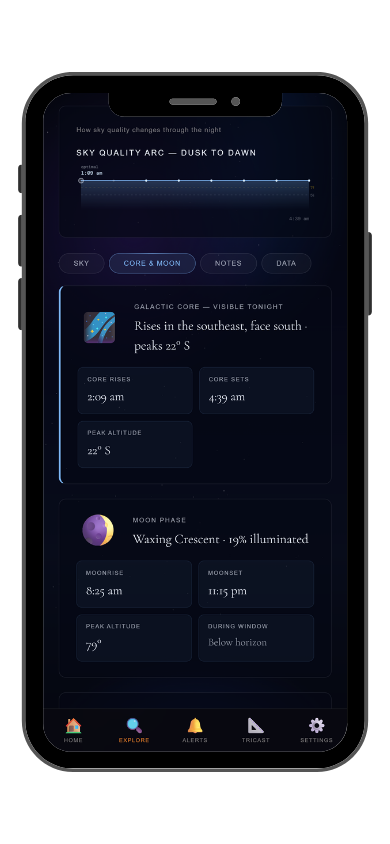
The galactic core is visible from March through October, with the best shooting conditions from May through August. The desert climate is one of the driest in California, which keeps humidity and cloud cover minimal most of the year. Summer temperatures can exceed 110°F, so night shooting is the practical approach in any season. Spring offers the double reward of wildflower blooms paired with galactic core visibility, a combination that draws large crowds during peak bloom years.