Frequently asked
Is tonight good for stargazing at Arthur's Pass?
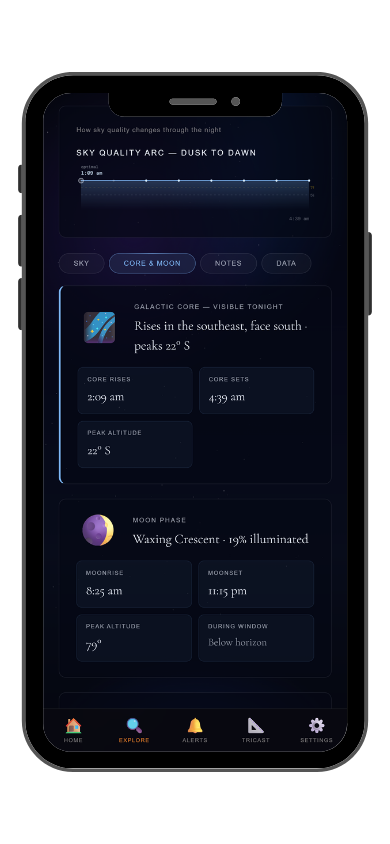
The live score above pulls today's forecast and runs it through StarCast's scoring model, factoring in cloud cover, moon illumination, Bortle class, humidity, and atmospheric transparency. Above 70 is an excellent night. Below 40, conditions are poor. The score updates daily.
What makes Arthur's Pass good for astrophotography?
Arthur's Pass National Park straddles the Southern Alps at 920 meters, midway between Christchurch and the West Coast. The village is small with minimal lighting, and the mountain terrain on all sides blocks regional light effectively. Christchurch is 150 kilometers to the east and produces a glow on the horizon, but the passes and ridgelines above the village are largely clear of it. The alpine landscape of beech forest, schist rock, and high passes gives photographers a New Zealand mountain foreground that differs considerably from the Mackenzie Basin locations to the south. The Otira Gorge and Devil's Punchbowl area are accessible shooting positions close to the village.
When is the Milky Way visible at Arthur's Pass?
The galactic core is visible from February through October. The pass sits in a rain-shadow zone on the eastern side of the divide, which gives it more clear nights than the West Coast side. June and July bring the longest nights and the core high overhead, though mountain snow can limit access to upper terrain. Autumn is a reliable window: March through May tends to be settled, with the core rising early in the evening. The Transalpine train from Christchurch reaches the village, making it accessible without a car if needed.