Frequently asked
Is tonight good for stargazing near Asheville?
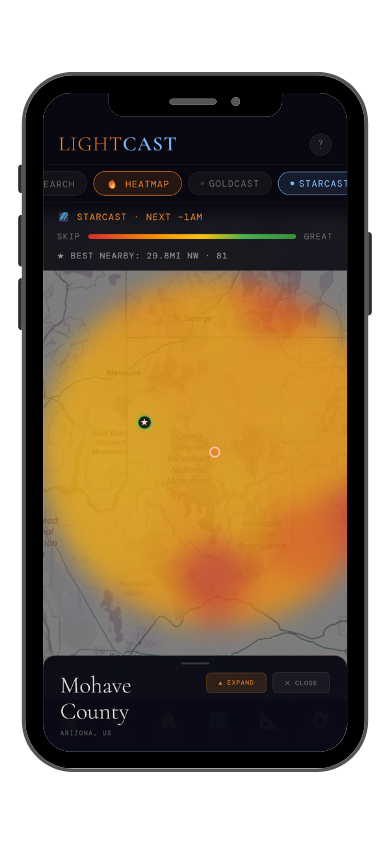
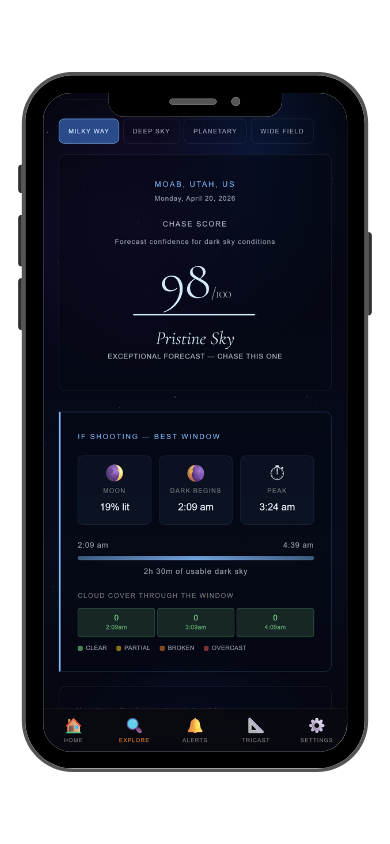
The live score above pulls today's forecast and runs it through StarCast's scoring model, factoring in cloud cover, moon illumination, Bortle class, humidity, and atmospheric transparency. Above 70 is an excellent night. Below 40, conditions are poor. The score updates daily.
What makes the Asheville area good for astrophotography?
Asheville sits at 2,134 feet in the Blue Ridge Mountains, surrounded by the largest expanse of national forest in the eastern US. While Asheville itself creates a light dome, the surrounding Blue Ridge Parkway and Pisgah and Nantahala national forests provide accessible Bortle Class 3 to 4 skies within a 30-minute drive in multiple directions. The Blue Ridge Parkway pullouts offer ridge-line positions above the valley fog that frequently rolls in below, which itself becomes a foreground element in long exposures. Max Patch, a bald summit at 4,629 feet with 360-degree views, is the most popular astrophotography location in the region. The southern Appalachian landscape of mixed forest, open balds, and mountain ridges provides foreground variety that few eastern dark sky areas can match.
When is the Milky Way visible near Asheville?
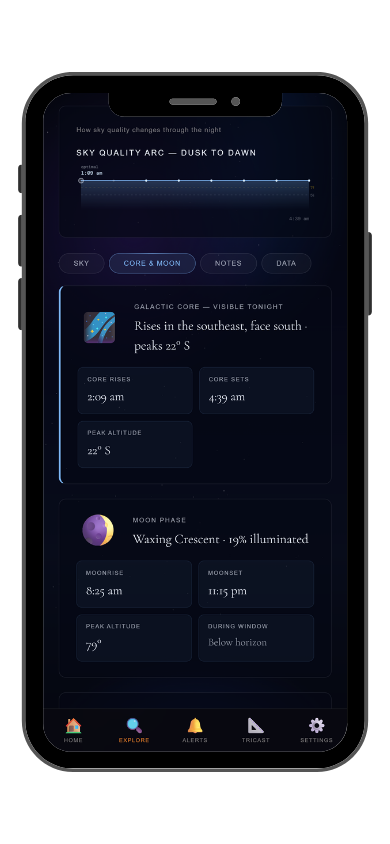
The galactic core is visible from April through October, with June through August the peak window. The southern Appalachians can see significant cloud cover, particularly in summer, so checking the forecast before driving to higher elevation shooting spots is important. Fall delivers the clearest and driest conditions of the year and coincides with peak foliage, making October a favorite month for photographers in this region.