Frequently asked
Is tonight good for stargazing at Banff National Park?
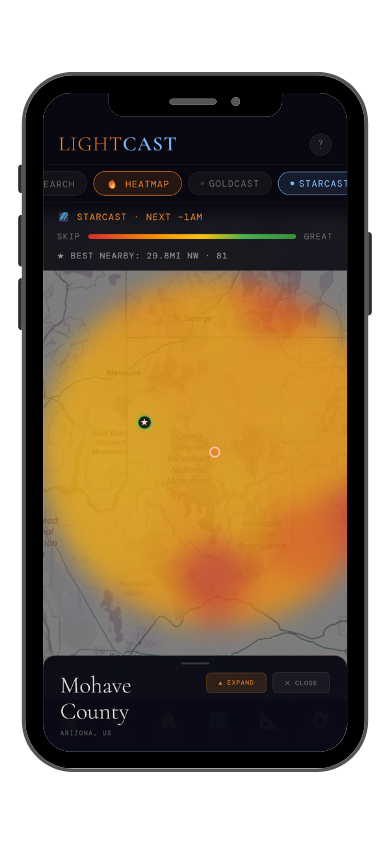
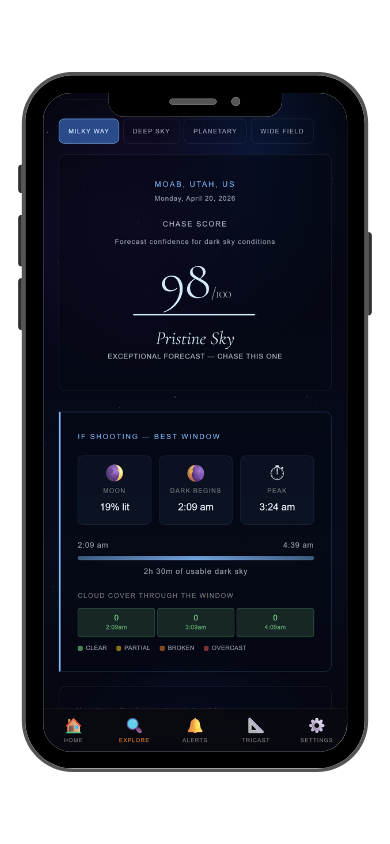
The live score above pulls today's forecast and runs it through StarCast's scoring model, factoring in cloud cover, moon illumination, Bortle class, humidity, and atmospheric transparency. Above 70 is an excellent night. Below 40, conditions are poor. The score updates daily.
What makes Banff National Park good for astrophotography?
Banff National Park in the Canadian Rockies is one of the most celebrated landscape photography destinations on Earth, and its night skies match the grandeur of its daytime scenery. The park holds Dark Sky Preserve status, with Bortle Class 2 to 3 skies available in its backcountry and Bortle Class 3 to 4 near its iconic lake locations. Moraine Lake and Lake Louise — with their turquoise glacial water and surrounding mountain amphitheaters — are among the most sought-after Milky Way reflection locations in the world. Other locations including the Vermilion Lakes, Bow Lake, and the Icefields Parkway offer varied foreground with unobstructed mountain horizons. Banff Town produces some local light pollution, but moving a short distance into the park eliminates most of its impact.
When is the Milky Way visible at Banff National Park?
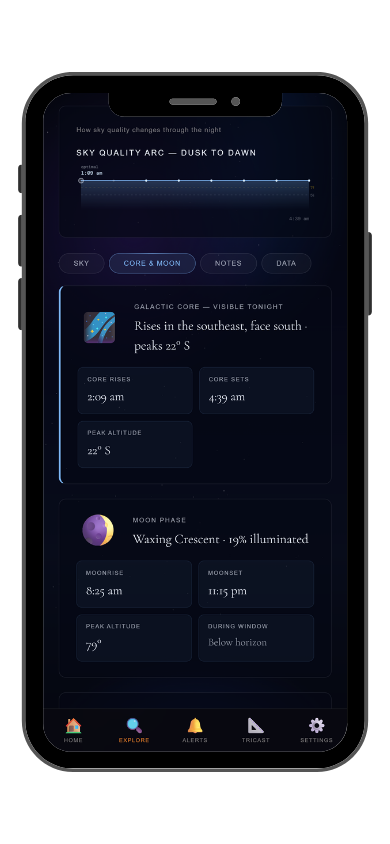
The galactic core is visible from approximately April through October. Summer nights are short at this northern latitude, with true astronomical darkness compressed to a few hours near midnight in June and July. September and early October offer the best combination of dark hours, galactic visibility, and the onset of aurora season. The lakes are typically ice-free from June through October, making reflections possible in that window. Winter brings long nights with frequent aurora displays over snow-covered peaks — a completely different but equally dramatic photography experience.