Frequently asked
Is tonight good for stargazing at Bears Ears National Monument?
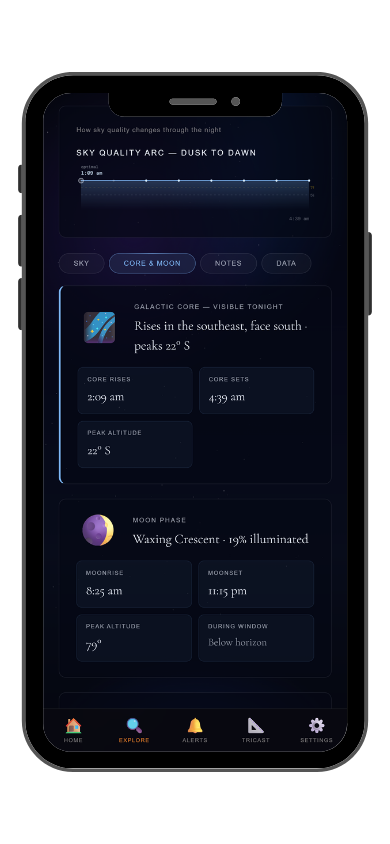
The live score above pulls today's forecast and runs it through StarCast's scoring model, factoring in cloud cover, moon illumination, Bortle class, humidity, and atmospheric transparency. Above 70 is an excellent night. Below 40, conditions are poor. The score updates daily.
What makes Bears Ears National Monument good for astrophotography?
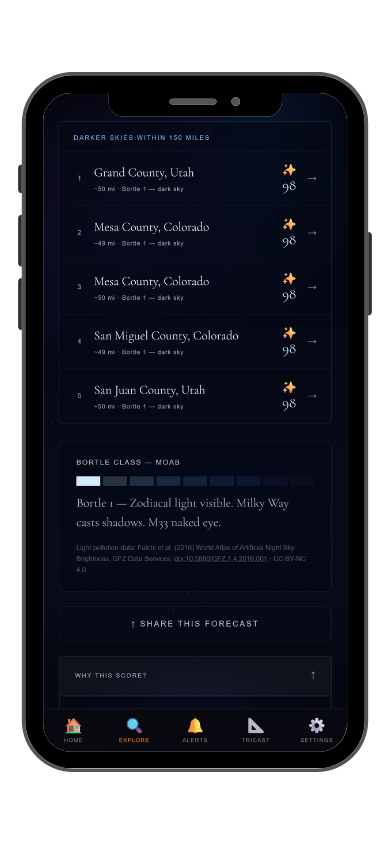
Bears Ears National Monument in southeastern Utah is one of the most culturally and geologically significant landscapes in North America, protecting thousands of ancient Native American sites including cliff dwellings, kivas, and petroglyphs across a vast canyon and mesa landscape. The monument's remote location in the San Juan County desert produces Bortle Class 1 to 2 skies that rival Natural Bridges — its neighbor to the west — in quality. The Twin Peaks buttes that give the monument its name are distinctive landmarks, and the Cedar Mesa canyons below contain ancestral Puebloan ruins that become extraordinary foreground subjects under the Milky Way. Shooting the galactic core above a thousand-year-old cliff dwelling is an experience that combines astronomical and human history in a way few places on Earth can offer.
When is the Milky Way visible at Bears Ears National Monument?
The galactic core is visible from approximately March through October, with the peak window running May through August. The high desert climate of the Colorado Plateau provides excellent clear night frequency throughout the season. Summer monsoons can bring afternoon and evening storms from mid-July through early September. Many of the most culturally significant and photogenic locations are accessed via rough unpaved roads and require hiking to reach, making advance planning and daylight scouting essential before nighttime shoots.