Frequently asked
Is tonight good for stargazing in Bishop?
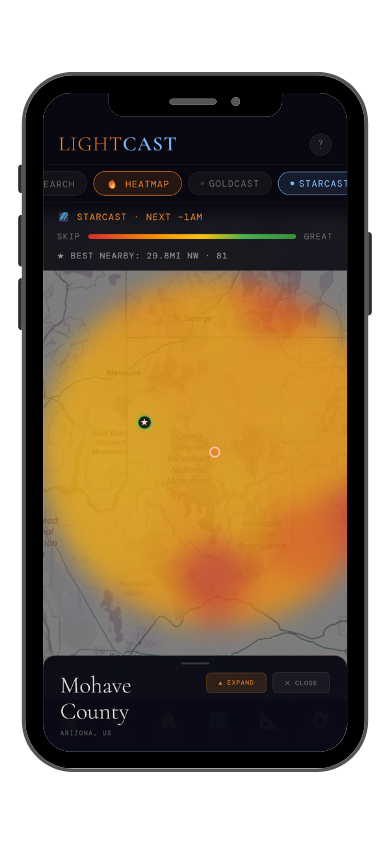
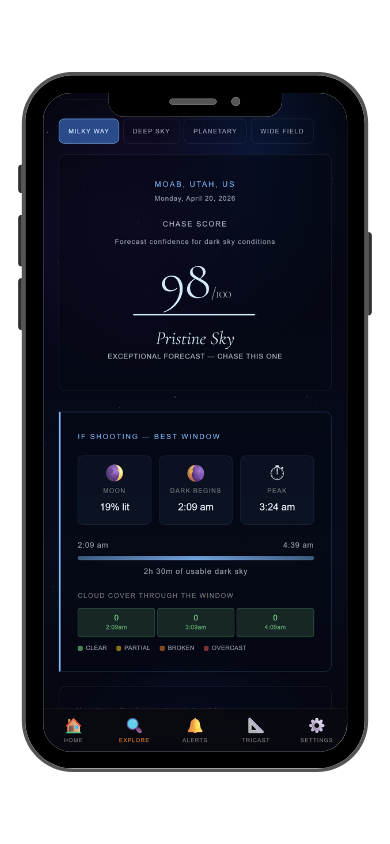
The live score above pulls today's forecast and runs it through StarCast's scoring model, factoring in cloud cover, moon illumination, Bortle class, humidity, and atmospheric transparency. Above 70 is an excellent night for astrophotography. Below 40, conditions are poor. The score updates daily.
What makes Bishop good for astrophotography?
Bishop sits at 4,150 feet in the Owens Valley — the deepest valley in the continental United States — flanked by the Sierra Nevada to the west and the White-Inyo Mountains to the east. This geography creates one of the most dramatic vertical landscapes in North America: within 15 miles of Bishop, the terrain rises from 4,000 feet on the valley floor to over 14,000 feet at the Sierra crest, including Mount Tom, Mount Humphreys, and access routes toward Mount Whitney. The Ancient Bristlecone Pine Forest in the White Mountains east of Bishop — home to the oldest living trees on Earth, some exceeding 5,000 years old — is a premier astrophotography destination with Bortle Class 2 skies at 10,000 to 11,000 feet elevation. Bishop's small size and Owens Valley isolation mean Bortle Class 3 to 4 darkness begins at the edge of town. The Alabama Hills near Lone Pine to the south offer sculpted granite boulder foregrounds.
When is the Milky Way visible near Bishop?
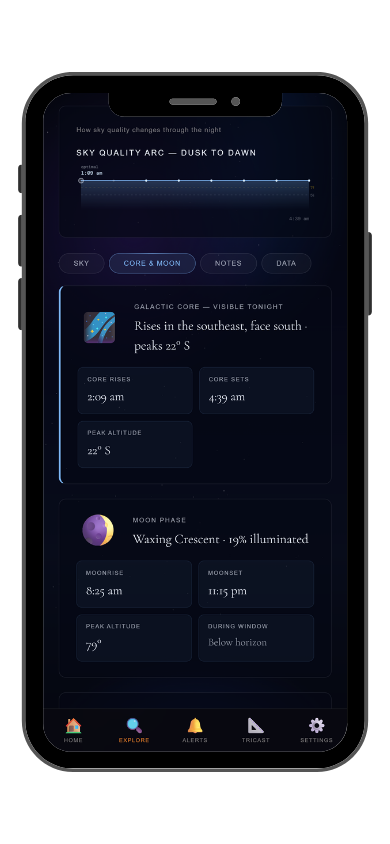
The galactic core is visible from late February through late October at Bishop's latitude. The Ancient Bristlecone Pine Forest is accessible from late spring through October (road conditions permitting). Prime astrophotography season runs April through October, with the bristlecone forest most accessible and productive from June through September. The Owens Valley's extremely low humidity and high clear-sky frequency — a function of its position in the Sierra Nevada rain shadow — make it one of the most productive astrophotography regions in the western United States. High-country Sierra locations above Bishop open after snowmelt in late June and provide extraordinary alpine foregrounds. New moon windows in June and July are peak targets combining the highest galactic core altitude with the best conditions.