Frequently asked
Is tonight good for stargazing at Black Hills?
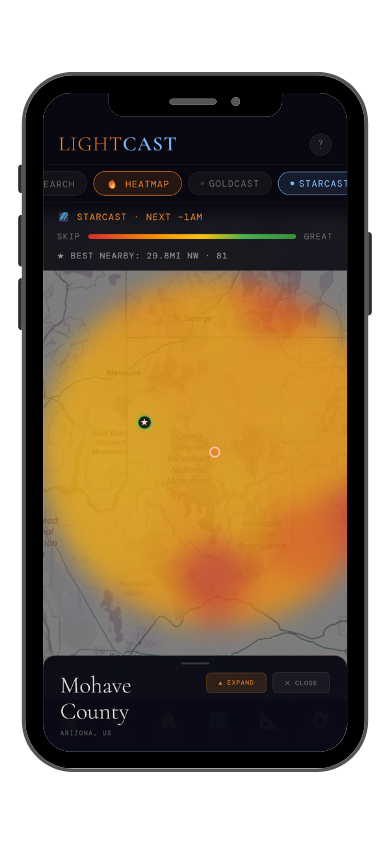
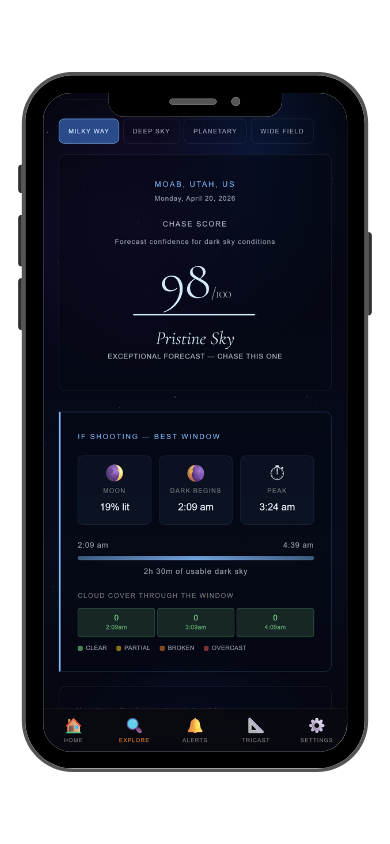
The live score above pulls today's forecast and runs it through StarCast's scoring model, which factors in cloud cover, moon illumination, Bortle class, humidity, and atmospheric transparency. Above 70 is an excellent night. Below 40, conditions are poor. The score updates daily.
What makes Black Hills good for astrophotography?
The Black Hills of South Dakota rise sharply from the Great Plains, creating an island of elevation and forest in a region that's otherwise flat and dark in every direction. Custer State Park and the surrounding national forest offer granite spires, pine ridgelines, and open meadows as foreground. The Needles Highway and Cathedral Spires areas photograph dramatically under the Milky Way. Rapid City generates some eastern horizon glow, but shooting west and south from higher elevations keeps skies clean. The region is dark enough to see the galactic core clearly with the naked eye on moonless nights.
When is the Milky Way visible at Black Hills?
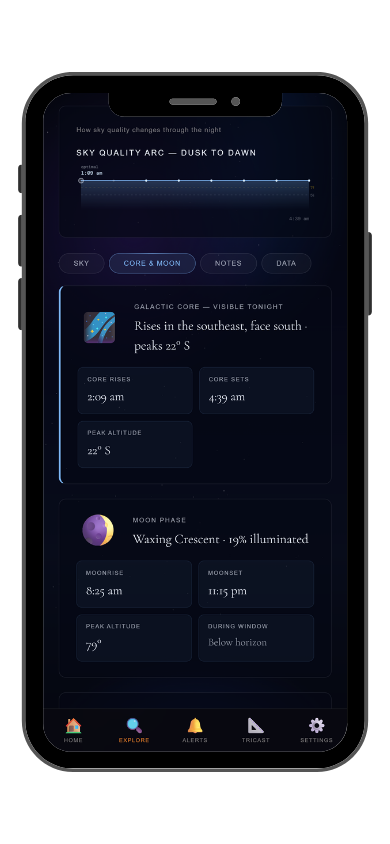
The galactic core is visible from April through October. June through August is peak season: warm nights, dry air, and the core positioned high enough for strong compositions above the granite formations. Wildfire smoke from western fires occasionally drifts into South Dakota in late summer. Spring and fall bring fewer crowds and cooler temperatures, with the core still visible through October.