Frequently asked
Is tonight good for stargazing at Black Mesa?
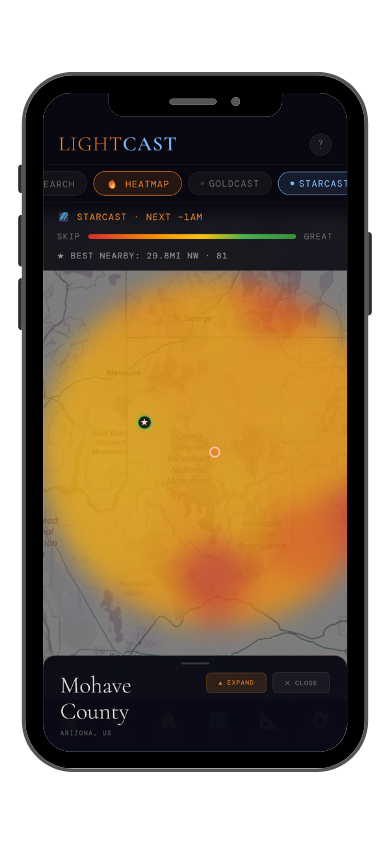
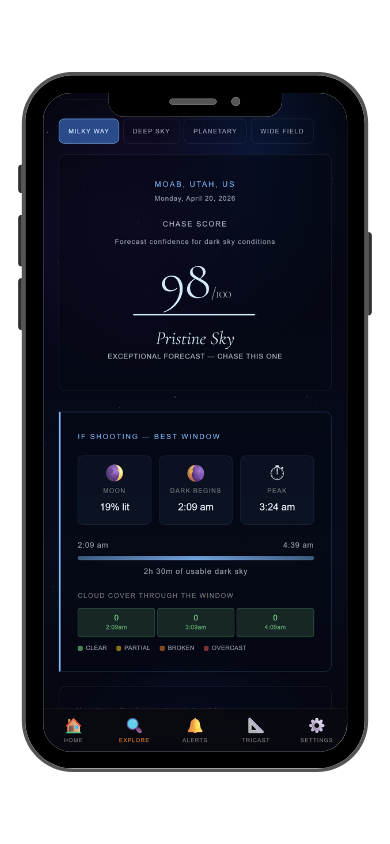
The live score above pulls today's forecast and runs it through StarCast's scoring model, factoring in cloud cover, moon illumination, Bortle class, humidity, and atmospheric transparency. Above 70 is an excellent night. Below 40, conditions are poor. The score updates daily.
What makes Black Mesa good for astrophotography?
Black Mesa is Oklahoma's highest point at 4,973 feet, rising above the state's Panhandle in the extreme northwestern corner where Oklahoma, New Mexico, and Colorado converge. The surrounding Black Mesa Nature Preserve covers 1,600 acres of black lava rock at the point where the Rocky Mountains meet the Great Plains. The site sits under some of the darkest skies in the US, with Bortle Class 1 to 2 conditions in a region of extremely low population density. September's Okie-Tex Star Party, one of the premier annual star parties in the country, is held here, drawing hundreds of amateur astronomers and astrophotographers with serious equipment. The unique geology, combining volcanic basalt with fossil-rich sedimentary layers, creates a distinctive and underused foreground for night photography.
When is the Milky Way visible at Black Mesa?
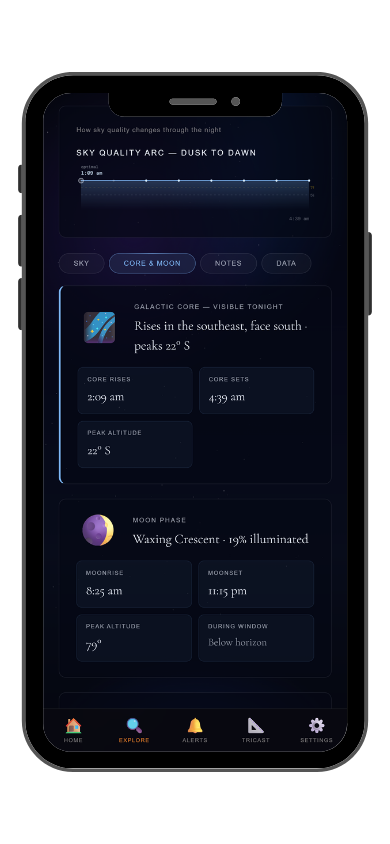
The galactic core is visible from March through October. The Oklahoma Panhandle's semi-arid climate delivers consistently clear skies and low humidity. The Okie-Tex Star Party in late September is the single largest annual gathering of dark sky enthusiasts at this location and the best time to visit if community astronomy is part of the appeal. The site is remote, with the nearest services in Boise City, about 30 miles away.