Frequently asked
Is tonight good for stargazing at Black Rock Desert?
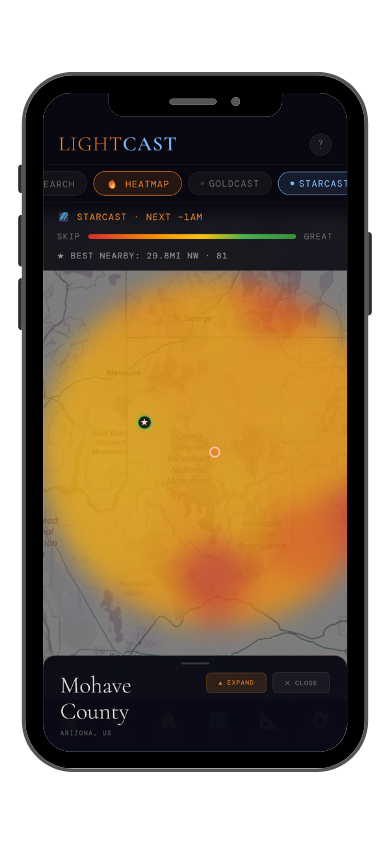
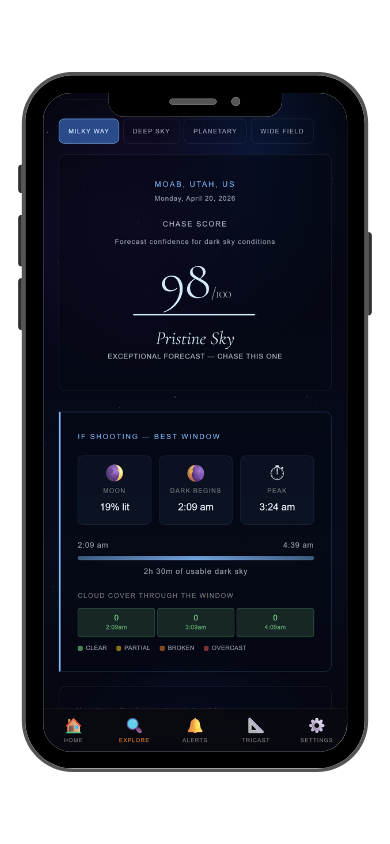
The live score above pulls today's forecast and runs it through StarCast's scoring model, factoring in cloud cover, moon illumination, Bortle class, humidity, and atmospheric transparency. Above 70 is an excellent night. Below 40, conditions are poor. The score updates daily.
What makes Black Rock Desert good for astrophotography?
The Black Rock Desert is a vast dry lakebed playa in northwestern Nevada, about 100 miles north of Reno. It sits under Bortle Class 1 skies, the darkest classification on the scale. The playa stretches more than 100 miles in length and is one of the flattest places in the western United States, giving a completely unobstructed horizon in every direction. The high desert air at roughly 3,900 feet is extremely dry, contributing to exceptional atmospheric transparency. On the darkest nights, the Milky Way is bright enough to cast faint shadows on the white playa surface. The area is managed by the BLM and is open for dispersed camping with no fees outside of designated events. Access requires a high-clearance vehicle when conditions are wet.
When is the Milky Way visible at Black Rock Desert?
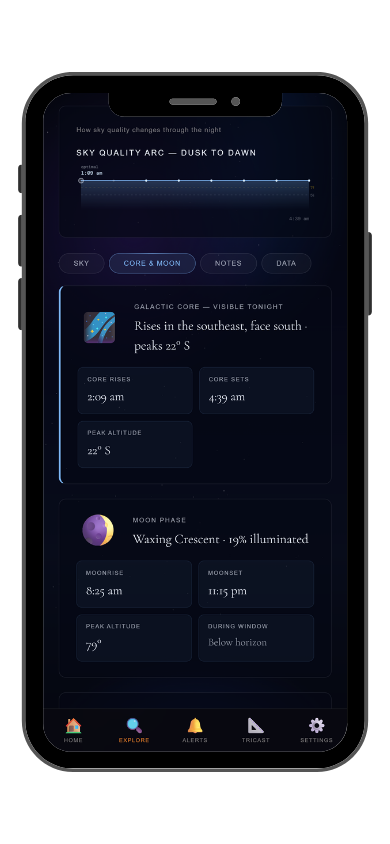
The galactic core is visible from March through October, with peak season from May through August. The playa is most accessible and most reliably dry from late spring through fall. Winter and early spring can bring surface water that makes vehicle access difficult or impossible. The area becomes crowded during Burning Man in late August and early September, so planning around that window is worth considering for photography-focused trips.