Frequently asked
Is tonight good for stargazing in Blanding?
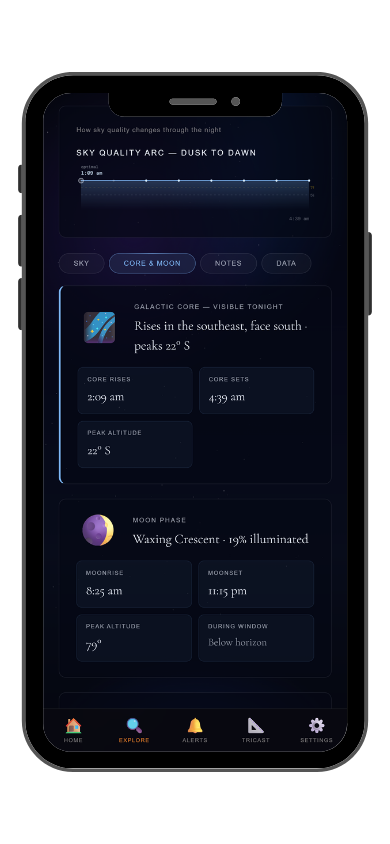
The live score above pulls today's forecast and runs it through StarCast's scoring model, factoring in cloud cover, moon illumination, Bortle class, humidity, and atmospheric transparency. Above 70 is an excellent night for astrophotography. Below 40, conditions are poor. The score updates daily.
What makes Blanding good for astrophotography?
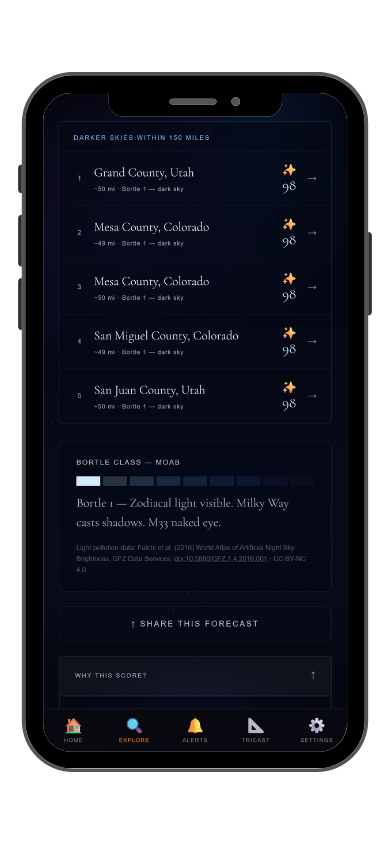
Blanding sits at 6,000 feet in the heart of the Bears Ears region of southeastern Utah — one of the most expansive dark sky areas in the continental United States. Bears Ears National Monument, Canyonlands National Park, Natural Bridges National Monument (the world's first International Dark Sky Park), and the Manti-La Sal National Forest all lie within a short drive. Natural Bridges is a 20-mile drive and offers three natural sandstone bridges — Sipapu, Kachina, and Owachomo — as foreground with Bortle Class 2 overhead skies. The Abajo Mountains rise to 11,360 feet just west of Blanding and add high-elevation foreground options. The region's Native American history — Ancestral Puebloan ruins, cliff dwellings, and rock art — provides deeply layered cultural foregrounds that make Bears Ears unlike any other astrophotography landscape in the country.
When is the Milky Way visible near Blanding?
The galactic core is visible from late February through late October at Blanding's Four Corners latitude. Natural Bridges National Monument and the surrounding canyon country provide year-round access. Prime astrophotography season runs April through October, with the core at peak altitude in June and July. The high-desert plateau climate delivers low annual precipitation and very reliable dark sky conditions. Natural Bridges in particular is frequently cited as one of the darkest and most accessible sky parks in the country, making Blanding one of the best anchor towns for astrophotography road trips through the Colorado Plateau.