Frequently asked
Is tonight good for stargazing at Boundary Peak?
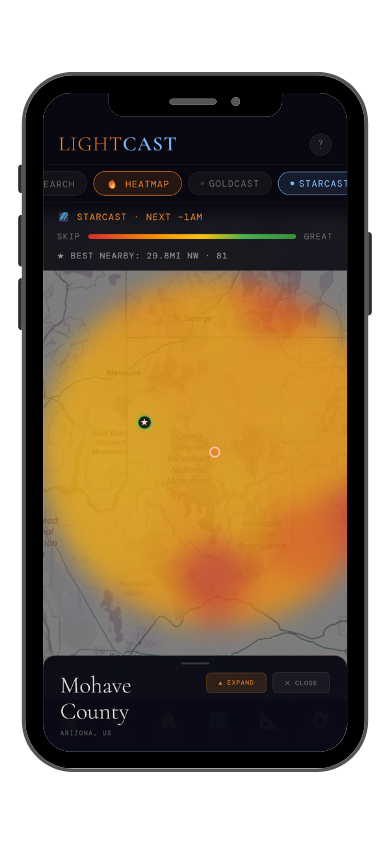
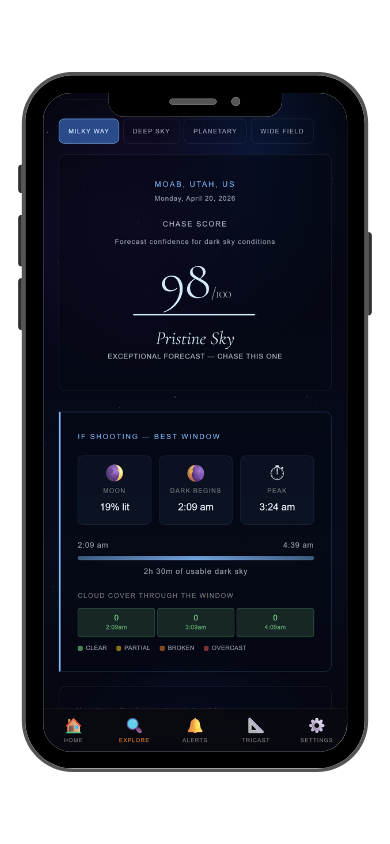
The live score above pulls today's forecast and runs it through StarCast's scoring model, factoring in cloud cover, moon illumination, Bortle class, humidity, and atmospheric transparency. Above 70 is an excellent night. Below 40, conditions are poor. The score updates daily.
What makes Boundary Peak good for astrophotography?
Boundary Peak is Nevada's highest point at 13,147 feet in the White Mountains along the California-Nevada border. The surrounding Basin and Range terrain, including the Esmeralda County valleys, is among the emptiest in the country: Tonopah is 80 miles to the northeast and produces very little light, while the Owens Valley to the west has minimal development above Bishop. The elevation places photographers above most atmospheric moisture and haze, producing exceptionally sharp star images. The high-desert approach road offers multiple shooting positions from 8,000 feet up without requiring a summit attempt.
When is the Milky Way visible at Boundary Peak?
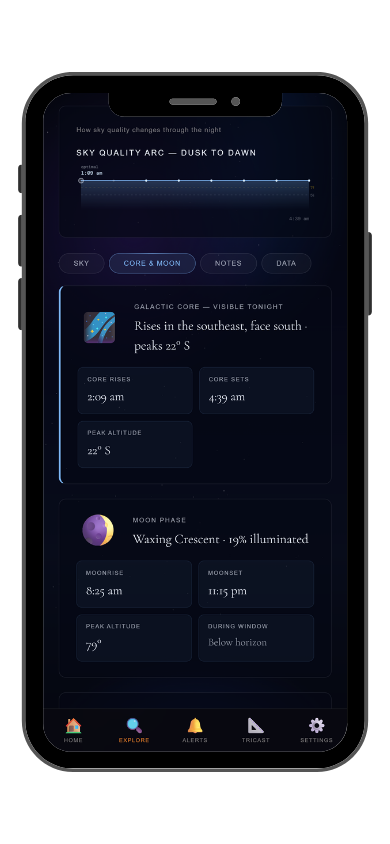
The galactic core is visible from March through October. The White Mountains have a dry, stable climate year-round, with the clearest nights typically falling in spring and early fall. Summer monsoon moisture from the south occasionally reaches the area in July and August but is less consistent than in Arizona or New Mexico. The access road (Highway 264 to Forest Road 139) is typically accessible from late May through October, though high-clearance vehicles are recommended for the upper section.