Frequently asked
Is tonight good for stargazing at the Boundary Waters?
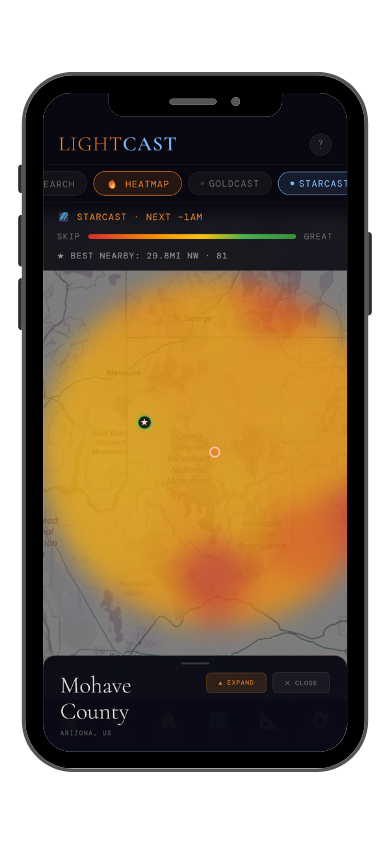
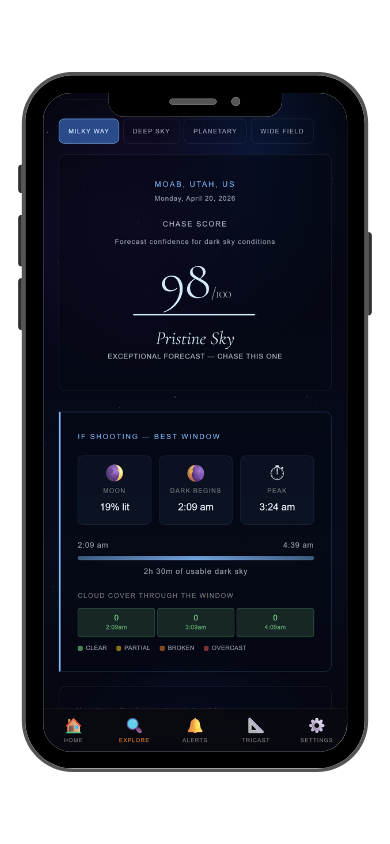
The live score above pulls today's forecast and runs it through StarCast's scoring model, factoring in cloud cover, moon illumination, Bortle class, humidity, and atmospheric transparency. Above 70 is an excellent night. Below 40, conditions are poor. The score updates daily.
What makes the Boundary Waters good for astrophotography?
The Boundary Waters Canoe Area Wilderness was designated the world's largest International Dark Sky Sanctuary in 2020 by DarkSky International. It covers over one million acres along the Minnesota-Canada border and shares the designation with Voyageurs National Park and Quetico Provincial Park in Canada, forming the largest dark sky region in the world. The BWCA reaches Bortle Class 1 conditions in its interior, the darkest rating on the scale. The lakes and open water provide reflective foregrounds and naturally open sightlines. The region is consistently cited as one of the best aurora viewing locations in the continental United States due to its northern latitude, and Milky Way photography over lake water is a staple of the local photography community.
When is the Milky Way visible at the Boundary Waters?
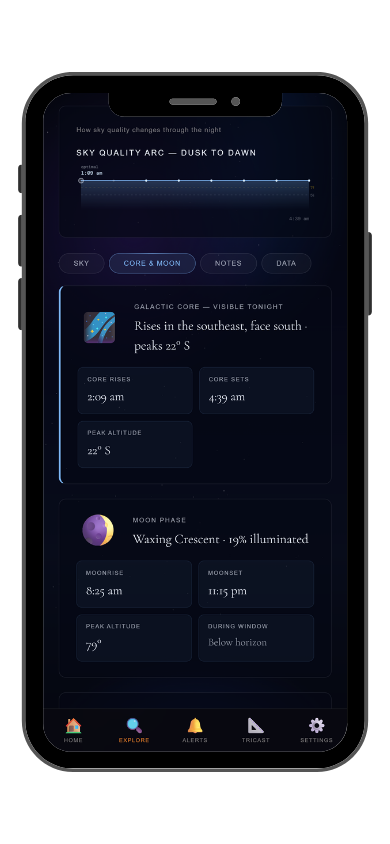
The galactic core is visible from late April through September. The northern latitude puts the galactic center lower in the southern sky, but the extreme darkness compensates significantly. Fall and winter are prime aurora season. Bug season from late May through July is worth planning around for comfort during longer exposures. The Ely Dark Sky Festival each January highlights the area's winter astronomy opportunities.