Frequently asked
Is tonight good for stargazing at Bruneau Dunes?
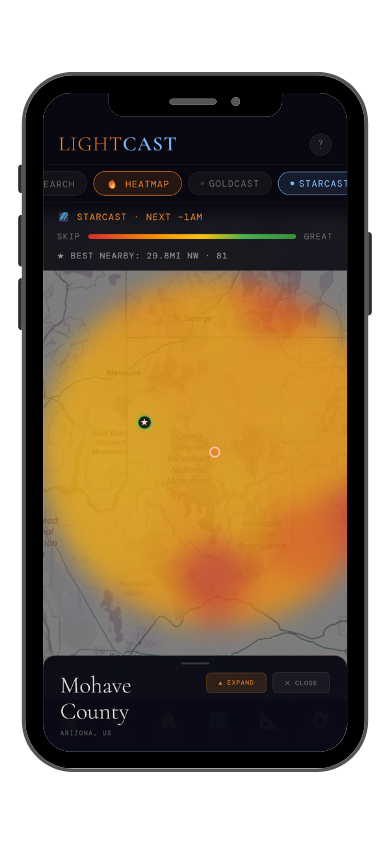
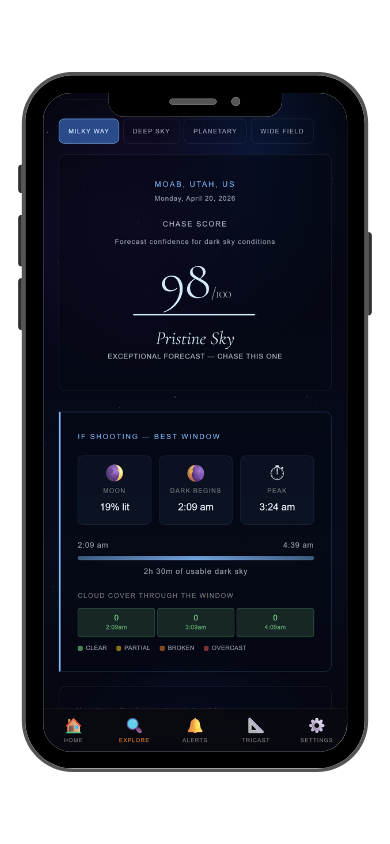
The live score above pulls today's forecast and runs it through StarCast's scoring model, factoring in cloud cover, moon illumination, Bortle class, humidity, and atmospheric transparency. Above 70 is an excellent night for astrophotography. Below 40, conditions are poor. The score updates daily.
What makes Bruneau Dunes good for astrophotography?
Bruneau Dunes State Park sits in the high desert of southern Idaho, roughly an hour southeast of Boise, and holds the tallest single structured sand dune in North America at 470 feet. The park runs its own public observatory with a research grade telescope, a strong signal of how consistently dark and clear the skies stay here. Away from Boise's glow, conditions typically reach Bortle Class 2, and the dune itself makes for a striking, uncommon silhouette against the stars, unlike the rock and forest foregrounds found at most Western dark sky sites.
When is the Milky Way visible at Bruneau Dunes?
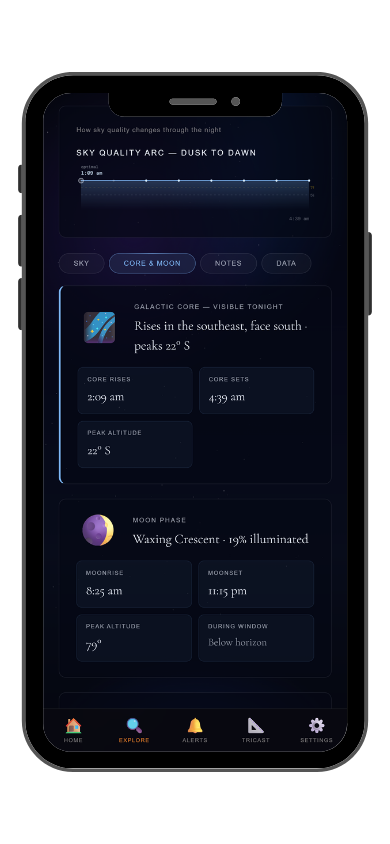
The core is visible from March through October. The park observatory hosts public star parties on select nights through the warmer months, timed around new moon periods for the darkest possible skies. May through September tends to bring the most reliably clear and dry conditions, since southern Idaho's high desert climate keeps humidity low and cloud cover minimal most of the summer.