Frequently asked
Is tonight good for stargazing at Bryce Point?
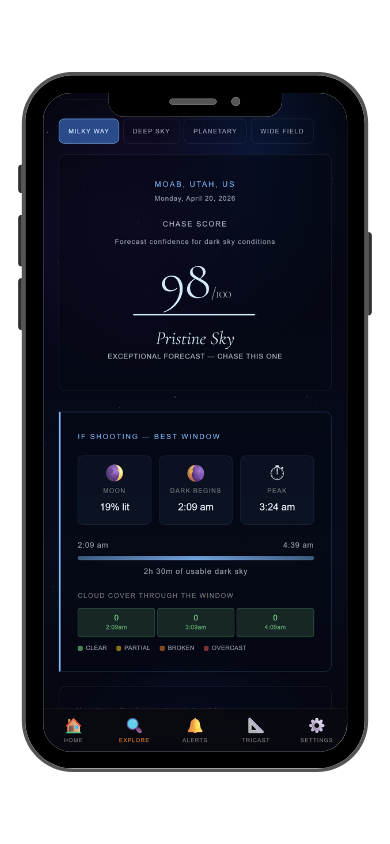
The live score above pulls today's forecast and runs it through StarCast's scoring model, factoring in cloud cover, moon illumination, Bortle class, humidity, and atmospheric transparency. Above 70 is an excellent night. Below 40, conditions are poor. The score updates daily.
What makes Bryce Point good for astrophotography?
Bryce Point sits at 8,296 feet at the southern end of the main Bryce Canyon scenic drive, overlooking the Silent City amphitheater. It's one of the darkest overlooks in the park and sees fewer overnight visitors than Sunrise or Sunset Point. The view south and east is nearly unobstructed, giving a wide shooting angle for the galactic core above the hoodoos. Bryce Canyon is a certified International Dark Sky Park with Bortle Class 2 conditions on clear nights. The lack of canyon walls to the south makes Bryce Point one of the best spots in the park for low-horizon Milky Way compositions.
When is the Milky Way visible at Bryce Point?
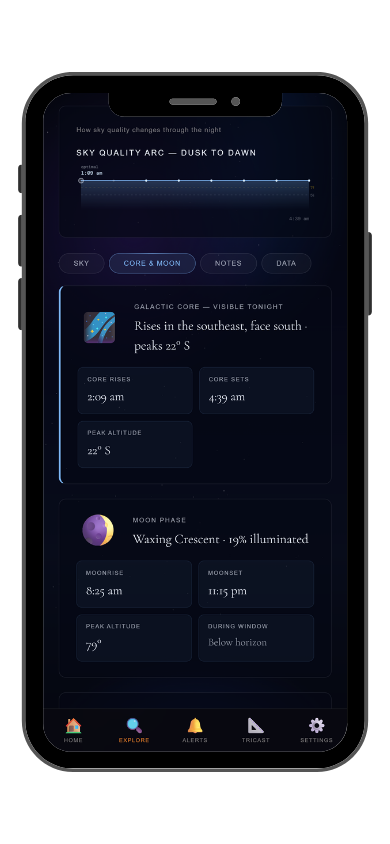
The galactic core is visible from mid-March through late October. Peak season runs May through August. At Bryce Point, the core clears the horizon to the southeast by 10 to 11 p.m. in June and rises earlier as summer progresses. The park's annual Astronomy Festival in June draws astronomers and photographers for several nights of telescope viewing and dark sky programming. Winter visits offer stunning snow-covered hoodoos under stars, though the galactic core is below the horizon from November through February.