Frequently asked
Is tonight good for stargazing at Capulin Volcano?
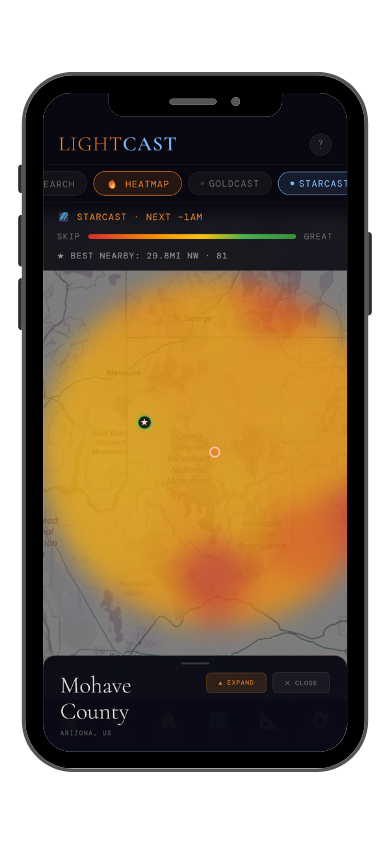
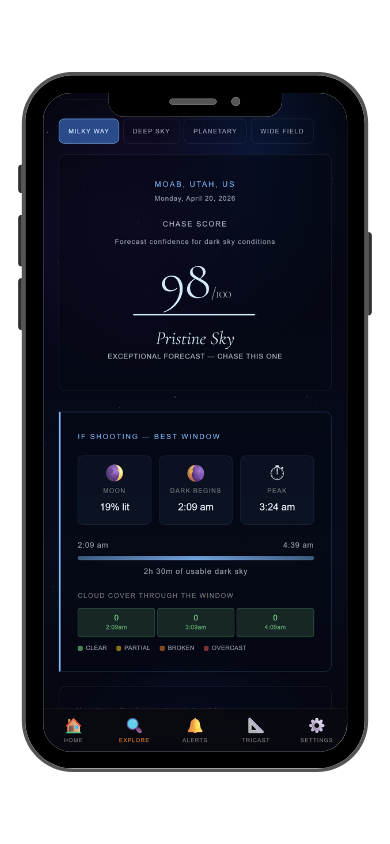
The live score above pulls today's forecast and runs it through StarCast's scoring model, factoring in cloud cover, moon illumination, Bortle class, humidity, and atmospheric transparency. Above 70 is an excellent night. Below 40, conditions are poor. The score updates daily.
What makes Capulin Volcano good for astrophotography?
Capulin Volcano National Monument is an extinct cinder cone rising to 8,182 feet in the remote northeastern corner of New Mexico. The summit crater rim provides 360-degree unobstructed views and sits above the surrounding plains by several hundred feet, reducing horizon interference. The region sits under Bortle Class 2 skies in one of the least-visited and least-known dark sky areas in New Mexico. The nearest significant city, Raton, is about 30 miles away and small enough to produce minimal horizon glow. The symmetrical volcanic cone makes for a striking and distinctive foreground, and the surrounding Raton-Clayton Volcanic Field extends the open, low-development landscape in all directions.
When is the Milky Way visible at Capulin Volcano?
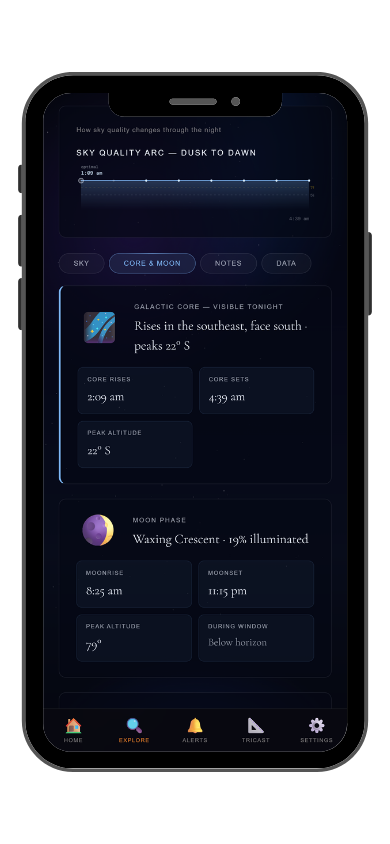
The galactic core is visible from April through October. Northeastern New Mexico sees significantly fewer visitors than the state's more famous parks, meaning the summit is often uncrowded even during peak season. Spring and fall offer the clearest conditions, while summer brings some afternoon thunderstorm activity that usually clears by evening. The monument's roads are typically open year-round barring winter storms.