Frequently asked
Is tonight good for stargazing in Cedar City?
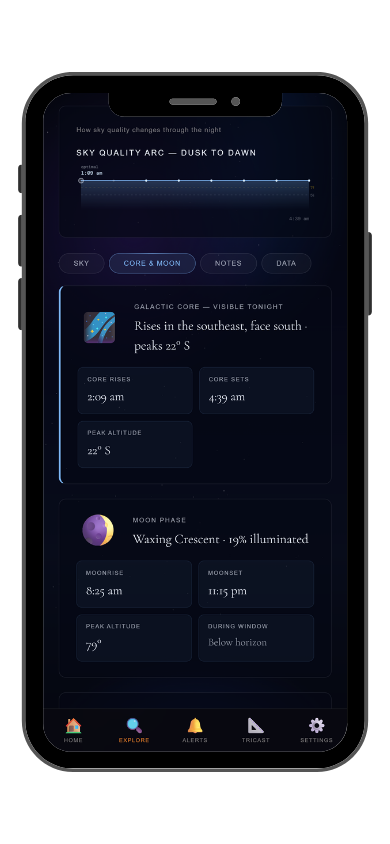
The live score above pulls today's forecast and runs it through StarCast's scoring model, factoring in cloud cover, moon illumination, Bortle class, humidity, and atmospheric transparency. Above 70 is an excellent night for astrophotography. Below 40, conditions are poor. The score updates daily.
What makes Cedar City good for astrophotography?
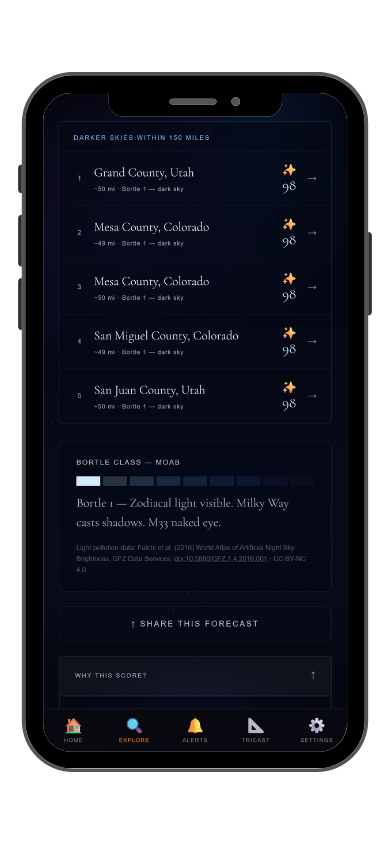
Cedar City sits at 5,800 feet on the edge of the Colorado Plateau in southwestern Utah, with Brian Head Peak and the Markagunt Plateau rising immediately to the east. The city serves as the primary gateway to Cedar Breaks National Monument, a dark sky park with Bortle Class 2 skies at 10,000 feet elevation — one of the highest and darkest shooting locations in the state. The pink and orange amphitheater of Cedar Breaks rivals Bryce Canyon as a foreground, and at this elevation, the Milky Way appears with exceptional contrast and color. Iron County's wide-open terrain and sparse population keep light domes minimal in all directions except a faint glow from the city itself. Brian Head resort area also provides easy high-elevation access in summer.
When is the Milky Way visible near Cedar City?
The galactic core is visible from late March through early October at Cedar City's latitude. Cedar Breaks National Monument, the prime shooting location, is accessible by road from late May through October depending on snowpack. The ideal astrophotography window is June through September, when the monument's access road is reliably open and the core climbs high enough for dramatic compositions above the hoodoo amphitheater. New moon weekends in July and August draw the most astrophotographers to Cedar Breaks for its combination of altitude, darkness, and foreground quality.