Frequently asked
Is tonight good for stargazing in the Cederberg?
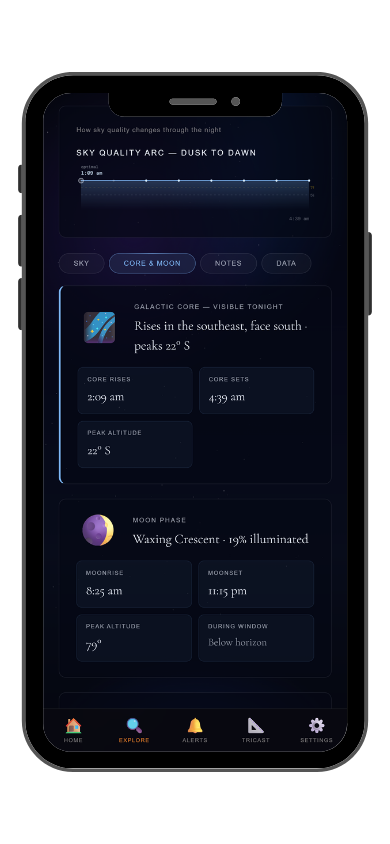
The live score above pulls today's forecast and runs it through StarCast's scoring model, factoring in cloud cover, moon illumination, Bortle class, humidity, and atmospheric transparency. Above 70 is an excellent night. Below 40, conditions are poor. The score updates daily.
What makes the Cederberg good for astrophotography?
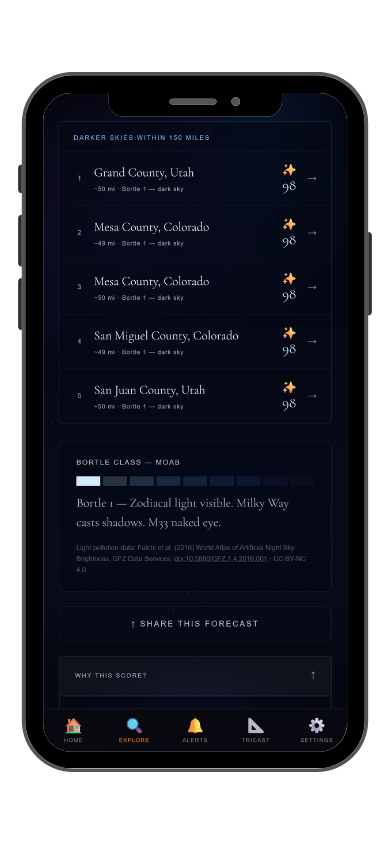
The Cederberg Wilderness Area in the Western Cape of South Africa is one of the most celebrated dark sky destinations on the African continent, a rugged sandstone mountain wilderness about 200 kilometers north of Cape Town. The Cederberg's remote valleys and peaks achieve Bortle Class 1 to 2 skies with the Southern Hemisphere's brilliant galactic core passing overhead. The landscape of weathered orange sandstone formations, endemic fynbos vegetation, and ancient San rock art sites provides extraordinary foreground that is uniquely South African. The Milky Way's central bulge rises to a very high elevation from this southern latitude, revealing the galaxy's structure in remarkable detail. The region's Mediterranean climate delivers an extremely high frequency of clear nights, particularly from April through October, making it one of the most reliably clear dark sky destinations accessible by road in southern Africa.
When is the Milky Way visible in the Cederberg?
The galactic core is visible year-round from the Cederberg's southern latitude, with the austral winter from May through August placing it at its highest and most spectacular in the sky. The Western Cape's Mediterranean climate means the dry season from April through October delivers very high clear night frequency, while the winter rains from May through August can bring cloud cover but are interspersed with many clear nights. The shoulder months of April to May and August to September typically offer the best balance of galactic positioning, clear skies, and comfortable temperatures. Summer nights from November through March are shorter but warm and often clear.