Frequently asked
Is tonight good for stargazing at Chiricahua National Monument?
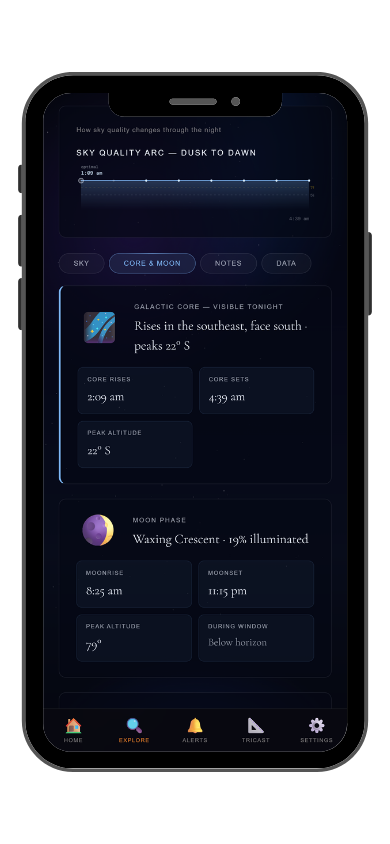
The live score above pulls today's forecast and runs it through StarCast's scoring model, factoring in cloud cover, moon illumination, Bortle class, humidity, and atmospheric transparency. Above 70 is an excellent night. Below 40, conditions are poor. The score updates daily.
What makes Chiricahua National Monument good for astrophotography?
Chiricahua National Monument in southeastern Arizona protects a dramatic landscape of volcanic rhyolite columns, balanced rocks, and spires rising from a sky island mountain range at elevations up to 7,310 feet. The monument is remote, lightly visited, and surrounded by the vast grasslands and desert of the southeastern Arizona basin and range — conditions that produce Bortle Class 2 to 3 skies with dark horizons in all directions. The rock formations called the Pinnacles and Balanced Rock are among the most striking geological foreground subjects in Arizona. The high elevation keeps temperatures comfortable in summer and improves atmospheric transparency. The sky island ecosystem also makes Chiricahua one of the best places in the US for rare Sonoran and Mexican bird species by day, adding wildlife appeal to the astronomy destination.
When is the Milky Way visible at Chiricahua National Monument?
The galactic core is visible from approximately February through November. The summer monsoon season from July through September brings afternoon thunderstorms that typically clear by evening, often leaving highly transparent skies behind. Spring and fall are the most consistently clear seasons. The monument's higher elevation moderates summer heat and extends comfortable shooting conditions. Winter nights are cold at 7,000 feet but offer superb transparency and uncrowded access.