Frequently asked
Is tonight good for stargazing at Chiricahua?
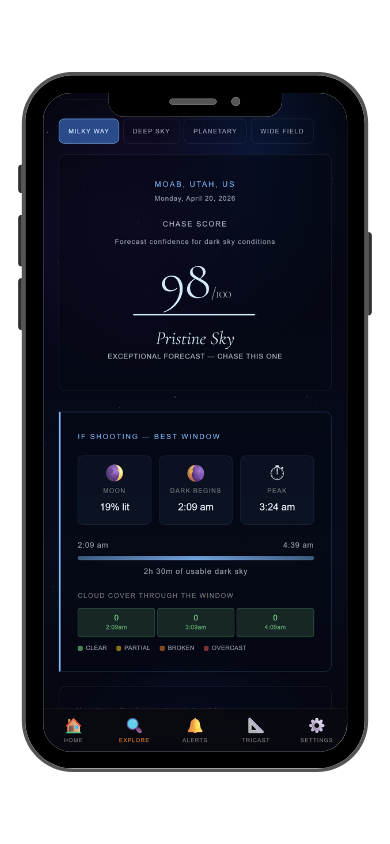
The live score above pulls today's forecast and runs it through StarCast's scoring model, factoring in cloud cover, moon illumination, Bortle class, humidity, and atmospheric transparency. Above 70 is an excellent night. Below 40, conditions are poor. The score updates daily.
What makes Chiricahua good for astrophotography?
Chiricahua National Monument sits in the far southeastern corner of Arizona in one of the most remote and least-visited parts of the state. The monument regularly achieves Bortle Class 2 conditions, with towering volcanic rhyolite spires, balanced rocks, and "sky island" terrain creating foreground subjects unlike anything else in the Southwest. The Chiricahua Mountains rise to over 9,700 feet, and the monument itself sits at around 5,400 feet. The surrounding Apache-Sitgreaves and Coronado National Forests extend the low-development buffer for miles. The unusual geology, where millions of years of volcanic eruption and erosion produced hundreds of dramatic rock columns, gives astrophotographers a compositional variety unmatched in Arizona outside the Grand Canyon.
When is the Milky Way visible at Chiricahua?
The galactic core is visible from March through October. The monument's southeastern Arizona location sees some monsoon activity in July and August, but nights often clear after afternoon storms. Spring and fall offer the most reliably clear conditions. The monument road and visitor center are open year-round. The remote location means access requires planning: the nearest significant town, Willcox, is about 36 miles away.