Frequently asked
Is tonight good for stargazing in Cody?
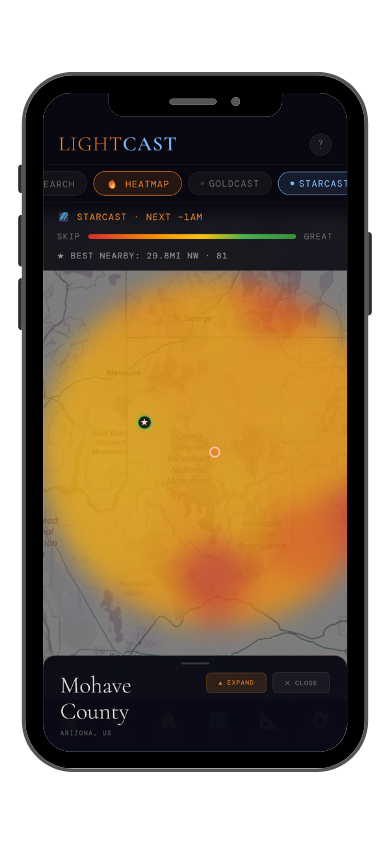
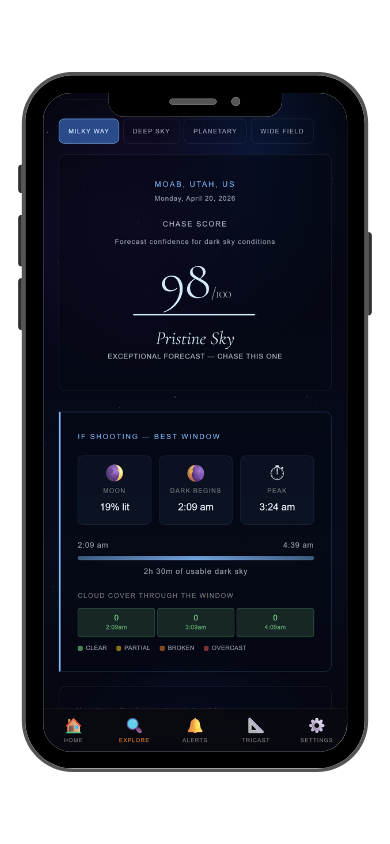
The live score above pulls today's forecast and runs it through StarCast's scoring model, factoring in cloud cover, moon illumination, Bortle class, humidity, and atmospheric transparency. Above 70 is an excellent night for astrophotography. Below 40, conditions are poor. The score updates daily.
What makes Cody good for astrophotography?
Cody sits at 5,100 feet at the eastern entrance to Yellowstone National Park, 52 miles to the west along the North Fork of the Shoshone River. The Wapiti Valley — the canyon carved by the Shoshone through the Absaroka Range — is one of the most scenic drives in the American West by day and one of the most accessible dark sky corridors after dark, with Bortle Class 3 to 4 skies and the dramatic volcanic spires of the Absarokas as foreground. Yellowstone itself achieves Bortle Class 2 conditions in its interior, and the geothermal features — hot springs, geysers, and fumaroles — are uniquely dramatic night photography subjects, particularly with steam rising against a star field. Buffalo Bill Reservoir just west of Cody provides water reflection foreground with the canyon walls rising behind it.
When is the Milky Way visible near Cody?
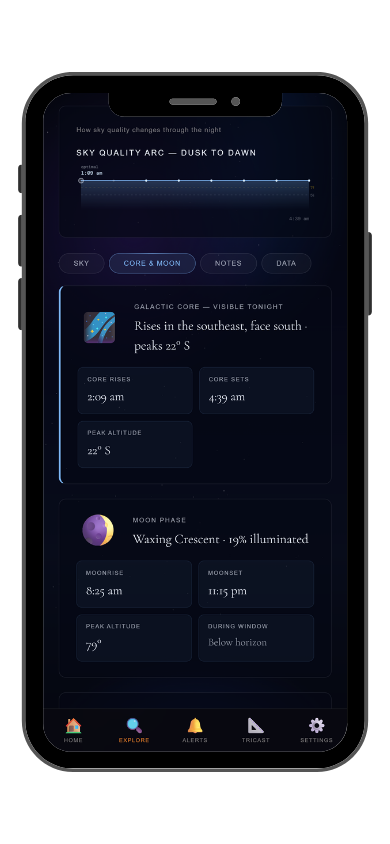
The galactic core is visible from late March through early October at Cody's Wyoming latitude. Prime astrophotography season runs May through September, coinciding with Yellowstone's accessible road season. The Wapiti Valley is particularly effective from June through August when the core is high enough to clear the canyon walls. Wyoming's continental high-desert climate produces more stable and clear summer nights than Pacific Northwest mountain ranges to the west, and Cody's position in the rain shadow of the Absarokas means it is frequently clearer than higher terrain nearby. New moon windows in July and August are the most popular for Yellowstone and canyon astrophotography.