Frequently asked
Is tonight good for stargazing at Coral Pink Sand Dunes?
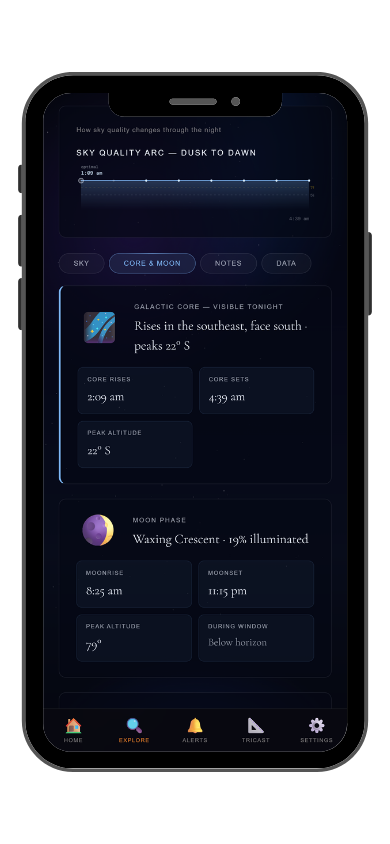
The live score above pulls today's forecast and runs it through StarCast's scoring model, factoring in cloud cover, moon illumination, Bortle class, humidity, and atmospheric transparency. Above 70 is an excellent night. Below 40, conditions are poor. The score updates daily.
What makes Coral Pink Sand Dunes good for astrophotography?
Coral Pink Sand Dunes State Park in southwestern Utah has one of the most unusual foregrounds available to night sky photographers: deep pink and orange sand dunes that rise up to 100 feet, shaped by winds funneled through a gap in the Moquith Mountains. The nearest significant town, Kanab, is about 20 miles away, and the park's surrounding canyon terrain blocks most of its light. Dune textures photograph well in starlight, and the smooth, reflective surface of packed sand can hold interesting shadows and gradients across a long exposure.
When is the Milky Way visible at Coral Pink Sand Dunes?
The galactic core is visible from March through October. Spring and early summer are the most reliable for clear nights in this part of Utah. The dunes cool quickly after sunset, which can create some low-lying atmospheric shimmer on warm evenings, but skies above 20 degrees elevation are typically sharp. Wind can be persistent: calm nights are worth waiting for, as sand movement during a long exposure will show in the dune texture and can affect image sharpness.