Frequently asked
Is tonight good for stargazing at Crestone?
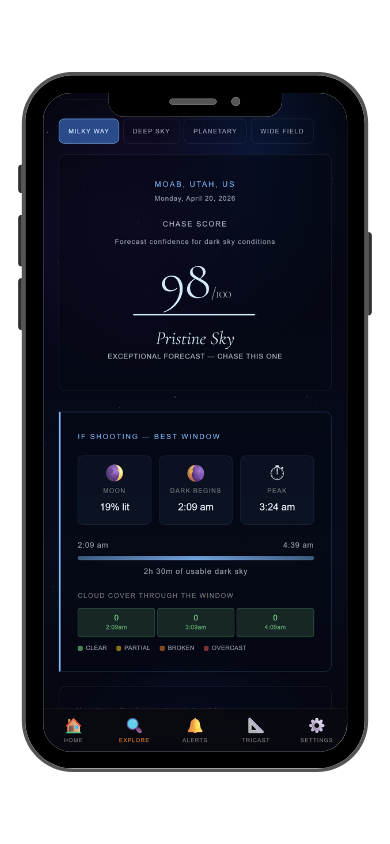
The live score above pulls today's forecast and runs it through StarCast's scoring model, which factors in cloud cover, moon illumination, Bortle class, humidity, and atmospheric transparency. Above 70 is an excellent night. Below 40, conditions are poor. The score updates daily.
What makes Crestone good for astrophotography?
Crestone sits at the northern edge of the San Luis Valley, one of the largest and flattest high-altitude basins in North America. The valley floor at 7,500 feet has almost no light pollution to the south and west, and the Great Sand Dunes are just 30 miles southeast. The Sangre de Cristo peaks rise abruptly behind the town, giving dramatic east-facing foreground. The area's minimal commercial development preserves the darkness.
When is the Milky Way visible at Crestone?
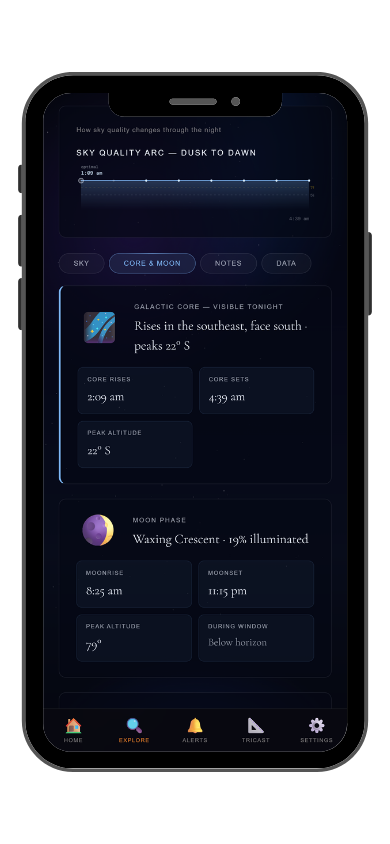
The galactic core is visible from late March through October. The San Luis Valley's exceptional dryness makes it one of Colorado's most consistent stargazing locations, with clear nights common even when the Front Range is clouded over. The core rises in the south over the open valley floor, with the Sangre de Cristo silhouette as a natural frame to the east.