StarCast · Custer State Park, SD

Night Sky Tonight in Custer State Park

Reading tonight's sky conditions…
/ 100
Moon
Dark window
Galactic core
Conditions
Tonight
Bortle class
LightCast
Now on iOS
LightCast Suite
Push alerts · 3-day forecast · nearby dark skies

Get notified before clear nights. Set your threshold once and never miss a prime shooting window again.

Download on the App Store
7-day free trial · $2.99/mo · Cancel anytime in App Store
Learn more →

What's in the score
Cloud cover
Moon illumination
Bortle class
Transparency
Humidity

What the app shows you
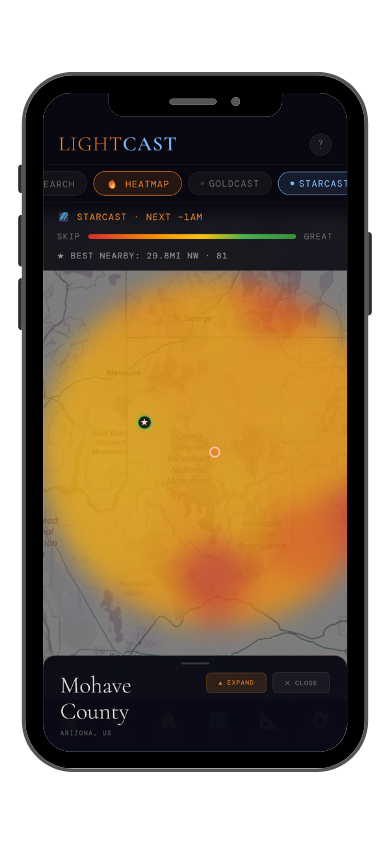
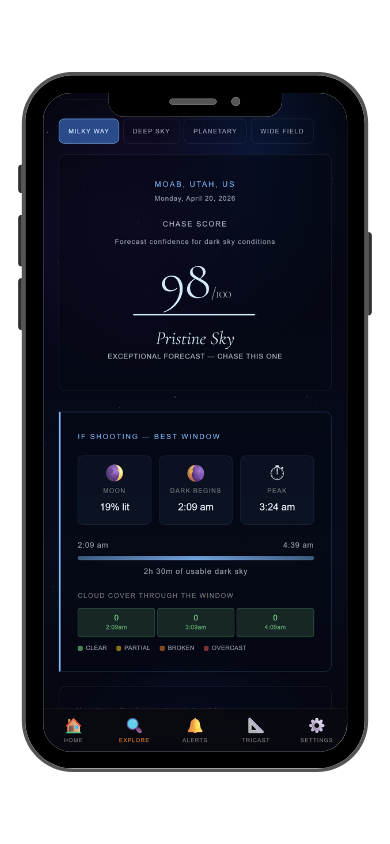
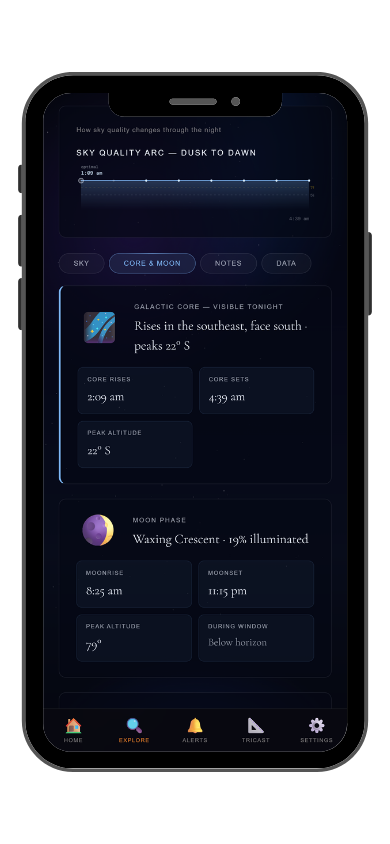
StarCast galactic core forecast
Nearby dark sky locations

Live scores for the night sky, Milky Way Core windows, darker skies nearby, & more
Get LightCast Suite on iOS


Frequently asked
Is tonight good for stargazing at Custer State Park?
The live score above pulls today's forecast and runs it through StarCast's scoring model, which factors in cloud cover, moon illumination, Bortle class, humidity, and atmospheric transparency. Above 70 is an excellent night. Below 40, conditions are poor. The score updates daily.
What makes Custer State Park good for astrophotography?
Custer is one of the largest state parks in the US and sits at the heart of the Black Hills dark sky region. The Wildlife Loop Road traverses open prairie where bison herds roam, and photographing the Milky Way over a bison silhouette is a uniquely South Dakota composition. The Needles area within the park features narrow granite spires and rock formations that create dramatic foreground. The park has multiple campgrounds and backcountry access, with far less visitation than the nearby national park circuit. Bortle 3 skies are typical, darkening to Bortle 2 in the more remote western sections.
When is the Milky Way visible at Custer State Park?
The galactic core is visible from April through October. June through August is the primary season, with warm nights and the core positioned high in the south. The Wildlife Loop is open year-round and the bison are present all year, so star trail photography in winter is possible on clear nights. New moon weekends in July and August fill the park's campgrounds quickly: booking early is essential for summer visits.