Frequently asked
Is tonight good for stargazing at Davis Mountains?
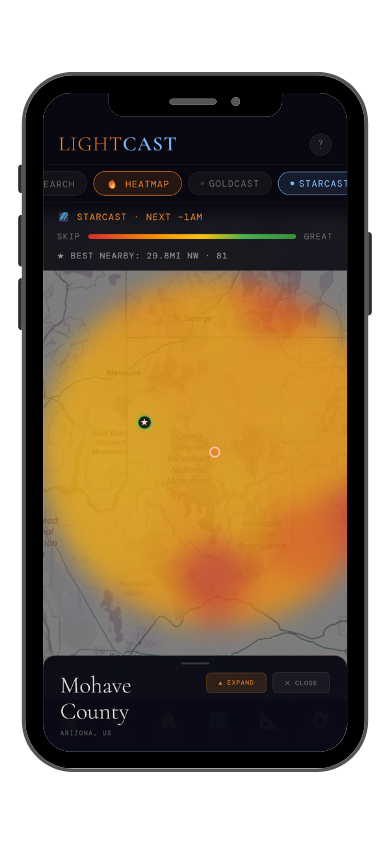
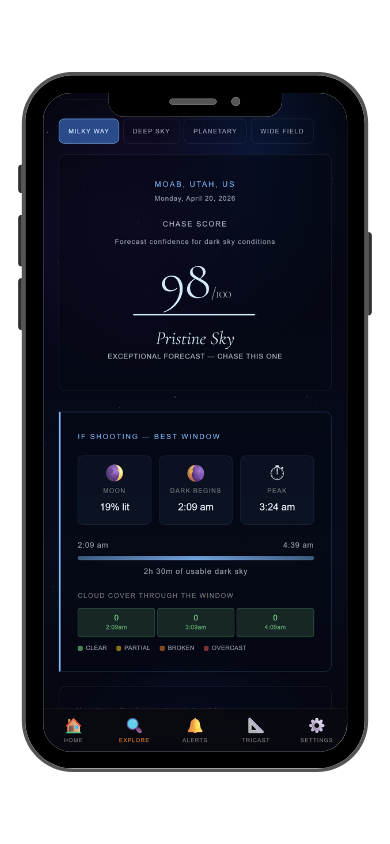
The live score above pulls today's forecast and runs it through StarCast's scoring model, factoring in cloud cover, moon illumination, Bortle class, humidity, and atmospheric transparency. Above 70 is an excellent night. Below 40, conditions are poor. The score updates daily.
What makes Davis Mountains good for astrophotography?
The Davis Mountains in far west Texas sit at elevations between 5,000 and 8,000 feet, far enough from El Paso, Midland, and San Antonio to have some of the darkest skies in the lower 48. McDonald Observatory is located here specifically because of the sky quality: Bortle Class 1 to 2 conditions are common at higher elevations. The mountains rise sharply from the Chihuahuan Desert, creating layered ridge lines as foreground. The Skyline Drive loop through the state park gives multiple shooting positions with different exposures to the south.
When is the Milky Way visible at Davis Mountains?
The galactic core is visible from March through October. West Texas has one of the most stable clear-sky climates in the country: the area averages around 300 clear nights per year, and humidity rarely becomes a problem at elevation. The core rises early and climbs high in the south from May through August. McDonald Observatory hosts regular Star Parties open to the public throughout the year, which can be worth combining with a night shoot in the state park.