Frequently asked
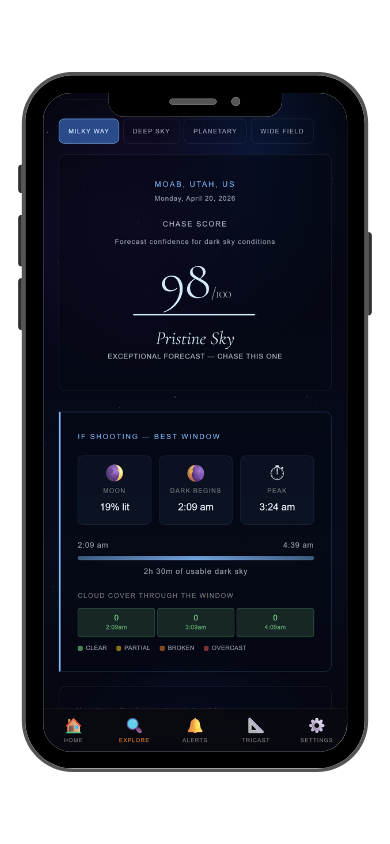
Is tonight good for stargazing at Dead Horse Point?
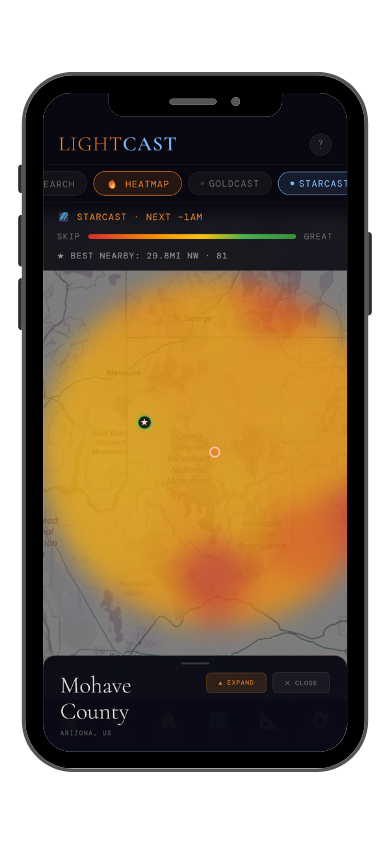
The live score above pulls today's forecast and runs it through StarCast's scoring model, factoring in cloud cover, moon illumination, Bortle class, humidity, and atmospheric transparency. Above 70 is an excellent night. Below 40, conditions are poor. The score updates daily.
What makes Dead Horse Point good for astrophotography?
Dead Horse Point is a mesa top that juts out over a 2,000-foot drop above a dramatic bend in the Colorado River. The 360-degree view from the point overlook is unobstructed in every direction, making it one of the most open shooting platforms in canyon country. The park sits inside a dark sky corridor between Moab and Canyonlands with Bortle Class 2 to 3 skies. Potash evaporation ponds 2,000 feet below are sometimes visible in the valley at night and add an unexpected teal color element to long-exposure shots.
When is the Milky Way visible at Dead Horse Point?
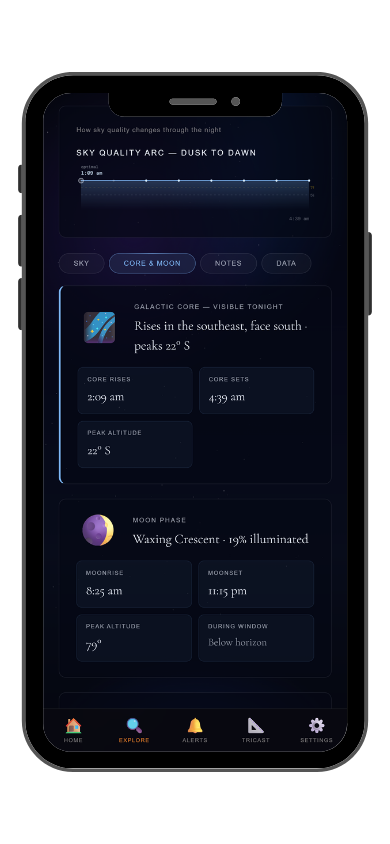
The galactic core is visible from mid-March through late October. The point's southern exposure means the core rises cleanly above the canyon rim with no obstructions. Peak shooting season runs April through September. Summer monsoon season (July to mid-August) can bring afternoon storms that clear by evening, sometimes leaving dramatic cloud formations above the canyon for blue-hour and post-storm Milky Way shots.