Frequently asked
Is tonight good for stargazing at Denali?
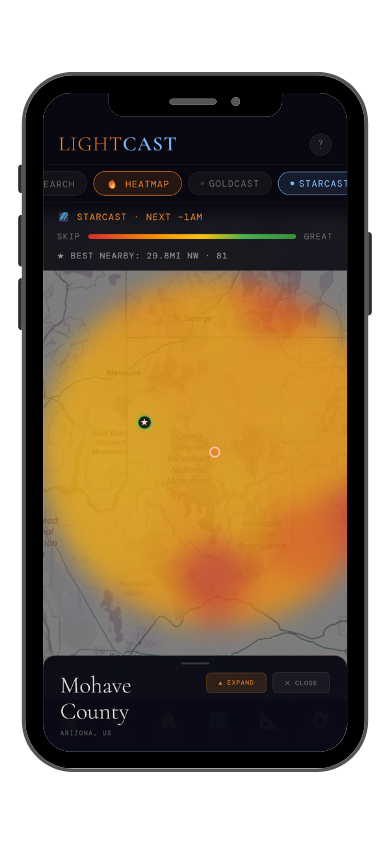
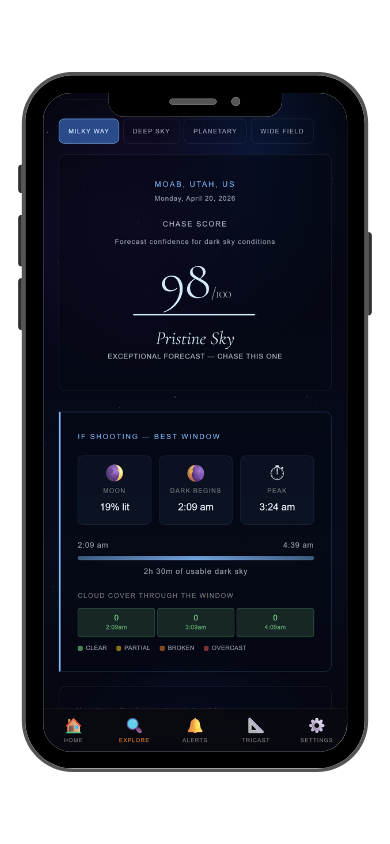
The live score above pulls today's forecast and runs it through StarCast's scoring model, factoring in cloud cover, moon illumination, Bortle class, humidity, and atmospheric transparency. Above 70 is an excellent night. Below 40, conditions are poor. The score updates daily.
What makes Denali good for astrophotography?
Denali National Park covers six million acres in central Alaska and was designated an International Dark Sky Park in 2021. The park sits under Bortle Class 1 to 2 skies across its entire range, with virtually no artificial light within hundreds of miles in most directions. The 20,310-foot peak provides a dramatic centerpiece for night sky photography from designated viewpoints along the park road. Wonder Lake, accessible at mile 85, reflects both auroras and stars on calm nights and is one of the most photographed night sky locations in Alaska. Polychrome Pass at mile 46 offers high, open views in every direction. The park is located within the auroral oval, making it one of the best aurora borealis destinations in the country.
When is the Milky Way visible at Denali?
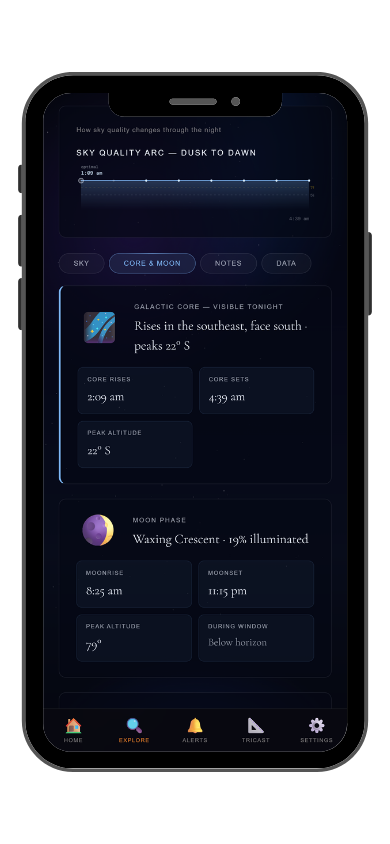
The galactic core is visible from approximately late August through late September, the only window when actual darkness returns after Alaska's midnight sun. Aurora season runs from late August through April, with the longest and darkest nights in December and January bringing up to 19 hours of darkness. Summer visits from late May through early August will not produce dark skies due to the midnight sun. Late August and September offer the best combination of Milky Way visibility, aurora potential, and accessible road conditions before winter closures.