Frequently asked
Is tonight good for stargazing at Eifel National Park?
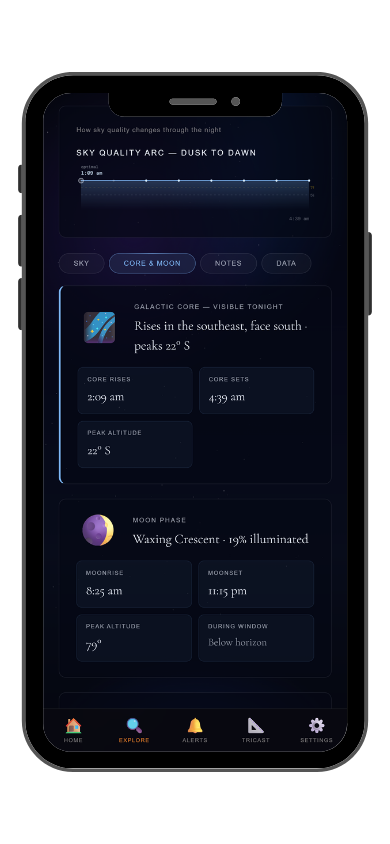
The live score above pulls today's forecast and runs it through StarCast's scoring model, factoring in cloud cover, moon illumination, Bortle class, humidity, and atmospheric transparency. Above 70 is an excellent night. Below 40, conditions are poor. The score updates daily.
What makes Eifel National Park good for astrophotography?
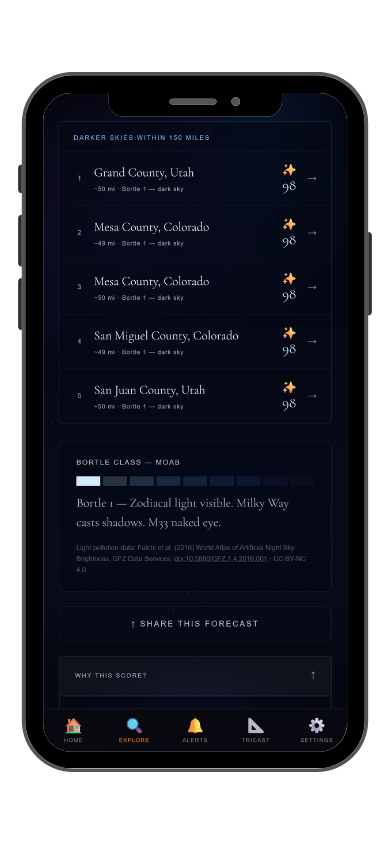
Eifel National Park in western Germany near the Belgian and Luxembourg borders contains the Westeifel Volcanoes Geopark and is part of the International Dark Sky Park network — one of only a handful of certified dark sky sites in central Europe. The park's location between Cologne, Bonn, and Trier creates a roughly triangular pocket of relatively protected darkness, with Bortle Class 3 to 4 skies in its core areas. The volcanic landscape of maare — circular lakes formed in ancient volcanic craters — provides distinctive and photogenic foreground. The Laacher See maar, Gemündener Maar, and the forested Eifel plateau offer varied compositions. The park's designation and active dark sky management make it the most reliably dark accessible site in the densely populated Rhine corridor of western Germany.
When is the Milky Way visible at Eifel National Park?
The galactic core is visible from approximately April through October, with July and August offering the highest arc and the shortest nights simultaneously. Astronomical darkness at this central European latitude doesn't arrive until late evening in summer, compressing the shooting window. Germany's temperate oceanic climate brings variable cloud cover throughout the year, with summer offering slightly better clear night frequency than the wetter autumn and winter months. The forecast score is a particularly valuable planning tool at this location given the inherent weather variability.