Frequently asked
Is tonight good for stargazing at El Leoncito?
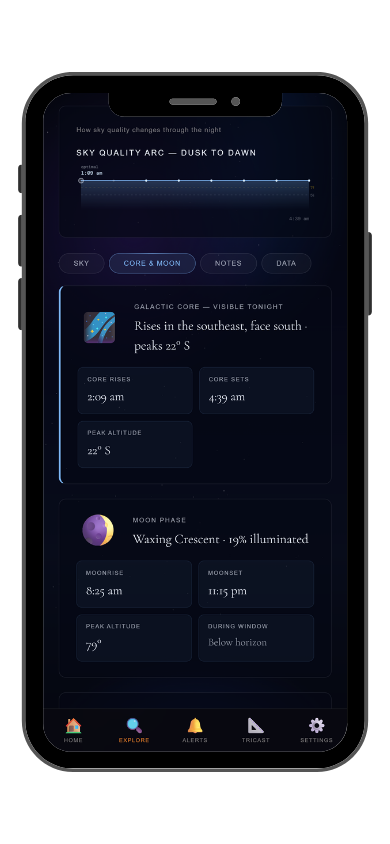
The live score above pulls today's forecast and runs it through StarCast's scoring model, factoring in cloud cover, moon illumination, Bortle class, humidity, and atmospheric transparency. Above 70 is an excellent night. Below 40, conditions are poor. The score updates daily.
What makes El Leoncito good for astrophotography?
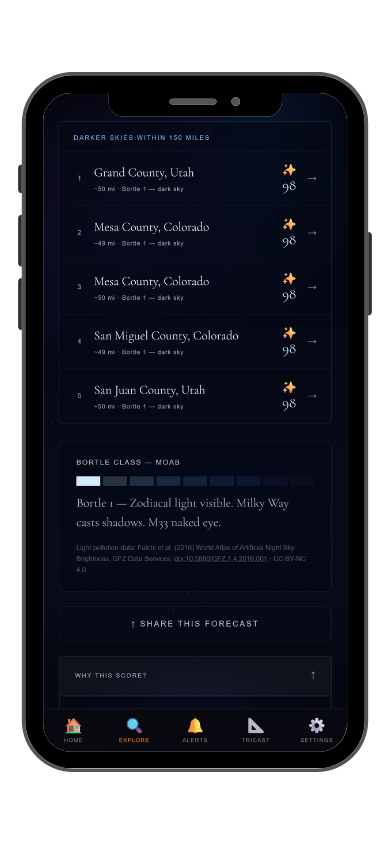
El Leoncito National Park in the Argentine Andes of San Juan province is home to two major astronomical observatories: CASLEO (Complejo Astronómico El Leoncito) and the Carlos U. Cesco station. The park sits at 2,500 meters in a high Andean valley on the Argentine side of the Andes, benefiting from the same dry, stable air that makes the Chilean Atacama world-class for astronomy. The surrounding Precordillera mountains screen all regional light, and San Juan, the nearest city, is 340 kilometers to the east. Bortle Class 1 conditions are standard, and the Southern Hemisphere sky, including the galactic center, the Magellanic Clouds, and Centaurus, transits nearly overhead.
When is the Milky Way visible at El Leoncito?
The galactic core is visible from February through October. The Argentine Andean dry season runs from April through September, delivering the clearest and most stable nights. The park's high elevation puts photographers above most atmospheric moisture, and the Andean climate gives a clear night frequency comparable to the northern Atacama. Summer (December through February) can bring some afternoon thunderstorm activity, but nights are often clear. CASLEO offers limited public visits, and dispersed camping is permitted within the park.