Frequently asked
Is tonight good for stargazing in Española?
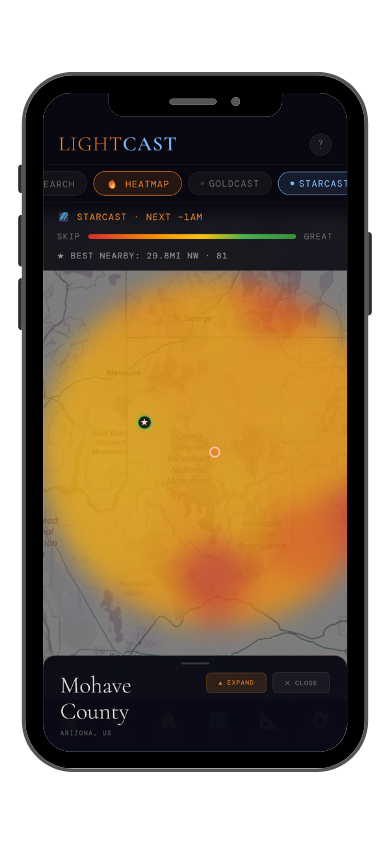
The live score above pulls today's forecast and runs it through StarCast's scoring model, factoring in cloud cover, moon illumination, Bortle class, humidity, and atmospheric transparency. Above 70 is an excellent night for astrophotography. Below 40, conditions are poor. The score updates daily.
What makes Española good for astrophotography?
Española sits at 5,600 feet in the Rio Grande valley between the Jemez Mountains to the west and the Sangre de Cristo Mountains to the east. The town itself has moderate light output, but the surrounding landscape transitions quickly to some of the best dark sky terrain in New Mexico. The Rio Grande Gorge — just 15 miles west — is a premier astrophotography location, where the gorge cuts 800 feet deep through the Taos Plateau and the basalt rim provides a dramatic, otherworldly foreground under the Milky Way. Bandelier National Monument is 15 miles to the south, offering Ancestral Puebloan cliff dwellings as foreground elements under dark Bortle Class 3 skies. The Jemez Mountains and Valles Caldera to the southwest push into genuine Bortle Class 2 darkness at higher elevations.
When is the Milky Way visible near Española?
The galactic core is visible from late March through early October at Española's latitude. The Rio Grande Gorge is particularly effective for Milky Way photography from April through September, when the core rises over the canyon rim on the eastern side. Prime season runs May through August. The surrounding high-desert plateau stays dry enough to shoot reliably through most of the season, with monsoon moisture in July and August adding variable cloud risk but also producing stunning storm-lit landscapes. The nearby Valles Caldera National Preserve, accessible via Highway 4, is one of the most distinctive and underutilized astrophotography locations in the state.