Frequently asked
Is tonight good for stargazing at Fiordland?
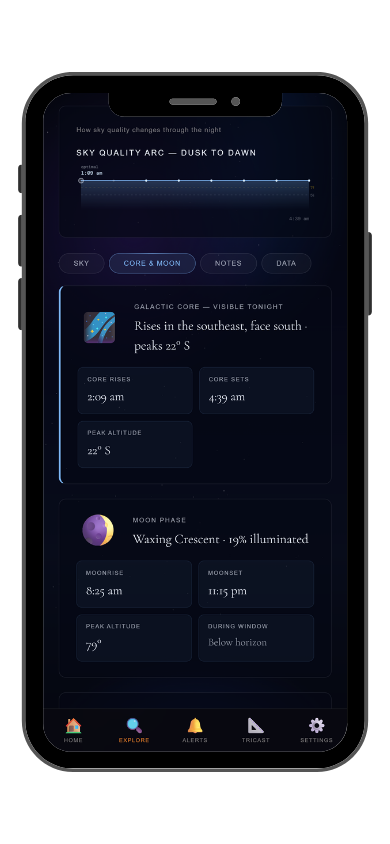
The live score above pulls today's forecast and runs it through StarCast's scoring model, factoring in cloud cover, moon illumination, Bortle class, humidity, and atmospheric transparency. Above 70 is an excellent night. Below 40, conditions are poor. The score updates daily.
What makes Fiordland good for astrophotography?
Fiordland National Park is the largest national park in New Zealand and one of the most remote: its western fjords are accessible only by boat or floatplane, with no roads penetrating the interior. The park's latitude, around 45 to 46 degrees south, puts it well within range of the galactic center rising high overhead during Southern Hemisphere winter. Te Anau is the gateway town and sits on the eastern shore of Lake Te Anau, New Zealand's second-largest lake, which creates excellent reflection opportunities. The eastern side of the park, around Te Anau and the Eglinton Valley, is more accessible and reliably drier than the western fjords.
When is the Milky Way visible at Fiordland?
The galactic core is visible from February through October. Winter (June through August) brings the longest nights and best core position overhead, but also peak rainfall on the western side of the park. The Eglinton Valley and Te Anau Basin are considerably drier than Milford Sound and give more reliable clear nights in winter. The Kepler Track and Manapouri area also offer good dark sky access. Check weather carefully: Fiordland is one of the wettest places in New Zealand, and patience is part of the process.